
Is the latest Gold Safe-Haven rally just a geopolitical blip or the start of a new multi-year bull market?
Is the Gold Safe-Haven bid back for good?
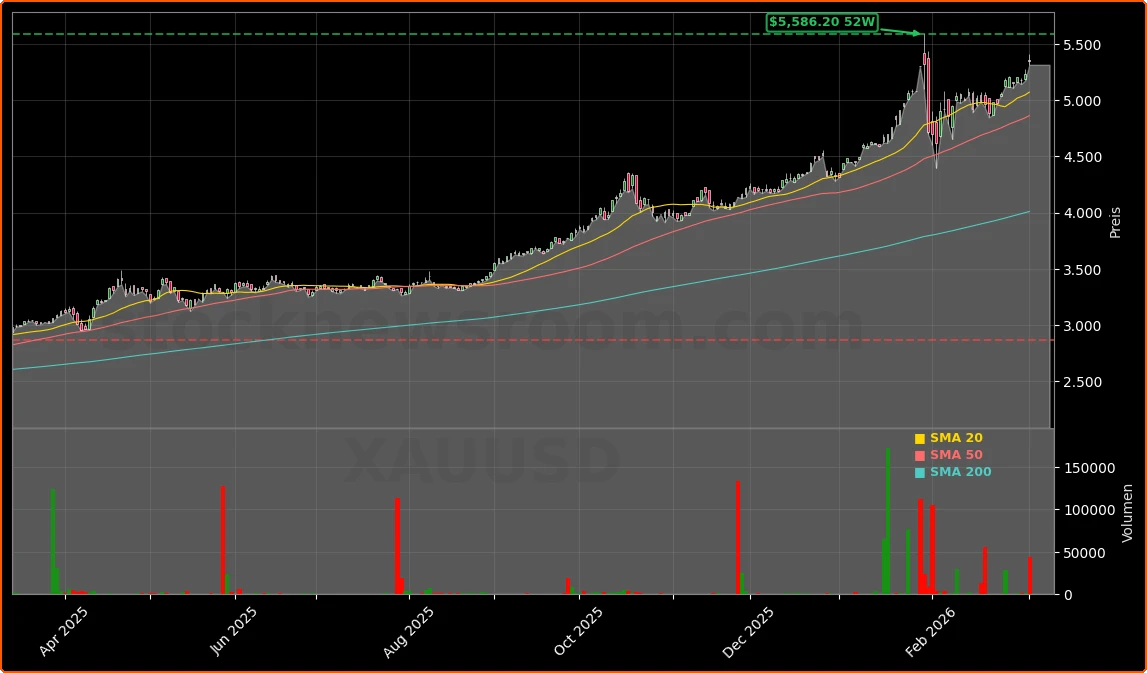
Spot gold (xau) is trading around $5,365, up roughly 2.2% from Friday’s close at $5,247.90 and edging toward the recent peak near $5,400. The move follows a weekend escalation in the Middle East, where U.S. and Israeli forces targeted Iran’s leadership, prompting missile retaliation and tighter controls on shipping through one of the world’s key energy chokepoints. The combination of war risk, energy concerns and persistent inflation has reignited the Gold Safe-Haven narrative on Wall Street.
This latest leg higher caps a powerful run: since late 2025, gold has climbed close to 25% after already delivering about 65% gains last year, its strongest annual rise since the late 1970s. That performance has left bullion trading not far from its all-time high above $5,400, even as Bitcoin has retreated from prior records and now lags well behind the yellow metal in relative strength. With U.S. Treasury yields drifting lower, the opportunity cost of holding non‑yielding assets like gold has fallen, reinforcing Safe-Haven demand from both institutional portfolios and retail investors.
What does this mean for mining leaders like Newmont?
The surge in bullion prices is filtering quickly into gold equities. Newmont Corporation, one of the world’s largest gold producers, has drawn a wave of bullish analyst commentary in recent weeks. Bernstein upgraded Newmont from “Market Perform” to “Outperform,” with analyst Bob Brackett lifting his price target to $157, citing a constructive multi‑year outlook for gold and renewed operational focus under the company’s new CEO. Bank of America also raised its target on Newmont from $134 to $151 while reiterating a “Buy” rating as it refreshed its North American metals and mining valuation framework.
Upstream, the higher price deck is encouraging more aggressive exploration budgets. Canadian banks such as CIBC have updated their forecast path for bullion to as high as $6,000 per ounce in 2026 and $6,500 in 2027, arguing that the same macro forces that powered last year’s rally—geopolitical risk, deglobalization and sticky inflation—remain firmly in place. That outlook is supportive not only for senior producers like Newmont but also for drilling contractors and early‑stage explorers whose activity levels are tightly linked to miners’ capex cycles.
How are explorers and equipment suppliers positioned?
Exploration companies exposed to large copper‑gold systems are already leaning into the boom. Firms advancing projects in established porphyry belts are ramping up Q1 drilling programs, betting that sustained Gold Safe-Haven flows and strong copper fundamentals will keep capital accessible. New listings on European venues such as the Frankfurt Stock Exchange are aimed at broadening the investor base and improving liquidity, particularly for companies that control 100%-owned copper‑gold projects near existing major deposits.
On the service side, equipment providers such as Caterpillar benefit indirectly from the upswing. Through partnerships with major miners including Newmont, Caterpillar has gained leverage to higher gold prices as producers tap strong balance sheets to upgrade fleets and expand operations. If the current price environment persists near or above $5,000, pressure will likely build on management teams to convert windfall cash flows into higher exploration spend, acquisitions and shareholder returns, reinforcing the mining and drilling upcycle.
How does gold stack up against tech and crypto?
The Gold Safe-Haven trade is also reshaping cross‑asset positioning. While AI bellwethers like NVIDIA, Apple and Tesla remain core holdings in S&P 500 and Nasdaq portfolios, recent volatility in growth stocks has pushed multi‑asset managers to rebalance toward real assets. Several large equity funds have highlighted the contribution from gold and copper holdings to Q4 2025 performance as metals outpaced more cyclical sectors.
In digital assets, tokenized gold such as PAX Gold and XAUT has emerged as a bridge between bullion and crypto infrastructure, offering on‑chain exposure to physical metal held in vaults. These products combine the portability of blockchain with the familiar risk profile of gold, but they still carry counterparty and platform risks that pure physical holdings avoid. For investors seeking portfolio ballast against extreme outcomes—ranging from sovereign debt stress to systemic banking issues—direct ownership or fully allocated ETFs remain the preferred implementation of the Gold Safe-Haven theme.
At the macro level, the above‑ground gold stock is valued at roughly $36 trillion, underscoring its role as a global wealth reservoir alongside sovereign bonds and reserve currencies. As long as the Iran conflict threatens to spill over and trade policy uncertainty weighs on growth expectations, Wall Street is likely to maintain elevated allocations to bullion, miners and related plays.
Conclusion
In summary, today’s spike toward record prices reinforces gold’s status as the premier Gold Safe-Haven asset and a key market driver across sectors. For U.S. and international investors, the move is a reminder that balancing high‑beta tech exposure with strategic allocations to bullion and quality miners can improve risk‑adjusted returns. The next catalysts to watch will be further developments in the Iran crisis, U.S. yield moves and mining companies’ Q1 updates on capex and drilling plans, which will reveal how aggressively they are positioning for a prolonged gold super‑cycle.
Further Reading
- Gold (XAU=) price, news and history (Yahoo Finance)
- Is Gold.com (GOLD) a Buy as Wall Street Analysts Look Optimistic? (Zacks Investment Research)
- Gold.com (GOLD) Q2 Earnings and Revenues Top Estimates (Zacks Investment Research)
- First Eagle Overseas Equity ETF Q4 2025 Portfolio Review (Seeking Alpha)