
Can the strong Home Depot quarter truly offset the weak consumer sentiment and the sluggish U.S. housing market?
How did Home Depot’s quarter perform in detail?
Home Depot, Inc. reported a profit of $2.57 billion in the fourth fiscal quarter, down from $3.0 billion the previous year. On an adjusted basis, earnings per share were $2.72, significantly exceeding analysts’ expectations of $2.53. The prior year benefited from an additional calendar week, which complicates comparisons and contributed approximately $0.30 per share to that period’s results.
Revenue fell from $39.7 billion to $38.2 billion year-over-year. Adjusted for the additional week in the previous year, Home Depot still surpassed the consensus estimate of around $38.09 billion. On a comparable sales basis, revenue increased by 0.4%, with a 0.3% rise in the U.S. This allowed the company to achieve slight growth in its core business after several weaker periods.
CEO Ted Decker described the results as in line with their expectations. The Home Depot quarter was characterized by a lack of storms in the third quarter and ongoing consumer uncertainty, primarily driven by the weak U.S. housing market and high financing costs. However, underlying demand remained relatively stable.
What is currently holding back Home Depot?
The detailed data from Home Depot’s quarter shows that the consumer slump continues to leave its mark. The number of customer visits decreased by 1.6% in the fourth quarter. At the same time, the average transaction value rose from $89.11 to $91.28. Customers are visiting stores less frequently but spending slightly more per purchase—a typical pattern during periods of heightened price sensitivity.
The U.S. housing market, which has been in a significant downturn since 2022, is particularly burdensome. High mortgage rates and rising home prices are slowing down property turnover, dampening demand for larger renovation projects. Many consumers are postponing major investments while smaller repairs and maintenance continue.
In this context, the CFO emphasizes that while many things are slowly moving in the right direction, there is still no clear catalyst for a significantly higher demand in the home improvement sector. Accordingly, the outlook remains cautious, even though the Home Depot quarter exceeded expectations.
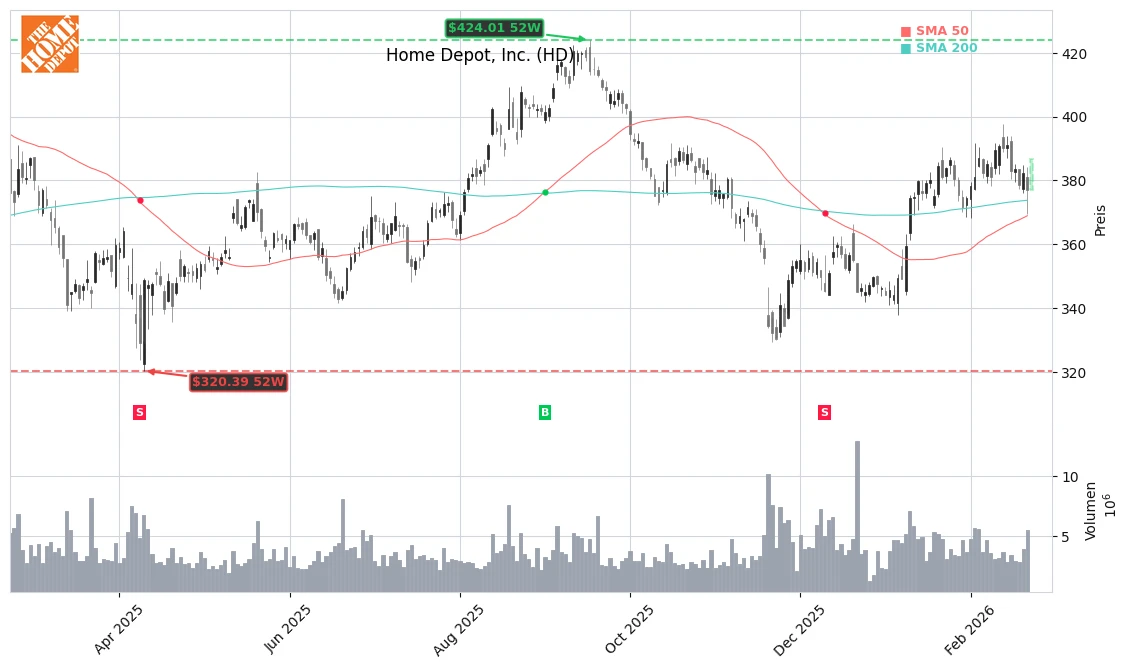
” alt=”Home Depot, Inc. stock chart – 252 days price trend – February 2026″ loading=”lazy” style=”width:100%;height:auto;border-radius:8px;”>
What is Home Depot’s outlook?
For fiscal year 2026, Home Depot, Inc. expects adjusted earnings to range from flat to up 4% compared to the $14.69 per share from the previous year. The management anticipates revenue growth of approximately 2.5% to 4.5%, with comparable sales expected to remain stable or increase by 2%. Thus, a dynamic rebound is not yet in sight.
Nonetheless, parts of the market are showing more optimism. Bernstein had already raised its price target for Home Depot from $362 to $381 before the earnings report and confirmed a “Market Perform” rating. This was driven by expectations of a solid quarter and the medium-term opportunities arising from the strategic realignment towards professional customers (“Pro” segment) and the role as a central supplier for construction companies.
Other analysts highlight technological initiatives such as AI-powered “Blueprint Takeoffs,” which aim to accelerate project planning for professional clients. These measures are intended to strengthen customer loyalty in the professional segment and ultimately ensure more stable, margin-rich revenues.
What does the Home Depot quarter mean for the stock?
With a closing price of $376.99 and a pre-market increase to $386.88, the market reacted positively to the Home Depot quarter. The stock reflects a mix of short-term relief over the earnings beat and the awareness that recovery in the home improvement market will progress only gradually.
Bullish voices point out that Home Depot continues to demonstrate its high profitability despite declining overall revenue and has robust cash flows that secure dividends and investments in technology and logistics. Conversely, more skeptical observers emphasize that profit declines and waning momentum in the do-it-yourself segment do not yet allow for a clear growth narrative.
„Under the surface, demand remained relatively stable throughout the year—despite headwinds from the housing market and consumer restraint.”
— Ted Decker, CEO of Home Depot
Bottom Line
For investors, Home Depot remains a quality stock, whose short-term price development heavily depends on interest rates, the housing market, and overall consumer sentiment in the U.S. It will be crucial to see if upcoming reports confirm the slight upward trend in comparable sales and whether the Pro business continues to gain momentum.
Related Sources
- Home Depot, Inc. on Yahoo Finance (Yahoo Finance)
- Home Depot beats Wall Street’s expectations, even as sales decline (CNBC)
- Home Depot’s stock set to surge as sales growth provides signs of a turnaround (Market Watch)
- The Home Depot Announces Fourth Quarter and Fiscal 2025 Results (PRNewsWire)