
Is IBM at risk of permanently losing its lucrative mainframe and COBOL service business due to the current AI disruption?
IBM: How severely is the AI attack hitting?
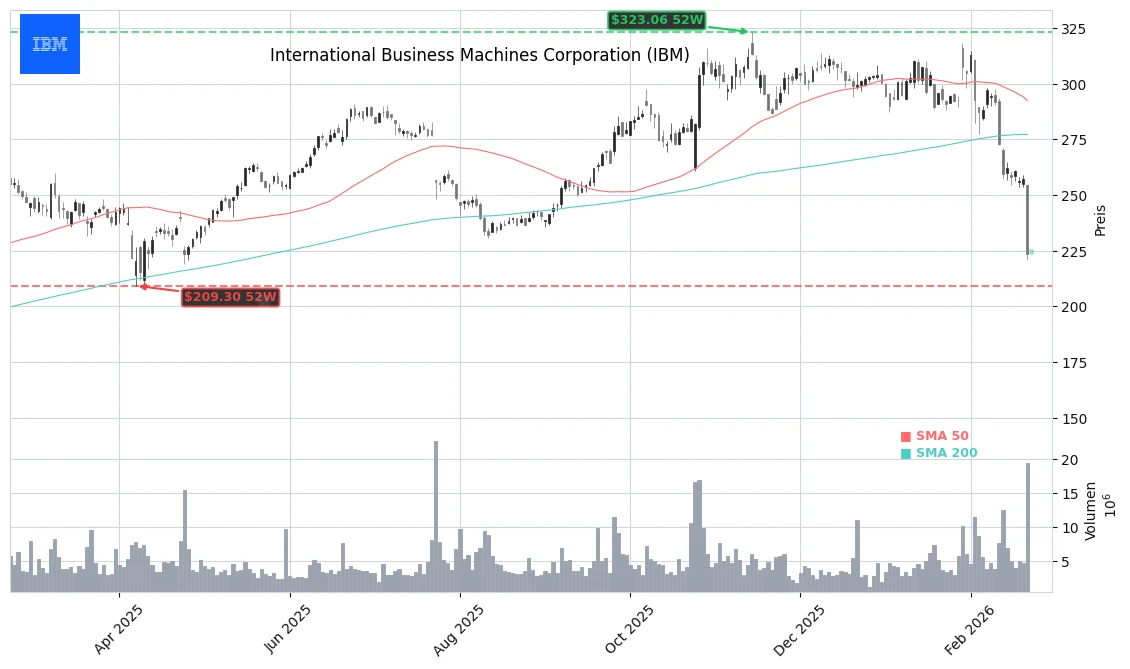
In regular trading, IBM closed at $223.35, down 13.15% from the previous close of $257.16. After-hours, the stock slightly recovered to $225.81 (+1.10%), but remains significantly below the levels seen earlier in February, which were close to record highs. This drop marks the largest one-day loss since 2000 and pushes the annual balance down by approximately 22%.
The trigger for the IBM AI disruption is the announcement from Anthropic that its tool “Claude Code” can automatically analyze large COBOL codebases, map dependencies, document workflows, and identify risks. COBOL is estimated to drive about 95% of US ATM transactions and is embedded in hundreds of billions of lines of code running on IBM mainframes in financial institutions, airlines, and government agencies.
IBM has earned revenue for decades from consulting, maintenance, and modernization projects for critical legacy systems in this area. If AI now takes over a significant portion of the previously costly analysis and documentation work, it threatens margin and price pressure on a crucial service component.
IBM AI Disruption: Is the mainframe monopoly at risk?
The market’s concern is that the IBM AI disruption could undermine the traditional model of “COBOL code on IBM systems, along with expensive consulting contracts.” Until now, modernizing old COBOL landscapes was considered extremely labor-intensive due to retiring experienced developers and often incomplete documentation. Anthropic argues that AI reverses this dynamic: instead of years of analysis by external consultants, much of the preliminary work can now be automated in significantly less time.
Additionally, a large portion of COBOL systems operates in heavily regulated sectors such as social security, public administration, and finance—areas where the company has traditionally had a disproportionate presence. The fact that Claude can now apparently actively rewrite COBOL code or transition it to more modern architectures fuels speculation that customers may gradually move away from mainframes.
At the same time, some observers are downplaying the panic. IBM itself already offers AI-powered tools for analyzing and partially translating COBOL, such as into Java, and has positioned itself for years as a partner for mainframe modernization—including cloud connectivity and hybrid architectures. Therefore, the current IBM AI disruption does not necessarily mean that the company will be completely displaced in this field, but it does suggest that competition is likely to become more intense and price-sensitive.
IBM: What do analysts say about the stock plunge?
Although the historic daily loss caught many investors off guard, not all firms are sounding the alarm. Analysts at Jefferies point out that IBM’s long-term growth depends more on overall demand for cloud, automation, and generative AI than on pure COBOL modernization projects. Jefferies maintains a positive outlook and views the setback as an overreaction.
Other research firms emphasize that IBM recently delivered solid quarterly results, a stable cash flow, and an attractive dividend yield. Nevertheless, several analysts have adjusted their price targets and incorporated the AI risks in legacy services more heavily into their models. The market reflects this uncertainty: institutional investors show a mixed picture according to recent data, with some aggressively building positions while others are reducing their commitments.
For the debate surrounding IBM AI disruption, it remains crucial whether IBM can position itself as a provider of modernization tools and services around Claude-like capabilities—rather than solely relying on the protection of its mainframe stronghold.
IBM: What’s next for investors?
The IBM AI disruption comes at a time when the market is already nervous, with numerous software and cybersecurity stocks suffering double-digit losses following AI announcements from other providers. IBM is now the most prominent example of how quickly perceptions of established IT service providers can shift when new models address concrete use cases in lucrative niches.
For long-term investors, two questions arise: How significant is the actual revenue share from the heavily impacted COBOL and mainframe modernization compared to the overall business? And can IBM expand its AI strategy to benefit from the disruption rather than just suffer from it?
“Legacy code modernization has been more expensive than a complete rebuild for years—AI turns this equation around.”
— Anthropic Blog on Claude Code
Bottom Line
In the short term, volatility is likely to remain high as traders react to further headlines regarding the IBM AI disruption and new product announcements from the AI sector. In the medium to long term, it will be crucial for IBM to prove that its mainframe business does not solely depend on legacy systems but is actively transforming into an AI-driven hybrid cloud world.
Related Sources
- International Business Machines Corporation (IBM) on Yahoo Finance (Yahoo Finance)
- IBM Stock Plummets On Anthropic’s New AI COBOL Threat (Stocktwits)
- International Business Machines (NYSE:IBM) Stock Price Down 13.4% – Here’s Why (MarketBeat)
- IBM’s stock heads for worst month in 34 years — and Anthropic is partly to blame (MarketWatch)