Can the IBM Confluent Acquisition really turn real-time data streaming into the missing engine behind IBM’s AI and quantum ambitions?
[fxmag_hero_image]How does IBM Confluent Acquisition change the story?
International Business Machines Corporation has completed its purchase of Confluent for $31 per share in cash, valuing the deal at about $11 billion. It is IBM’s second-largest transaction ever, behind the $33 billion Red Hat takeover, and it is intended to play a similar role: becoming the default data-streaming layer for IBM’s AI and hybrid-cloud stack. Confluent’s platform, built on Apache Kafka, is already used by more than 6,500 enterprises, including around 40% of the Fortune 500, to move operational data in real time.
IBM is integrating Confluent on day one with watsonx.data, IBM MQ, IBM webMethods Hybrid Integration and IBM Z mainframes. The goal is to ensure that AI models and agents can access clean, governed, continuously refreshed data across on‑premises systems and multiple clouds. Management argues that transactions now settle in milliseconds, so AI-driven decisions must be made just as fast – something batch-based, overnight data pipelines struggle to deliver.
The IBM Confluent Acquisition also reinforces CEO Arvind Krishna’s strategy of positioning IBM as an AI and middleware enabler rather than a pure application vendor. That positioning could help insulate IBM from some of the valuation and disruption swings hitting front-end AI software names.
What does it mean for AI and quantum ambitions at IBM?
IBM has spent the last several years recasting itself as an AI-first infrastructure and consulting company while simultaneously building what many investors see as one of the most advanced quantum computing roadmaps in the industry. In Q4 2025, IBM delivered 12% year-over-year revenue growth and expanded its AI-related book of business to about $12.5 billion, up sharply from $5 billion a year earlier. Free cash flow of roughly $15 billion in 2025 gives the group significant firepower to pursue deals like Confluent while still funding quantum and AI research.
From an AI deployment perspective, the combined platform aims to close a key gap: getting live operational signals into models, copilots and agents at scale. Customers such as BMW, L’Oréal, Michelin and Ticketmaster already rely on Confluent to stream inventory, IoT and customer-activity data across complex global environments. IBM intends to tie that capability directly into watsonx and its automation tools so that enterprise AI doesn’t just analyze historical data but can trigger actions in real time.
For quantum computing, IBM continues to target a large-scale, fault-tolerant system by the end of the decade and sees AI and quantum as mutually reinforcing technologies. While quantum remains years from broad commercial rollout, investors gain exposure through a diversified, cash-generating business rather than a pre-revenue pure play. That trade-off is increasingly attractive for portfolio managers skeptical of speculative quantum valuations.
How does IBM stack up against big-tech rivals?
The IBM Confluent Acquisition puts IBM more squarely in competition with hyperscalers and data players that also want to own the AI data plane. NVIDIA has dominated the AI hardware narrative with its GPUs and networking stack, but it increasingly partners with IBM on enterprise AI solutions, allowing clients to run models on NVIDIA hardware while leaning on IBM for integration, governance and mainframe connectivity. That complementary positioning reduces direct conflict and could help IBM capture more AI-related consulting and software revenue.
Meanwhile, Apple and Tesla pursue AI mostly as a differentiator inside their consumer and automotive ecosystems rather than building broad enterprise platforms. IBM’s focus stays on regulated industries, hybrid cloud and legacy modernization, areas where long-standing relationships and mainframe expertise remain hard to replicate. Analysts at Wedbush recently reiterated an Outperform rating on IBM with a $340 price target, citing its enterprise computing strength and AI momentum, while Morgan Stanley cut its target to $247 and kept an Equal Weight stance, pointing to perceived risks from new AI tools impacting mainframe workloads.
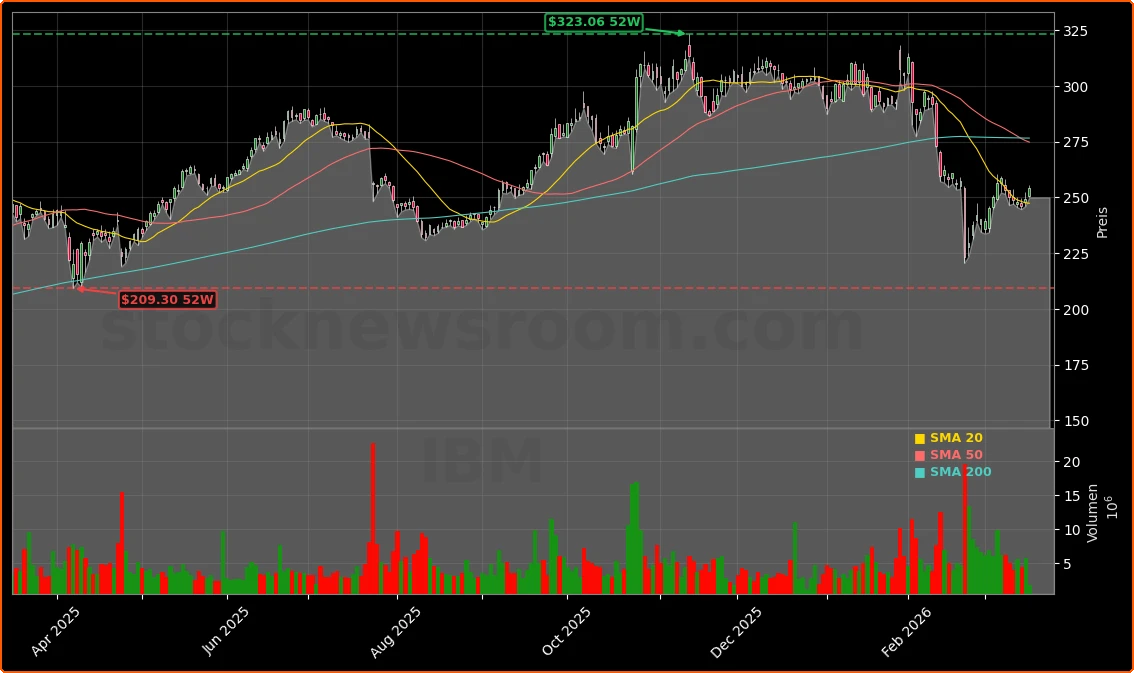
On Wall Street, the stock has been volatile. IBM suffered its steepest single-day drop in 25 years earlier this year after fears that third-party AI tools could erode COBOL modernization revenue, but shares have since rebounded. Institutional investors remain active on both sides: some funds have trimmed positions, while others have added, highlighting differing views on how the IBM Confluent Acquisition will translate into earnings growth.
With Confluent, we are giving clients the ability to move trusted data continuously across their entire operation so their AI models and agents can act on what is happening right now, not on data that is hours old.— Rob Thomas, Senior Vice President, IBM Software and Chief Commercial Officer
Looking at index context, IBM’s move higher today makes it one of the stronger names in the Dow and a notable gainer within the Russell 1000 technology cohort. Solid dividends and consistent cash generation continue to attract income-focused investors who also want exposure to secular AI and quantum computing themes without paying the rich multiples seen in some pure AI names.