
Can the current Intel rally continue amid the AI boom, or will the stock face a sharp reversal at resistance?
Intel Forecast: Will the Recovery Hold After the Rally?
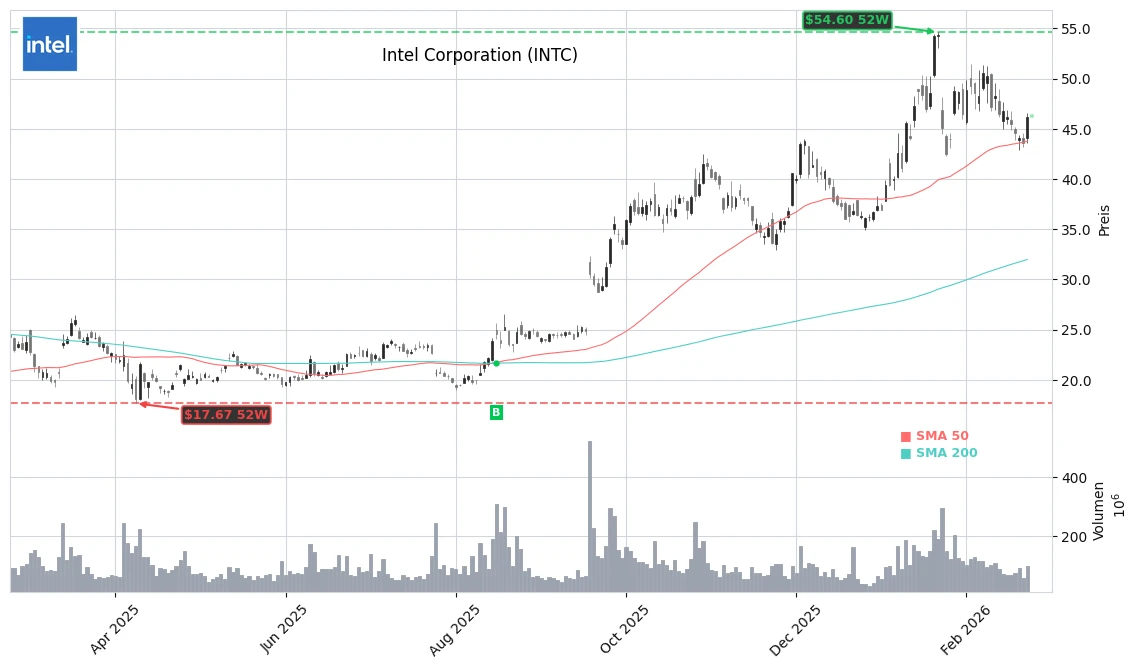
The stock of Intel Corporation (INTC) rose by 5.71% to $46.12 on the last trading day, while the broader market saw much smaller gains. This ended a five-day losing streak for the chipmaker and marked a significant technical breakout. In pre-market trading, the stock is slightly up at $46.39, indicating ongoing buying interest. Technically, bulls have successfully defended the support area around $43 to $44—a zone that many market participants view as a base for a recovery scenario up to around $55. The Intel forecast remains constructive in the short term, as long as this support is not significantly breached.
Support comes from the entire semiconductor sector: The Philadelphia Semiconductor Index recently hit a record high, with numerous industry stocks closing in the green. In this environment, both Intel and AMD saw significant gains. While AMD is making headlines with a multi-billion dollar AI contract from Meta, Intel benefits from the assessment that the market for AI hardware is large enough for several key players.
Intel: How Strong is the AI Fantasy Factor?
Fundamentally, the Intel forecast is increasingly dominated by AI themes. Although the company clearly lags behind Nvidia and AMD in the training business, a broad field opens up in inference and data center infrastructure. Intel recently announced a partnership with AI chip startup SambaNova Systems. SambaNova raised $350 million in a new funding round and is relying on a strategic collaboration with Intel to address the booming market for inference chips and AI applications. For Intel, this signals its intention to position itself as a relevant partner in the AI ecosystem.
Additional excitement comes from the security and infrastructure segment. For instance, quantum-safe encryption solutions from Arqit are being integrated directly into Intel environments to protect sensitive data streams in the cloud and critical networks. Intel is also showing readiness for innovation in the memory sector: Together with SoftBank subsidiary SAIMEMORY, the company is working on Z-Angle Memory, a potential new memory technology with high throughput and lower energy consumption, which is particularly interesting for large AI models and data centers. These initiatives strengthen the perception that Intel can benefit from the AI trend on both the CPU and infrastructure and security fronts.
” alt=”Intel Corporation Stock Chart – 252 Days Price Movement – February 2026″ loading=”lazy” style=”width:100%;height:auto;border-radius:8px;”>
Intel Forecast: What Do Chart Analysis and Analysts Say?
Technically, the stock is consolidating after a longer-term breakout and is currently confirming the area around $43 to $44 as a viable support. As long as this level holds, technically oriented investors see room for a continuation of the recovery toward recent highs around $55. Thus, the Intel forecast remains positive from a technical perspective, even though pullbacks in the volatile AI environment are always possible.
On the institutional side, a mixed picture emerges: Asset managers like Transatlantique Private Wealth have recently built new positions in Intel Corporation, while some analysts remain cautious. The current consensus is in the “Reduce” range with an average price target around $45 to $46, slightly below the current price level. Specific firms like Citigroup, Goldman Sachs, or RBC Capital Markets have not been cited with new ratings in recent reports, yet the consensus signals that many strategists are keeping an eye on the strong competition in the chip sector and product delays—such as with the Nova Lake generation. This creates a tension for risk-tolerant investors between cautious valuations and growing AI fantasy.
Intel: Opportunities and Risks for Investors
Several factors will be crucial for the further Intel forecast. On the opportunity side, the stabilization of the semiconductor sector, continued high capital inflow into AI infrastructure, and new partnerships in inference, memory, and security stand out. If the market takes inspiration from Nvidia, AMD, and other heavyweights and confirms the expectation of a “multi-vendor” AI ecosystem, Intel could unlock additional valuation reserves as a turnaround candidate.
On the risk side, the technological lag in certain high-end segments, potential delays in new chip generations, and geopolitical tensions surrounding the supply chain, particularly regarding Taiwan, remain burdensome. Additionally, it remains uncertain how quickly Intel can scale its foundry plans and capacity expansions in the U.S. and Europe to create a structural margin lever. Investors should consider these factors in their individual Intel forecast and be aware of the increased volatility in the AI and chip sector.
Bottom Line
The Intel forecast currently benefits from clear technical stabilization and new impulses from the AI ecosystem, making a recovery toward $55 fundamentally possible. For investors, the stock remains an exciting, albeit not risk-free, turnaround play in the semiconductor sector, heavily dependent on the further development of AI demand. Those entering should closely monitor the support zone around $43 to $44, as well as upcoming industry and company news, to quickly react to new signals for the trend.
Related Sources
- Intel Corporation (INTC) on Yahoo Finance (Yahoo Finance)
- Intel (INTC) Price Forecast: Breakout Holds as Bulls Defend Support (FXEmpire)
- Intel Corp. stock outperforms competitors on strong trading day (MarketWatch)
- AI chip startup SambaNova raises $350 million in Vista-led round, signs Intel partnership (Reuters)