
Can the Intel Google Partnership really turn a long‑doubted chip giant into one of Wall Street’s hottest AI comeback trades?

How is Intel’s stock reacting?
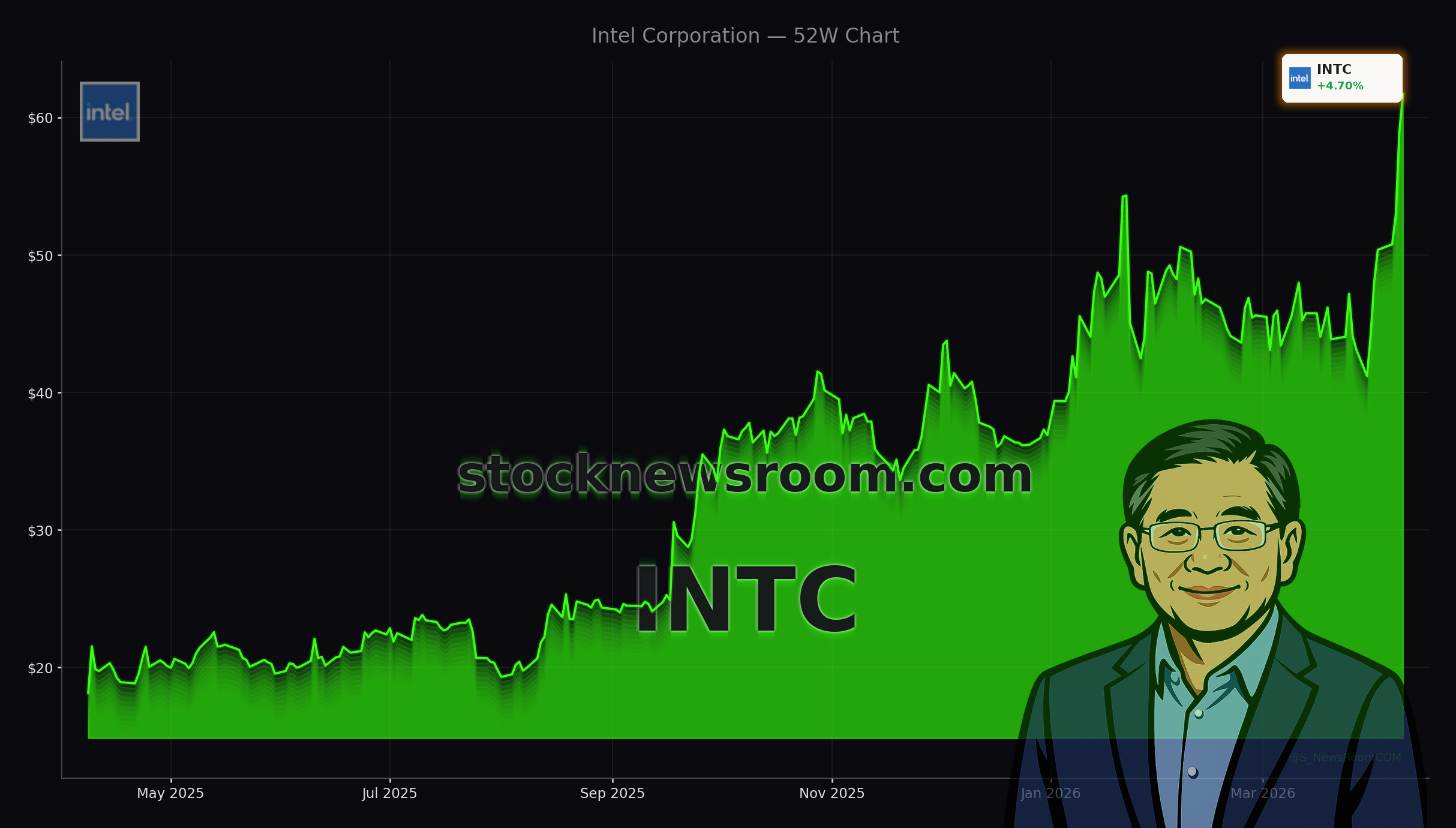
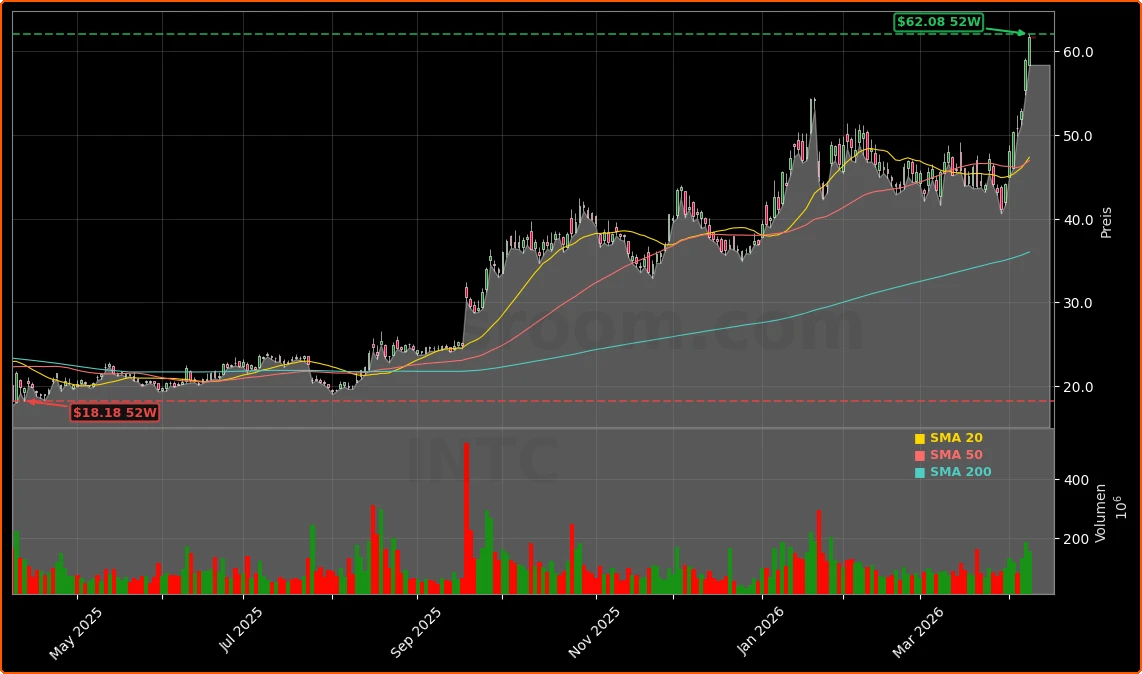
Intel Corporation (INTC) closed Thursday at $61.72, up 4.70% on the session and trading near $61.65 in after‑hours, leaving the stock just below its intraday high since April 2021 and setting a new 52‑week closing high. The shares have now climbed roughly 47% over the past seven trading days and more than 200% versus a year ago, making Intel one of the most powerful comeback stories in the S&P 500 and Nasdaq 100 this week.
The move extends what Dow Jones Market Data characterizes as Intel’s best seven‑day stretch on record since data began in 1980. The stock is still about 19% below its all‑time high near $75 from 2000, but the speed of the rebound is forcing investors to reassess Intel’s AI positioning versus NVIDIA and Advanced Micro Devices (AMD). With year‑to‑date gains above 60% and heavy trading volume, Intel has become one of the most actively traded large‑cap tech names on Wall Street.
Valuation, however, has inflated quickly. At current prices Intel trades at a forward P/E around 100 and a price‑to‑sales ratio near 5.8, a rich multiple for a company just returning to positive earnings. That makes the durability of the Intel Google Partnership, along with other AI and foundry wins, central to justifying the new premium.
What exactly is the Intel Google Partnership?
The expanded Intel Google Partnership is a multi‑year deal focused on AI and cloud infrastructure across Google’s global data‑center fleet. Google Cloud will continue to deploy multiple generations of Intel Xeon CPUs for AI training coordination, latency‑sensitive inference, and general‑purpose computing, including the latest Xeon 6 chips that power Google’s C4 and N4 instances.
Beyond CPUs, the agreement deepens co‑development of custom ASIC‑based infrastructure processing units. These IPUs offload networking, storage, and security tasks from the host CPU, freeing more cycles for AI workloads and improving total cost of ownership for hyperscale data centers. The partnership builds on nearly two decades of collaboration between the companies and targets better energy efficiency and more predictable capacity planning for Google’s AI build‑out.
No dollar value was disclosed, but the multi‑generation commitment gives Intel more visibility for ramping its advanced 18A manufacturing node and related packaging capacity. For investors, that visibility is crucial as Intel pours capital into its foundry strategy while trying to restore margins and free cash flow.
Can Intel’s CPUs really matter in the GPU era?
While GPUs from NVIDIA and AMD dominate headlines, AI workloads increasingly highlight the importance of balanced systems. GPUs excel at matrix math, but CPUs still orchestrate training runs, manage large‑scale inference, and handle the vast majority of cloud compute tasks around AI models. Intel argues that “agentic” AI systems and complex enterprise deployments are shifting the bottleneck back toward general‑purpose compute.
The Intel Google Partnership validates that view in a very public way. Google’s AI infrastructure chief has emphasized that Intel’s Xeon roadmap provides the performance and efficiency headroom needed for rapidly growing AI workloads. At the same time, Intel’s own Data Center and AI group returned to growth in fiscal 2025, rising about 5% to $16.9 billion in revenue, even as the company invested heavily in new nodes and packaging.
Wall Street has not yet showered Intel with the kind of premium enjoyed by pure AI accelerators, but the stock’s sharp re‑rating shows investors are now willing to pay more for a company that still supplies the CPU foundation for the majority of the world’s servers. The Google deal reduces some demand uncertainty and supports the thesis that Intel can benefit from AI without needing to unseat GPU leaders overnight.
How does this fit into Intel’s broader turnaround?
Financially, Intel is still in the middle of a multi‑year turnaround. Fiscal 2025 revenue was roughly flat at $52.9 billion, but non‑GAAP gross margin improved to 36.7% and operating margin swung from slightly negative to about 5.5%. Non‑GAAP EPS recovered to $0.42 from a loss the prior year, and operating cash flow reached $9.7 billion, though levered free cash flow stayed negative as Intel ramped capex for its 18A process and foundry push.
Strategically, the Intel Google Partnership comes on top of several notable moves that bolster the AI and manufacturing story. Intel recently reacquired full ownership of its Fab 34 facility in Ireland by buying back Apollo Global Management’s 49% stake for $14.2 billion, consolidating control over a key leading‑edge fab. The company also joined Elon Musk’s ambitious Terafab project in Texas, which aims to build a massive, vertically integrated chip manufacturing ecosystem for Tesla, SpaceX, and xAI. Those efforts, together with the Google win, position Intel as a central player in both hyperscale data centers and emerging AI‑heavy auto and robotics platforms.
Analyst opinion remains mixed but is slowly warming. Some firms still rate Intel a “Hold” as they watch whether the foundry business can stop bleeding cash and whether margins can keep expanding. Options flow tracked by large trading desks has turned distinctly bullish in recent days, signaling that institutional money is betting the AI narrative has legs.
What about rivals like NVIDIA, AMD and others?
For US investors, the key competitive question is whether Intel is simply riding an AI tide that lifts all boats, or whether deals like the Intel Google Partnership allow it to claw back share from rivals. NVIDIA continues to dominate AI accelerators with a robust software ecosystem and enormous data‑center revenue, while AMD is growing fast with EPYC CPUs and Instinct GPUs. Cloud providers such as Amazon’s AWS are also pushing custom silicon, and server vendors like Supermicro are rolling out turnkey AI systems at a rapid clip.
Still, hyperscalers rarely commit to a single technology track. Google’s renewed bet on Intel CPUs and IPUs suggests a more diversified infrastructure roadmap, where GPUs remain critical but are part of a broader, more balanced stack. That’s an environment where Intel’s scale, x86 compatibility, and manufacturing footprint can matter again. If upcoming earnings on April 23 confirm that supply constraints are easing and margins are holding, Wall Street may start to see Intel less as a laggard and more as a late‑cycle AI infrastructure winner.
Related Coverage
For a deeper dive into Intel’s role in Elon Musk’s chip ambitions, read how the Terafab alliance could reshape the AI foundry race in “Intel Terafab +9.7% Surge: Musk Alliance Reboots AI Foundry”. That analysis explores whether vertical integration with Tesla, SpaceX, and xAI can structurally boost Intel’s manufacturing leverage.
Investors tracking the broader AI hardware boom should also examine the memory and storage side of the story in “SanDisk Forecast Soars +9% in Aggressive AI Boom Rally”, which assesses whether surging expectations for SanDisk signal the start of a new AI memory super‑cycle or a late‑stage blow‑off in chip valuations.
Scaling AI requires more than accelerators — it requires balanced systems. CPUs and IPUs are central to delivering the performance, efficiency, and flexibility modern AI workloads demand.— Lip-Bu Tan, CEO of Intel Corporation
Overall, the Intel Google Partnership has turned Intel from an AI afterthought into a core infrastructure supplier for one of the world’s biggest clouds. For American portfolios, that means Intel is once again a serious contender in the AI stack rather than just a cyclical PC name. The next few quarters will show whether execution in manufacturing and data‑center chips can keep pace with the stock’s rally, but for now the partnership gives Intel’s turnaround a powerful AI tailwind.