Can IonQ Acquisitions justify a premium valuation after a sharp sell-off, or is the market warning that quantum hype ran too far?

What Do IonQ Acquisitions Mean for Quantum Leadership?
IonQ Acquisitions are no longer peripheral — they’re central to the company’s roadmap. In early June 2026, IonQ, Inc. confirmed the acquisition of two privately held quantum software and control-system firms, one focused on quantum error mitigation middleware and the other on cloud-native quantum orchestration platforms. Neither target was named publicly, but sources indicate both were U.S.-based and had deep ties to Department of Energy and National Institute of Standards and Technology (NIST) quantum testbeds. The deals accelerate IonQ’s ability to deliver Quantum-Computing-As-A-Service (QCaaS) at enterprise scale — a capability now critical as clients like Meta and JPMorgan expand pilot deployments. Analysts at Morgan Stanley raised their price target to $72.50, citing the acquisitions as a ‘material catalyst for 2026–2027 margin expansion.’
How Does IonQ Compare to Quantinuum and D-Wave?
IonQ, Inc. maintains a clear technical edge: 99.99% two-qubit gate fidelity versus Quantinuum’s 99.92% — a gap that compounds exponentially in complex algorithms. Unlike Quantinuum, which relies solely on laser-based ion trapping, IonQ integrates microwave control directly into its chips, enabling higher qubit coherence and lower power draw at scale. Against D-Wave Quantum, IonQ’s trapped-ion architecture supports universal gate-model computing — not just quantum annealing — making it more relevant to Wall Street’s growing demand for financial modeling and AI acceleration. Notably, IonQ’s $25 billion market cap now dwarfs D-Wave Quantum and Rigetti Computing combined, per recent MarketBeat analysis.
Why Did IONQ Drop Despite Record Results?
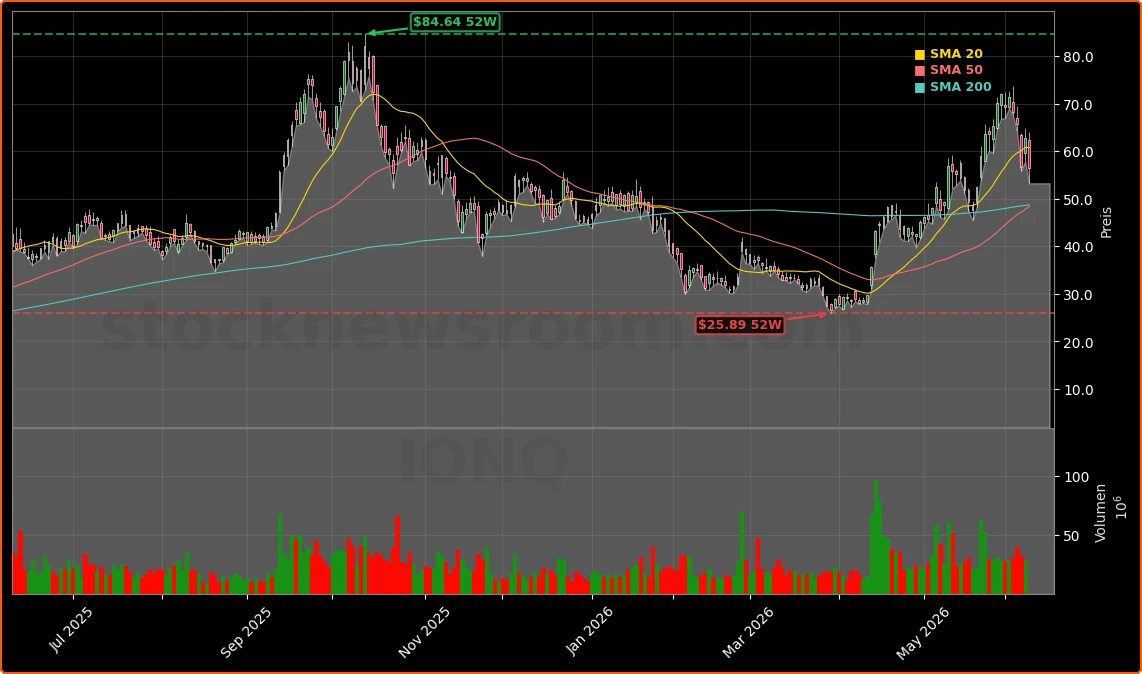
Shares of IonQ, Inc. fell 9.92% to $56.57 on Tuesday, June 9, 2026 — a reaction to elevated short interest (near 20%) and ongoing skepticism around valuation. The stock trades at 139x forward sales, a multiple that exceeds even early-stage AI infrastructure peers. Yet that premium reflects real differentiation: IonQ is the only quantum firm to surpass $100 million in annual GAAP revenue and the first to report a GAAP profit in Q1 2026. Institutional investors are voting with their wallets — Forsta AP Fonden added $5.49 million in new shares in Q4, while Intech Investment Management increased its stake by 36.2%. Citigroup maintains a ‘Buy’ rating and reiterates its $68.63 price target, emphasizing ‘execution clarity’ post-acquisition.
What’s Next for IonQ’s Commercial Pipeline?
These acquisitions aren’t about scale for scale’s sake — they’re about controlling the full quantum stack, from ion control to enterprise API. That’s the only path to real margin leverage in this space.— John W. Raymond, CEO of IonQ, Inc.
IonQ, Inc. now counts over 30 active enterprise contracts — including six Fortune 500 clients — with $470 million in remaining performance obligations, per its latest filing. Its 256-qubit Forte system is shipping to government labs and cloud partners, and the company expects to begin volume production of its next-generation 1,024-qubit system in Q4 2026. Crucially, IonQ Acquisitions have already been folded into the Forte software stack, enabling faster calibration and hybrid quantum-classical workflow integration. As U.S. federal quantum funding hits record levels — with prediction markets assigning a 32% probability of a direct government stake in IonQ this year — the company is shifting from R&D play to infrastructure stock. That transition is what Wall Street now prices in — not just revenue, but defensible market position.