Will the Iran Conflict stay a regional flashpoint or morph into a stagflation shock that rewrites the playbook for global markets?
How exposed are oil and energy stocks?
The immediate market focus is on crude supply routes, above all the Strait of Hormuz, through which a significant share of global seaborne oil and LNG flows. Iranian forces and Revolutionary Guard units have claimed attacks on US‑linked assets in the Gulf and signaled that traffic through Hormuz could be at risk. Any sustained disruption would likely push Brent and WTI sharply higher, with knock‑on effects for inflation and central‑bank policy.
For US investors, that puts large integrated producers such as Exxon Mobil, Chevron and refiners like Valero Energy in the spotlight, alongside service names with Middle East exposure. Energy has been a relative laggard in the S&P 500 this year; a protracted flare‑up in the Iran Conflict could reverse that quickly, while pressuring fuel‑intensive sectors including airlines and cruise operators.
European leaders are warning that the war carries significant security risks at home, with Germany, France and the UK jointly condemning Iranian missile strikes on regional states and urging a return to negotiations. Travel warnings now cover most of the wider Middle East, affecting passenger flows through key hubs like Dubai, Doha and Abu Dhabi, where thousands of tourists have been stranded and some airport facilities reportedly damaged.
What does this mean for safe havens and crypto?
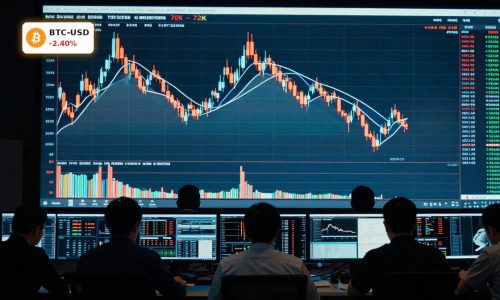
The conflict shock has revived demand for classic havens such as US Treasuries, the dollar and gold, but the reaction has been uneven across asset classes. In digital assets, Bitcoin initially sold off on news of the US‑Israeli strikes, dropping to around $63,000, before rebounding above $68,000 after confirmation of Khamenei’s death. Some market participants are interpreting the leadership vacuum as a potential catalyst for de‑escalation, though that remains highly uncertain as Iranian leaders vow revenge and Israeli forces continue to hit high‑value targets.
For US investors, crypto’s snapback underlines how swiftly positioning can change if the Iran Conflict is perceived either as contained or as spiraling beyond control. A sustained risk‑off phase would typically favor large‑cap defensive equities, higher‑quality credit and sectors with stable cash flows, while speculative growth and highly leveraged names could underperform. Volatility around geopolitical headlines is likely to remain elevated into the US cash session on Monday (ET).
Beyond markets, Western security agencies are bracing for wider repercussions. German officials speak of a heightened threat environment, including potential activation of Iranian sleeper networks in Europe and increased risks to Jewish and US‑linked institutions. Such concerns could indirectly hit multinational travel, tourism and luxury stocks with heavy European and Gulf exposure listed on the NYSE and NASDAQ.
Could the Iran Conflict hit global growth?
The broader macro impact hinges on two variables: the duration of hostilities and the status of commercial shipping lanes. If the Strait of Hormuz remains navigable and Gulf oil infrastructure is largely spared, economists expect the damage to global GDP to be manageable, with higher energy prices partially offset by resilient demand in the US and parts of Asia. A prolonged closure, by contrast, would be a genuine stagflation shock, complicating the Federal Reserve’s path on rate cuts.
US President Donald Trump has framed the removal of Khamenei and other senior commanders as a bid to end what he calls a decades‑long pattern of Iranian aggression, warning Tehran against further retaliation and promising a response with unprecedented force if US troops are attacked. Iran, for its part, is striking Israeli population centers at high frequency and has targeted at least two dozen US‑linked military facilities in the region, with Washington confirming US fatalities and ongoing combat operations.
Panic selling on Monday morning is rarely a winning strategy; the real risk for markets comes if the Strait of Hormuz is seriously disrupted and the conflict drags on.
— geopolitik
Conclusion
European Union leaders describe this moment as a decisive turning point for Iran’s internal politics, with some seeing a narrow path toward a more open society, others warning of a power vacuum that could fuel radicalization. For Wall Street, the key issue is less regime change itself and more the near‑term risk that Russia, China or regional powers are drawn more deeply into the Iran Conflict, transforming a regional war into a broader confrontation with far‑reaching economic consequences.
Further Reading
- Explainer: How the Strait of Hormuz shapes global oil flows (Reuters)
- Bitcoin rebounds as traders assess Middle East risk (Bloomberg)
- Global airlines reroute flights amid rising Gulf tensions (AP)
- Geopolitics – Iran‑War, Middle East-Eskalation und Maerkte bei Yahoo Finance (Yahoo Finance)