Will the Iran conflict fade like past Middle East scares or reset risk pricing across energy, shipping and global equities?
geopolitik: Is This a Contained Shock or a Structural Shift?
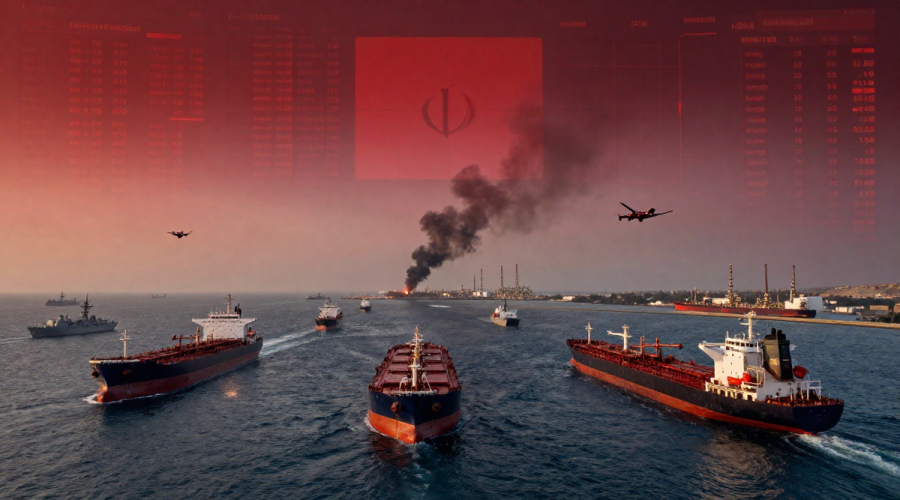
From a geopolitical markets perspective, the current conflict marks a sharp escalation beyond the periodic flare-ups investors have grown used to in the Middle East. The U.S. and Israel have carried out extensive strikes on Iranian infrastructure, reportedly dismantling hundreds of sites, while Iran has responded with waves of missiles and drones on Israel, U.S. bases and Gulf states. Airspace closures across large parts of the region, visible damage to refineries, power plants and even cloud data centers, and the near-standstill of shipping through the Strait of Hormuz underline that real economy channels are already impaired.
On Wall Street, the initial reaction has been the familiar pattern after major geopolitical shocks: broad equity indices sold off at the open, credit spreads widened and volatility spiked, but there was no full-blown panic. The S&P 500 and Nasdaq 100 have stabilized intraday as investors reassess scenarios instead of capitulating. This fits a broader Iran War Markets Analysis pattern: markets price probabilities, not certainties, and initially treat wars as events with a potentially short half-life – until evidence accumulates that disruption will last.
What is different this time is the concentration of risk in the world’s most important oil-producing region, the deliberate targeting of critical infrastructure and the explicit threats against tanker traffic. Those elements increase the odds that the shock could become semi-structural – embedding a higher risk premium into energy, shipping, defense and even parts of cloud computing.
geopolitik and Energy Majors: Who Wins from the Oil Shock?
The most immediate market impact comes through energy prices. Iran accounts directly for only a mid-single-digit share of global oil production, but the Strait of Hormuz is the transit chokepoint for roughly 30% of seaborne crude. Several major tanker owners and oil traders have halted voyages through the strait amid security warnings, and container lines are rerouting vessels around the Cape of Good Hope. Geopolitik risk models now need to assume not just the theoretical risk of closure, but an effective blockage via insurance and safety decisions.
Iranian Revolutionary Guard commanders have openly threatened to attack tankers and push oil to as high as $200 per barrel. At the same time, shipping and commodity analysts highlight that even without a formal closure, sporadic missile and drone attacks on tankers are enough to deter traffic and drive freight and insurance costs sharply higher. For integrated oil companies such as ExxonMobil, Chevron and European peers, the immediate effect of this Iran War Markets Analysis is positive for near-term earnings: higher realized prices on existing production outpace the incremental cost risk, at least initially.
That said, the market will begin to differentiate. Low-cost producers with diversified logistics and minimal direct exposure to Iranian infrastructure stand to benefit more sustainably than operators whose production or export terminals are in the direct line of fire, such as Saudi Aramco. Higher oil prices also feed back into inflation expectations, potentially complicating the Federal Reserve’s path to rate cuts. If energy stays elevated for months, the macro benefit to energy equities could be offset by tighter financial conditions and a hit to energy-intensive sectors from chemicals to autos.
geopolitik and Shipping, Airlines and Travel: Collateral Damage
Outside of energy producers, the most acute near-term losers sit in transportation and travel. Hundreds of container ships are reported stranded in or near the Persian Gulf, with hundreds of thousands of containers’ worth of goods effectively frozen. Rerouting around Africa adds roughly two weeks to Asia–Europe voyages, tying up capacity and supporting spot freight rate increases. For global logistics names and container lessors, this is a mixed picture: higher spot rates versus schedule chaos and customer pushback.
For airlines and tourism, the fallout is unambiguously negative. Airspace closures and direct attacks on airports have forced carriers to cancel flights across the Gulf. Lufthansa, for example, has moved widebody aircraft out of the region without passengers due to a lack of cabin crew and security constraints, while German tour operators report tens of thousands of stranded travelers in Gulf destinations. U.S. and European carriers face lost revenue, higher fuel costs and complex rerouting.
From a portfolio standpoint, this Iran War Markets Analysis suggests underweighting airlines and leisure names most dependent on Middle East hubs, at least until airspace reopening and insurance clarity emerge. Hotel operators and online travel agencies with broad geographic exposure will likely see only a modest impact, but carriers and airports in the region face more profound earnings downgrades.
geopolitik, Defense Contractors and Space Intelligence: A New Upcycle?
One of the clearest market signals from the conflict has been the rotation into defense and homeland security names. European defense contractors and South Korean defense stocks have rallied sharply as investors extrapolate higher defense budgets. In the U.S., defense primes such as Lockheed Martin, Northrop Grumman and RTX are poised to benefit from restocking of munitions, missile defense systems and electronic warfare capabilities, especially as allies in Europe and the Gulf reconsider their procurement priorities.
Beyond traditional defense, satellite imagery and ISR (intelligence, surveillance and reconnaissance) providers are in focus. Planet Labs, for example, has seen its stock jump as global demand for up-to-date imagery of Iranian facilities, Gulf shipping routes and conflict zones surges. After years of struggling to convert data into profits, the company has pivoted toward defense and security customers, and this conflict validates that strategic shift. Investors should, however, remain disciplined: war-driven order spikes can be lumpy, and valuations can run ahead of medium-term contract visibility.
Drone defense is another structural theme underscored by this Iran War Markets Analysis. DroneShield and similar companies that specialize in detecting and neutralizing unmanned aerial vehicles are seeing renewed interest after Iranian drones have struck oil refineries, power plants, data centers and even high-rise residential towers in Bahrain. The use of relatively cheap loitering munitions against high-value targets strengthens the case for integrated drone defense systems for militaries, airports, critical infrastructure and even large event venues.
geopolitik, Cloud Infrastructure and Cyber-Physical Risk
A less appreciated angle in the Iran War Markets Analysis is the vulnerability of digital and cloud infrastructure. Amazon Web Services has acknowledged that drone strikes in the United Arab Emirates directly hit two data centers and that a strike near a Bahraini facility damaged infrastructure and power delivery. Those events temporarily took parts of AWS’s Middle East cloud region offline and forced clients to consider failover and migration strategies.
For large cloud providers like Amazon, Microsoft and Google, the near-term financial impact from lost regional workloads is small relative to global scale. But the signal to investors is important: data centers are now explicitly in the target set for state-backed actors in high-intensity conflicts. That elevates the strategic value of redundancy, multi-region architectures and hybrid deployments. It also supports secular demand for cybersecurity, physical security and resilient networking solutions across the S&P 500 tech stack.
U.S. cloud customers with critical operations in high-risk regions will increasingly price geopolitical resilience into vendor selection. For infrastructure REITs, the risk premium may rise for facilities in conflict-prone geographies. Conversely, diversified North American and European data center operators can market geopolitical safety as a selling point.
geopolitik and Emerging Markets: Rethinking the Risk Premium
Hedge funds have already begun to reassess emerging market allocations in light of the Iran war. The combination of direct conflict risk, sanctions uncertainty and potential disruption to commodity and trade flows forces a repricing of EM sovereign and corporate spreads. Gulf equities, which had become a favored overweight for yield-seeking global investors, now carry a more elevated event risk, especially in countries with critical oil, gas or desalination infrastructure in the Iranian targeting envelope.
For broader EM benchmarks, the picture is mixed. Oil exporters benefit from higher prices but face political and security spillovers. Importers suffer terms-of-trade shocks but may gain from capital flowing out of the Gulf into relatively safer EMs. From a U.S. portfolio construction view, this Iran War Markets Analysis argues for selective exposure: favor energy exporters with diversified security partnerships and underweight highly exposed Gulf assets until there is clarity on ceasefire prospects or new security arrangements.
At the same time, the war underscores how quickly localized conflicts can leak into global risk assets. Iranian-made or derivative drones are being discussed in the context of potential deployments well beyond the Middle East, including theoretical scenarios in the Caribbean. The U.S. has responded by pre-positioning naval assets and tightening its security posture in the Western Hemisphere, adding another layer of geopolitical noise for risk models.
geopolitik and Central Banks: Will Oil Spike Derail Rate-Cut Hopes?
Central banks now sit at the intersection of geopolitics, inflation and growth. The European Union has already activated an energy crisis task force to prepare for surging oil, fuel and gas prices. In the U.S., higher energy costs will filter into headline CPI and could nudge inflation expectations upward just as the Federal Reserve was exploring the timing and pace of cuts. If Brent crude were to move toward levels implied by Iranian threats, the inflation shock could become large enough to delay easing or force a more cautious, data-dependent stance.
In an Iran War Markets Analysis framework, investors should watch the interaction between oil prices and Fed rhetoric closely. A short-lived spike that retraces quickly would likely be treated as noise; a sustained period of tight supply and high-risk premiums might effectively tighten financial conditions, pressuring rate-sensitive growth and tech stocks. Bond investors, meanwhile, could see renewed demand for Treasuries as geopolitical hedges, even as inflation uncertainty rises.
Conclusion
European economies, especially Germany’s export- and energy-intensive industrial base, are particularly vulnerable to prolonged disruption. Economists already point to the war as a drag via higher input costs and longer delivery times, hitting machinery, chemicals and automotive exports. Over a longer horizon, however, some argue that a post-war Iran reintegrated into the global system could represent a material growth opportunity for European and U.S. exporters.
Further Reading
- Oil prices jump as Middle East conflict threatens Strait of Hormuz shipments (Reuters)
- Defense stocks rally worldwide on renewed Gulf war fears (Bloomberg)
- AWS details data center outages after drone strikes in Middle East (CNBC)
- Geopolitik bei Yahoo Finance (Yahoo Finance)