Is JPMorgan’s sudden clampdown on private credit a one-off warning or the start of a broader repricing of risk?
How is JPMorgan reshaping private credit risk?
JPMorgan Chase & Co. has moved to limit lending to private credit funds after reducing the value of software loans used as collateral, directly cutting back-leverage capacity for many non-bank lenders. The bank’s marks focus on loans to software companies that boomed in recent years and are now seen as vulnerable to rapid competitive shifts from artificial intelligence. While actual defaults remain limited, the repricing signals that JPMorgan Private Credit Risk is being reassessed before losses hit the books, not after.
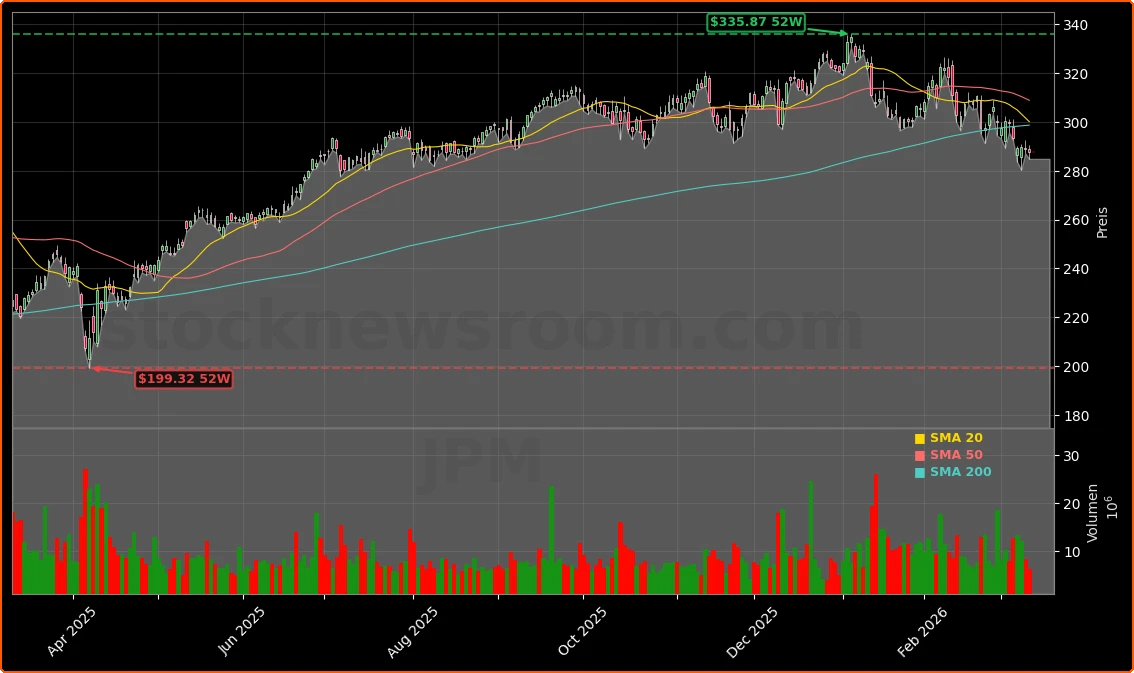
The current share price of JPMorgan (JPM) at about $287.52, slightly below the prior close of $289.01, shows only modest immediate stock pressure, but the policy shift is reverberating across private markets. Major funds that rely on bank facilities to juice returns now face tighter terms and potentially lower leverage, especially where software-heavy portfolios dominate. For investors in listed asset managers and interval funds that traffic in private loans, the new stance from the industry’s largest secured lender is a clear warning shot.
Unlike many peers, JPMorgan Chase & Co. enjoys covenants that let it revalue collateral at any time, not just after payment problems. That flexibility allows the bank to pull back credit lines preemptively when it perceives rising JPMorgan Private Credit Risk, making its internal risk views immediately consequential for the broader market.
Why are software loans under pressure?
The markdowns target loans to software businesses that became favorites of private credit lenders in the low-rate era. Those firms often featured high recurring revenue and strong margins, making them attractive borrowers for funds chasing yield. Now, however, AI tools and automation are threatening some business models, compressing pricing power and raising questions about the durability of cash flows that underpin loan repayments.
By assigning lower values to those loans, JPMorgan Chase & Co. effectively reduces the borrowing base of private credit funds and interval vehicles that pledge them as collateral. The move comes as several private credit platforms face elevated redemption requests and tighter liquidity, suggesting that investor patience with opaque marks and optimistic valuations may be thinning. Funds that had been able to quietly smooth volatility must now contend with a major financing partner that is marking to a more conservative view.
JPMorgan executives have been increasingly vocal on emerging risks. CEO Jamie Dimon has cautioned that the sprawling and relatively opaque private credit ecosystem could still be hiding more “cockroaches,” even as it has grown into a $1.8 trillion alternative-lending powerhouse. Troy Rohrbaugh, co-CEO of the commercial and investment bank, recently emphasized that the firm is taking a more conservative stance than many rivals on leveraged lending and back-leverage to non-bank lenders, with JPMorgan Private Credit Risk a key focus area.
How are competitors and markets reacting?
The tightening move has weighed on sentiment for listed private credit and alternative asset managers. Shares of firms like KKR and Blue Owl have come under pressure as investors contemplate a climate of reduced leverage and higher funding costs for private deals. The news lands as several funds face redemptions, underscoring how quickly confidence can swing in segments where transparency is limited.
For big U.S. banks, the episode underscores diverging strategies. While Wells Fargo is pushing deeper into digital assets with its WFUSD token plans and JPMorgan Chase & Co. continues to expand its own blockchain-based initiatives, the traditional credit books are seeing risk pulled back. Meanwhile, technology bellwethers such as Apple and NVIDIA—key beneficiaries of the AI wave disrupting software borrowers—remain central holdings for many portfolios, highlighting the split between AI winners and legacy software credits sitting inside private loans.
On the equity side, sentiment toward JPMorgan itself remains constructive. Zacks Investment Research recently upgraded JPMorgan to a “Strong Buy,” citing earnings momentum and resilient profitability. That bullish view suggests investors see the bank’s tougher stance on lending as a sign of discipline, not distress—reducing tail risk from leveraged exposures even as fee and trading franchises continue to perform within the S&P 500 financials cohort.
What does JPMorgan Private Credit Risk mean for investors?
For U.S. and international investors, the rise of JPMorgan Private Credit Risk as a market theme carries several implications. Holders of private credit interval funds and business development companies should scrutinize portfolio composition, particularly exposure to software and other AI-sensitive sectors. Reduced bank financing could pressure returns if funds are forced to delever or sell assets into a softer bid environment.
Public shareholders in JPMorgan Chase & Co. may see the change as a net positive risk-management step. The bank has grown its non-bank financials book rapidly in recent years; proactively tightening standards now reduces the chance of outsized write-downs in a downturn. By contrast, lenders without similar revaluation rights could be slower to recognize losses, leaving their balance sheets more exposed if conditions deteriorate.
They rarely get rattled, and this is the first time we’ve had a little issue.
— Head of a private credit fund on JPMorgan’s tougher stance
Conclusion
For diversified portfolios built around large-cap U.S. names like Tesla and NVIDIA alongside financials such as JPMorgan Chase & Co., the key takeaway is that private credit is entering a more mature, scrutinized phase. As AI redraws competitive lines across software and beyond, collateral values and leverage assumptions are being tested in real time. The evolution of JPMorgan Private Credit Risk policy will remain an important barometer for how aggressively Wall Street is willing to fund this once-booming corner of the market.
Further Reading
- JPMorgan Chase & Co. (JPM) Stock Quote & News (Yahoo Finance)
- JPMorgan Chase reins in lending to private credit firms after marking down software loans (CNBC)
- JPMorgan Tightens Software Private Credit Lending (Benzinga)
- JPMorgan Marks Down Software Loans Amid Fears of AI Disruption (PYMNTS)
- JPMorgan Chase & Co. (JPM) Upgraded to Strong Buy (Zacks Investment Research)