
Is JPMorgan’s sudden rethink on private credit a routine risk tweak or an early warning for a crowded $2 trillion market?
How serious is the JPMorgan Private Credit Risk shift?
The immediate focus is on JPMorgan Private Credit Risk and what it signals for the broader $2 trillion private‑credit universe. The bank is cutting back exposure to specific private‑credit funds after taking markdowns on software‑related loans held inside those vehicles. Crucially, JPMorgan is reserving the right to remark these assets at any time, which can instantly change how much funding the funds can obtain using those loans as collateral.
Private credit has boomed over the last decade as an alternative to traditional leveraged loans and high‑yield bonds, increasingly financing middle‑market and tech companies that might otherwise tap the syndicated loan market. Around $300 billion in bank financing from Wall Street underpins this model, often through so‑called back leverage structures where banks lend against portfolios of illiquid loans. If lenders like JPMorgan grow more cautious, that leverage chain tightens fast.
The move comes as spreads in both investment‑grade and high‑yield credit have started to widen from historically tight levels. Investors are now re‑pricing risk in areas that looked comfortably funded a year ago, and JPMorgan Private Credit Risk sits right at that fault line.
What does JPMorgan’s pullback mean for private credit?
By restricting lending and marking down underlying software loans, JPMorgan Chase & Co. is signaling that parts of private credit may not be priced to true market value. Other major players, including Morgan Stanley and Cliffwater, have recently limited redemptions in some private‑credit and interval funds, underlining how liquidity is becoming a pressure point.
The impact is two‑sided. On one hand, retail and high‑net‑worth investors have grown more cautious about opaque, illiquid funds after years of strong returns. On the other hand, banks that provide leverage to those funds are now re‑evaluating risks, especially in segments exposed to software and technology where competitive pressure from AI and pricing erosion may hit cash flows. If both funding pillars – bank capital and retail inflows – weaken simultaneously, the industry’s growth engine could stall.
Insurance companies add another layer of JPMorgan Private Credit Risk. They hold roughly $2 trillion of private‑credit‑linked exposure, about 18% of their bond portfolios, stretching beyond plain corporate loans into CLOs and business development companies. Some insurance platforms owned by alternative asset managers have moved deeper into high‑yield, unrated, and lower‑rated credit, increasing the chance that any repricing in private credit radiates out into more traditional fixed‑income markets.
How is this hitting JPMorgan shares and Wall Street?
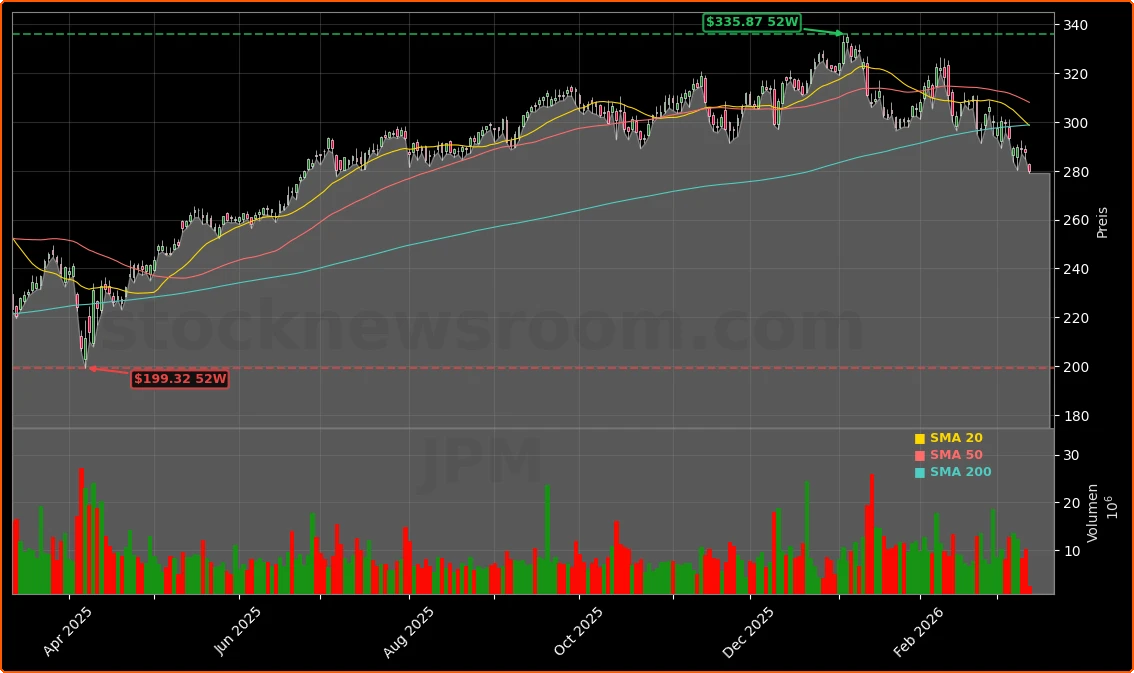
On Thursday, JPMorgan stock trades around $279.92, down about 2.64% from the previous close of $284.50, as investors digest the lending shift and legal headlines. The pullback comes after a strong multi‑quarter run that left major US banks, including JPMorgan Chase & Co., at elevated valuations compared with historical norms.
Despite today’s weakness, broker sentiment on JPMorgan remains broadly constructive. Zacks highlights that most sell‑side firms still rate the stock as a buy or overweight, reflecting the bank’s diversified earnings base and strong capital ratios. MarketBeat data show large institutions such as Vinva Investment Management significantly increasing positions in recent quarters, with roughly 70% of the float now in institutional hands. That concentration can amplify moves if sentiment on JPMorgan Private Credit Risk sours or if broader credit conditions deteriorate.
For now, equity markets see the tightening as a controlled risk‑management step rather than a sign of imminent systemic stress. But given the role of global systemically important banks in financing private credit, any further retrenchment would be closely watched by investors in the S&P 500 financials sector, as well as tech names dependent on leveraged financing, from software vendors to high‑growth players like NVIDIA and Tesla.
What about the new crypto lawsuit against JPMorgan?
Adding to the negative headlines, a proposed class action in federal court accuses JPMorgan Chase & Co. of enabling a $328 million crypto Ponzi scheme operated by now‑defunct Goliath Ventures. Investors allege that JPMorgan was the sole banking partner for Goliath between early 2023 and mid‑2025, during which more than $250 million in deposits reportedly moved through a key account, with roughly $123 million transferred on to wallets at Coinbase.
The complaint claims JPMorgan’s know‑your‑customer procedures should have flagged that Goliath was acting as an unlicensed private‑equity‑style crypto pool, taking investor funds without appropriate registration. That is particularly sensitive given CEO Jamie Dimon’s long‑standing public criticism of Bitcoin and speculative crypto activity. While the financial impact of the lawsuit is likely manageable for a bank of JPMorgan’s scale, the case revives questions about internal controls, transaction monitoring, and reputational risk at a time when regulators are scrutinizing both crypto and private markets.
For investors, the juxtaposition is striking: the same institution scaling back exposure to opaque private‑credit structures is accused of not catching red flags in a different high‑risk corner of finance. Together, these stories reinforce why JPMorgan Private Credit Risk and operational risk are now central themes in assessing the stock.
In the near term, much depends on whether other major lenders follow JPMorgan in remarking private‑credit portfolios and trimming back leverage lines. If the trend spreads, funding costs for leveraged borrowers – particularly in software and tech – could rise, pressuring growth assumptions baked into valuations across the NASDAQ and S&P 500. On the other hand, a disciplined recalibration of risk could leave stronger balance sheets and more sustainable returns for the largest, best‑run lenders and for blue‑chip borrowers like Apple.
Conclusion
JPMorgan Private Credit Risk now sits at the intersection of credit‑cycle timing, regulatory scrutiny, and investor confidence. For US and global portfolios, the key question is whether this is an early, contained reset in a frothy asset class or the first tremor before a broader repricing of credit and bank equities. The next few quarters – and any follow‑through actions by peers like Goldman Sachs and Morgan Stanley – will show how far this tightening goes and whether JPMorgan emerges with its risk‑management reputation strengthened or further tested.
Further Reading
- JPMorgan Chase & Co. (JPM) stock on Yahoo Finance (Yahoo Finance)
- JPMorgan reportedly restricts lending to private credit firms (The Globe and Mail)
- JPMorgan Chase & Co. is Vinva Investment Management Ltd’s 9th Largest Position (MarketBeat)
- JPMorgan Chase & Co. (JPM) Is Considered a Good Investment by Brokers: Is That True? (Zacks Investment Research)