Is the Lufthansa Middle East Crisis just a short-term shock or the start of a deeper hit to global airline valuations?
How hard is Lufthansa hit by the Middle East turmoil?
The Lufthansa Middle East Crisis intensified over the weekend after U.S. and Israeli strikes on Iran triggered widespread airspace closures across the Persian Gulf. Deutsche Lufthansa AG has halted flights to Tel Aviv, Beirut, Amman, Erbil, Dammam and Tehran at least until March 8, and suspended services to Dubai and Abu Dhabi through March 4. The carrier is largely avoiding Gulf-region airspace, forcing lengthy detours on remaining long-haul routes and driving up fuel burn per flight.
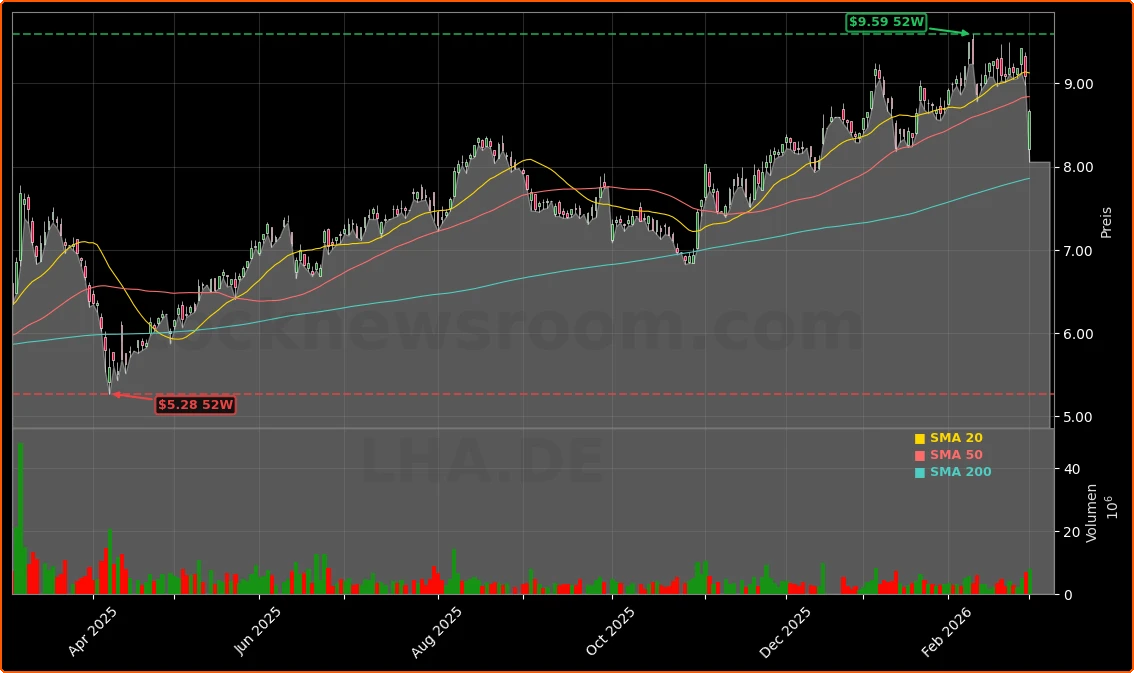
Sector-wide, airline stocks in Europe and Asia have dropped more than 6% as investors price in the “double whammy” of lost high-yield traffic and a spike in kerosene prices. Lufthansa’s shares had already fallen about 3.5% on Friday and were among the weakest names on the German market on Monday morning, at times showing intraday declines of more than 6%. Some off-exchange indications pointed to even steeper losses in early Tradegate trading as risk-off sentiment spread through equity markets.
What defines the Lufthansa Middle East Crisis for operations?
At the core of the Lufthansa Middle East Crisis is the closure of key hubs such as Dubai, Abu Dhabi and Doha, which has stranded an estimated hundreds of thousands of passengers region-wide and severed lucrative connecting flows between Europe and Asia. For Lufthansa and its peers, those hubs are critical for premium business travel and high-margin leisure demand, both of which support yields and load factors on long-haul routes.
Lufthansa states that passenger and crew safety has top priority and is offering affected customers free rebooking options or full refunds. The group is monitoring security conditions closely and coordinating with authorities to decide when additional flights can be mounted, including potential extra services from still-operational airports like Riyadh and Muscat. That means the near-term financial damage is twofold: foregone revenue from canceled flights and higher operating costs for remaining services due to fuel-intensive diversions around conflict zones.
How are fuel prices and strike risks compounding pressure?
The crisis hits just as oil prices jump, immediately feeding into kerosene costs and squeezing airline margins. Lufthansa already faced structural headwinds from recent labor disputes, including pilot strikes that led to more than 800 canceled flights and roughly 100,000 affected passengers. While the pilots’ union VC Cockpit has temporarily paused strikes this week in light of the escalating conflict, it emphasized that the underlying pay dispute is unresolved and that industrial action could resume later.
For Wall Street investors used to watching U.S. carriers and travel names like Apple-driven consumer tech plays, the Lufthansa Middle East Crisis offers a stark reminder that geopolitical shocks can weigh on airlines even when demand fundamentals are otherwise solid. Analysts in Europe have highlighted support zones for the stock around EUR 6.80, suggesting further downside is possible if airspace restrictions and elevated fuel prices persist. That technical level is now a key marker for global funds assessing entry points into the name relative to U.S. peers and diversified travel ETFs.
What does this mean for global airline and tech-heavy portfolios?
Lufthansa is not alone: Asian carriers such as Cathay Pacific, Qantas Airways, Singapore Airlines and Japan Airlines are also under pressure as Gulf routings become more complex or impossible. The broader European equity market, including the DAX and MDAX where Lufthansa trades, has sold off in response to the Iran war headlines, reinforcing a global risk-off mood even as major U.S. indices like the S&P 500 and NASDAQ track the situation more cautiously.
For U.S. investors holding international airline exposure alongside megacaps like NVIDIA and Tesla, the Lufthansa Middle East Crisis underscores the benefit of diversification across sectors less directly tied to jet fuel and tourism flows. At the same time, some long-term investors see Lufthansa as one of the comparatively profitable legacy carriers in Europe, arguing that a resolution of the conflict and normalization of airspace could unlock a recovery, particularly if the stock approaches historically important support ranges.
In the current situation, repatriation flights, passenger safety and maintaining air freight supply chains have absolute priority.
— VC Cockpit pilots’ union statement
Conclusion
In summary, the Lufthansa Middle East Crisis has turned the German flag carrier into a geopolitical barometer for the global airline trade: the more prolonged the airspace closures and fuel shock, the longer earnings and valuations may stay grounded; but if tensions ease and repatriation operations transition back to normal commercial flying, today’s volatility could set the stage for a rebound watched closely from Frankfurt to Wall Street.
Further Reading
- Lufthansa avoids large parts of Middle East airspace amid Iran conflict (dpa-AFX)
- Global airline stocks drop as Gulf airspace closures disrupt traffic (Reuters)
- European markets fall as Iran war escalation rattles travel sector (Bloomberg)
- Deutsche Lufthansa AG bei Yahoo Finance (Yahoo Finance)