Is LVMH’s latest -4.1% slide a short-term shakeout or the start of a deeper soft-luxury reset for global investors?

Is LVMH’s sell-off signaling a soft-luxury rethink?
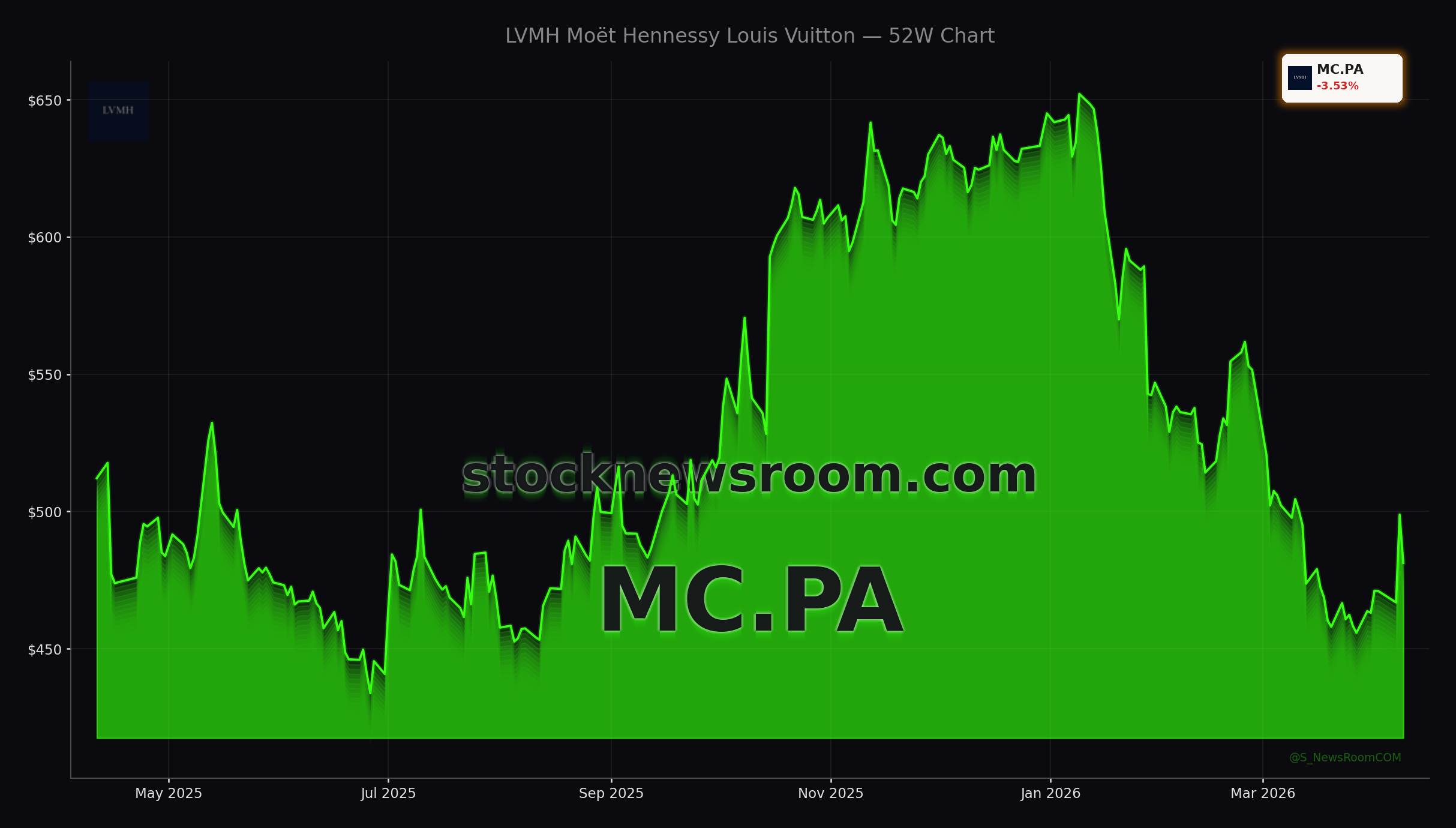
The 4.13% drop in LVMH Moët Hennessy Louis Vuitton SE to $478.25, from a prior close of $499.60, comes as heavyweight European names that rallied yesterday, including SAP and Siemens, hand back part of those gains. Within France’s blue-chip universe, luxury peers such as Hermès International and L’Oréal also traded lower, but the renewed focus on LVMH is sharper because of its outsized role in global consumer-discretionary indices and many U.S.-based international equity funds.
The current LVMH Luxury Analysis centers on a cyclical question: how resilient is demand for handbags, leather accessories and fashion versus jewelry and watches when macro conditions soften? On a day when Saint-Gobain, Pernod Ricard, Schneider Electric and other European bellwethers are down roughly 1–1.7%, LVMH’s steeper loss suggests investors see company-specific risks in addition to broad risk-off sentiment.
For U.S. portfolios, LVMH often appears in international growth or non-U.S. consumer funds, alongside mega-cap technology holdings like Apple or NVIDIA in the same account. That makes today’s move relevant not only for European benchmarks but also for American investors looking at overall style and sector balance in their global allocations.
What does JP Morgan say about soft vs. hard luxury?
JP Morgan’s latest commentary underscores a potential divergence inside the luxury complex that is shaping this LVMH Luxury Analysis. The bank argues that in phases of uncertainty, so-called “hard luxury” groups focused on jewelry and high-end watches tend to hold up better than “soft luxury” players, which rely more heavily on leather goods and fashion. The reasoning is that wealthier consumers treat jewelry as a store of value, while discretionary purchases of new handbags and apparel are easier to postpone.
LVMH, with flagships such as Louis Vuitton and Dior, has leaned heavily on leather goods and fashion for profit growth in recent years. That positioning worked extremely well during the post-pandemic boom, but JP Morgan now warns that this mix makes the company more vulnerable to a negative wealth effect if equity markets and high-end real estate weaken from current levels. In other words, when portfolio values drop, even affluent buyers may trade down or delay big-ticket fashion buys.
By contrast, hard-luxury peers specializing in jewelry or timepieces may see comparatively steadier demand, especially in markets where pieces are perceived as investment items. That relative argument is key for global sector allocators on Wall Street, who may rotate within the luxury universe rather than exit the space entirely.
How are global investors positioning around LVMH?
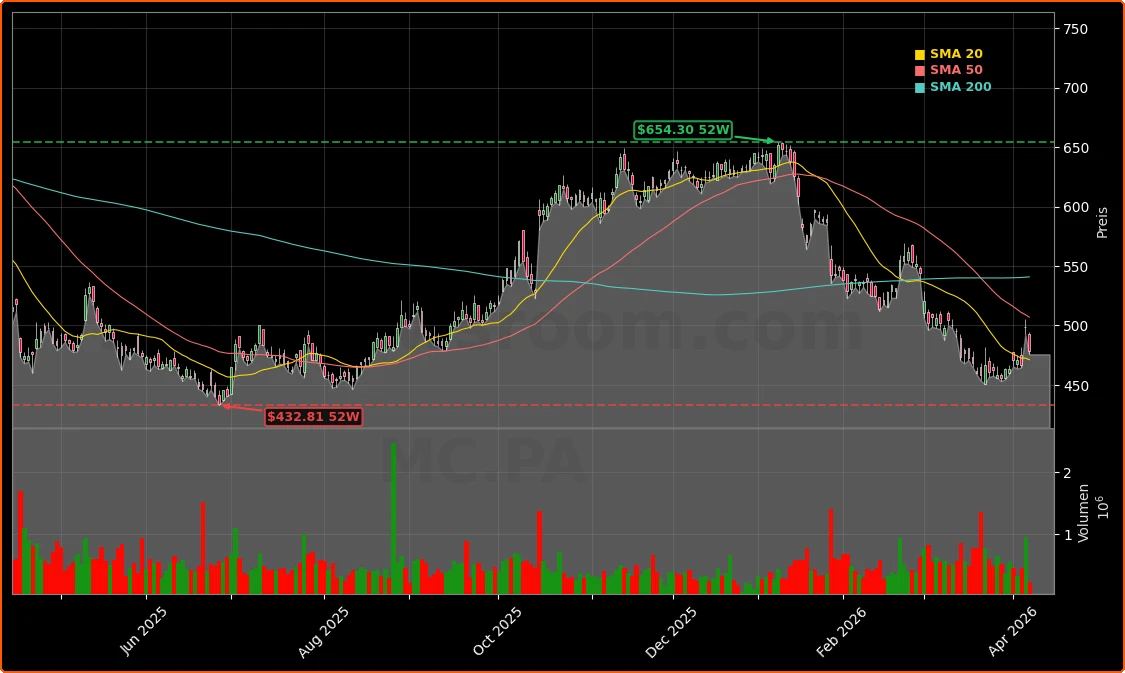
In this phase of LVMH Luxury Analysis, the main question for international investors is whether today’s pullback is just a short-term reversal of Wednesday’s strength or an early sign of a more durable derating. The stock is trading below its recent highs and well off earlier 52-week peaks, meaning the current move is a repricing rather than a blow-off top. Still, the combination of a softer share price and cautious commentary has sparked discussion among active managers who benchmark against global indices rather than the CAC 40 alone.
American investors often access LVMH via European ETFs, global consumer-discretionary funds, or concentrated international quality strategies that also include names like Tesla for growth exposure and Apple for cash-flow stability. For those investors, the soft-luxury narrative intersects with broader questions about consumer sensitivity to rates, uneven demand in China, and the durability of brand power at the very top of the price pyramid.
Sell-side houses such as Goldman Sachs and Morgan Stanley in recent months have generally framed European luxury as a long-term structural winner, but with greater dispersion expected between individual stocks. In this context, JP Morgan’s emphasis on hard-versus-soft exposure adds a new lens for comparing LVMH against peers and for deciding whether to overweight or underweight the group in diversified portfolios.
LVMH Luxury Analysis: What should U.S. investors watch next?
For U.S.-based holders, the latest turn in LVMH Luxury Analysis suggests several watch points. First, how quickly does demand for leather goods respond to any softening in equity markets or high-end housing? A visible slowdown in these end-markets could validate JP Morgan’s concerns about a wealth-effect hit to LVMH’s core categories. Second, relative share-price performance versus hard-luxury names in Europe will be crucial in the coming weeks as sector specialists test the rotation thesis.
Third, investors will pay close attention to management commentary in upcoming trading updates, especially any color on North American and Chinese high-end consumers. Signs that demand remains resilient despite macro noise would challenge the more bearish soft-luxury narrative; confirmation of belt-tightening would likely reinforce it. Finally, correlation with U.S. growth stocks such as NVIDIA and Apple matters: if risk-off sentiment broadens across equities, even high-quality luxury leaders can see amplified volatility as multi-asset investors de-risk.
Related coverage: Ownership structure and control at LVMH
For a deeper look at how governance and control interact with market volatility, investors can turn to prior coverage on LVMH. An in-depth piece, “LVMH Ownership Structure +2.4% Surge While Arnault Locks Control”, explores how recent shifts in the group’s ownership and Bernard Arnault’s firm grip on voting rights may influence strategic flexibility and risk tolerance. That analysis complements today’s market-focused discussion by explaining who ultimately steers LVMH through periods of cyclical pressure and what that might mean for minority shareholders over the long run.
In summary, today’s LVMH Luxury Analysis highlights mounting tension between the company’s powerful brand portfolio and its exposure to the more cyclical soft-luxury segment. The stock’s 4% slide underscores that investors are recalibrating expectations as JP Morgan and others flag the risk of a wealth-effect hit to leather-goods demand. For global and U.S.-based holders alike, the next key datapoints will be trading updates and relative performance within the luxury complex, which will show whether LVMH’s pullback is a buying opportunity or the start of a longer period of consolidation.