Is LVMH’s tightening ownership grip a defensive move against market stress or a long-term power play investors should welcome?
How does the new LVMH Ownership Structure look?
The core change in the LVMH Ownership Structure is numerical but symbolically powerful: the Arnault family has increased its stake from roughly 49.8% to 50.01%, crossing the line from blocking minority to outright majority. This move formally secures voting control over the $509.60 stock, which is up about 2.4% versus the previous close of $495.10 but still trades well below its 52‑week high near EUR 654. At the same time, shareholders approved a bylaw amendment lifting the maximum age for the combined Chairman and CEO role to 85. That decision effectively allows 77‑year‑old Bernard Arnault to remain in charge for years, reducing the likelihood of a near‑term leadership succession. For Wall Street portfolios that hold LVMH via European or global luxury ETFs, this cements a founder‑led structure that often commands a governance premium but also concentrates decision‑making power.
The LVMH Ownership Structure has always been family‑centric, yet the latest adjustments send a clear signal: continuity over transition. Arnault has publicly downplayed succession planning, even as all five of his children hold operational roles within the group. For U.S. investors used to institutional shareholder pressure at companies like Apple or Tesla, LVMH is moving in the opposite direction, reinforcing a long‑term, dynastic control model more typical of European conglomerates and some Asian family empires.
What does this mean for LVMH leadership?
Beyond share count, the power balance inside LVMH is shifting through boardroom and executive moves. Antoine Arnault, the eldest son, has joined the group’s executive committee, positioning him closer to the center of group‑wide strategy. Other management changes include Yves Cauchon taking over the Métiers d’Art division and Philippe Farnier becoming deputy CEO at Parfums Christian Dior and the broader LVMH Beauty unit. These appointments suggest a gradual internal rotation rather than a disruptive overhaul, consistent with the newly entrenched LVMH Ownership Structure.
For U.S. asset managers benchmarking against the S&P 500 and large‑cap consumer names like NVIDIA and Apple, the message is stability in brand stewardship even as regional demand becomes more volatile. Luxury conglomerates rely heavily on creative direction and heritage, and LVMH’s choice to extend Bernard Arnault’s potential tenure underlines a belief that continuity at the top remains a competitive advantage versus peers such as Hermès and Kering. However, it may also reduce the influence of activist investors or ESG‑oriented funds that typically prefer clearer succession visibility and more dispersed ownership.
How are Middle East tensions hitting LVMH?
While governance solidifies, macro risks are clouding the outlook. Heightened military tensions in the Middle East are pressuring luxury stocks across Europe, with rivals Hermès and Kering also seeing drawdowns. The timing is particularly sensitive: Gulf hubs such as Dubai, Doha and Riyadh have emerged as key growth drivers in recent quarters, partly offsetting sluggish Chinese and broader Asian demand. Traditionally, spending on apparel, leather goods and jewelry picks up around the Ramadan and Eid period, giving luxury groups an important seasonal tailwind.
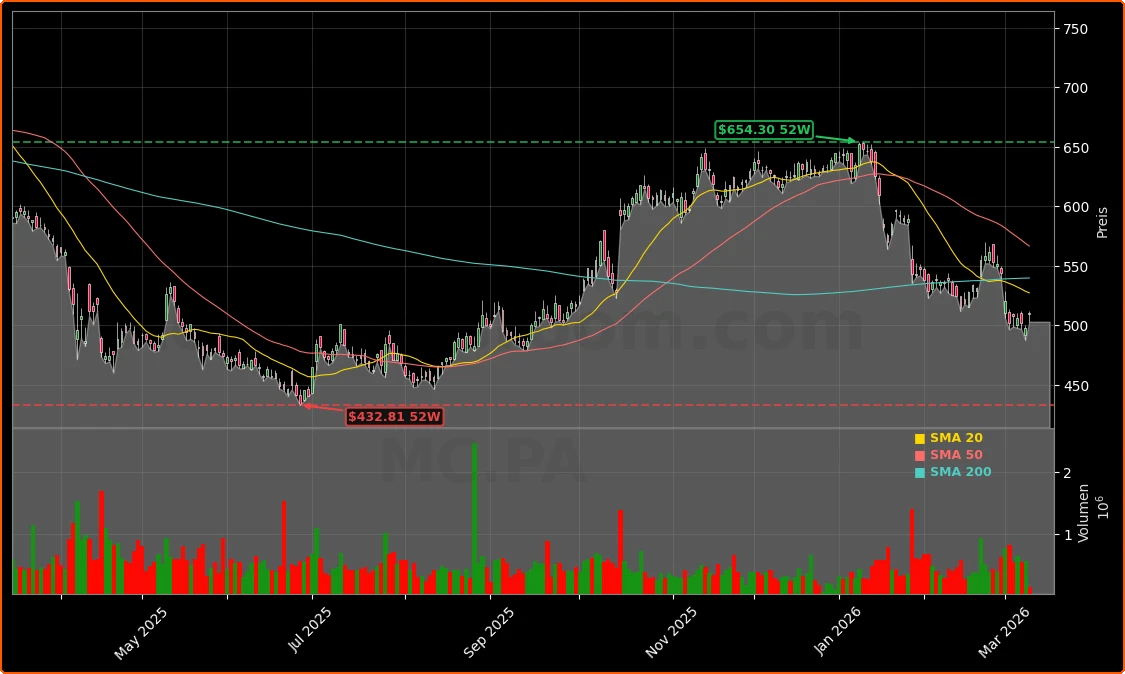
If the security situation dampens tourism flows or high‑end retail activity in the Gulf, LVMH could feel an immediate hit to foot traffic and full‑price sales in flagship stores. Technically, the stock’s recent dip below the psychologically important EUR 500 zone triggered additional selling pressure, with the relative strength index (RSI) slipping toward 30, a level often seen as oversold. Traders on Wall Street who use European luxury as a proxy for global high‑end consumption are watching whether this represents a capitulation low or merely a pause before further downside if geopolitical headlines worsen.
Is LVMH becoming a value play for U.S. investors?
At around $509.60, LVMH trades significantly below its 52‑week peak, yet far from its 12‑month low near EUR 436. For U.S. investors comparing global consumer names, the group still commands a premium multiple versus many S&P 500 discretionary stocks, reflecting its dominant position in leather goods, spirits, jewelry and beauty. However, the combination of a firmer LVMH Ownership Structure and cyclical fears has shifted the debate from pure growth to a more nuanced mix of quality and valuation. While some European brokers have trimmed price targets in recent months, major U.S. houses like Goldman Sachs and Morgan Stanley continue to highlight the resilience of top luxury brands through cycles, even if short‑term earnings revisions drift lower.
Conclusion
For now, there is no broad capitulation call from bulge‑bracket banks akin to what Citigroup or RBC Capital sometimes issue on more cyclical names. Instead, investors are weighing whether incremental geopolitical shocks and weaker Asian demand will merely delay a recovery in high‑end spending or structurally compress margins. Compared with U.S. consumer bellwethers and tech‑driven growth stories like NVIDIA and Tesla, LVMH’s risk‑reward profile looks more tied to global wealth trends, tourism normalization and currency moves than to innovation cycles or rate expectations on the NASDAQ.
Further Reading
- LVMH Moet Hennessy Louis Vuitton SE stock quote and price history (MarketWatch)
- Global luxury goods market outlook 2025-2026 (Bloomberg)
- Middle Eastern consumer spending trends around Ramadan (Reuters)
- LVMH Eigentümerstruktur und Marktbelastung bei Yahoo Finance (Yahoo Finance)