Is the Marvell NVIDIA Partnership turning a niche optics player into a must-own backbone of the next AI infrastructure wave?

How is Wall Street reacting to Marvell and NVIDIA?
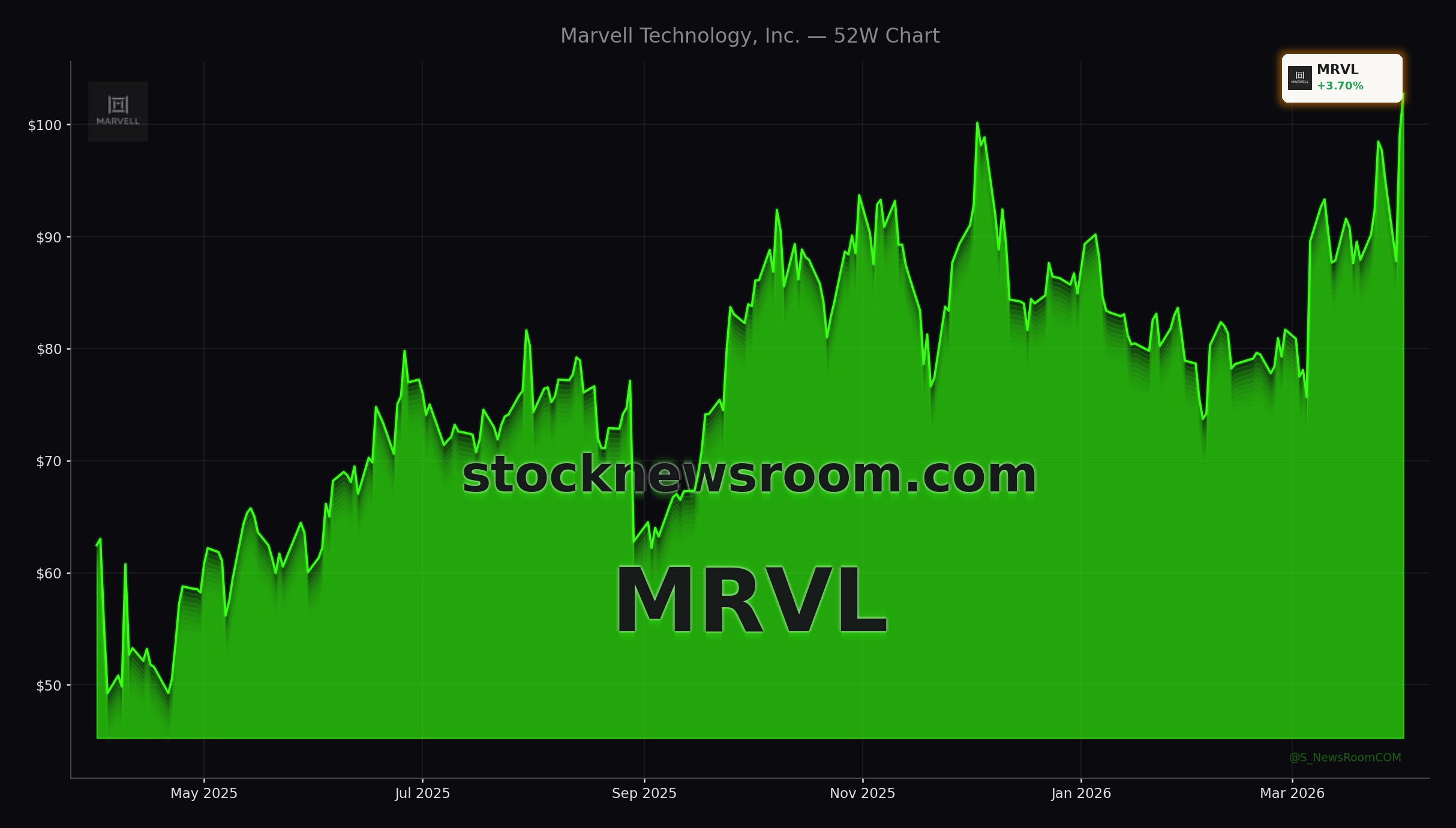
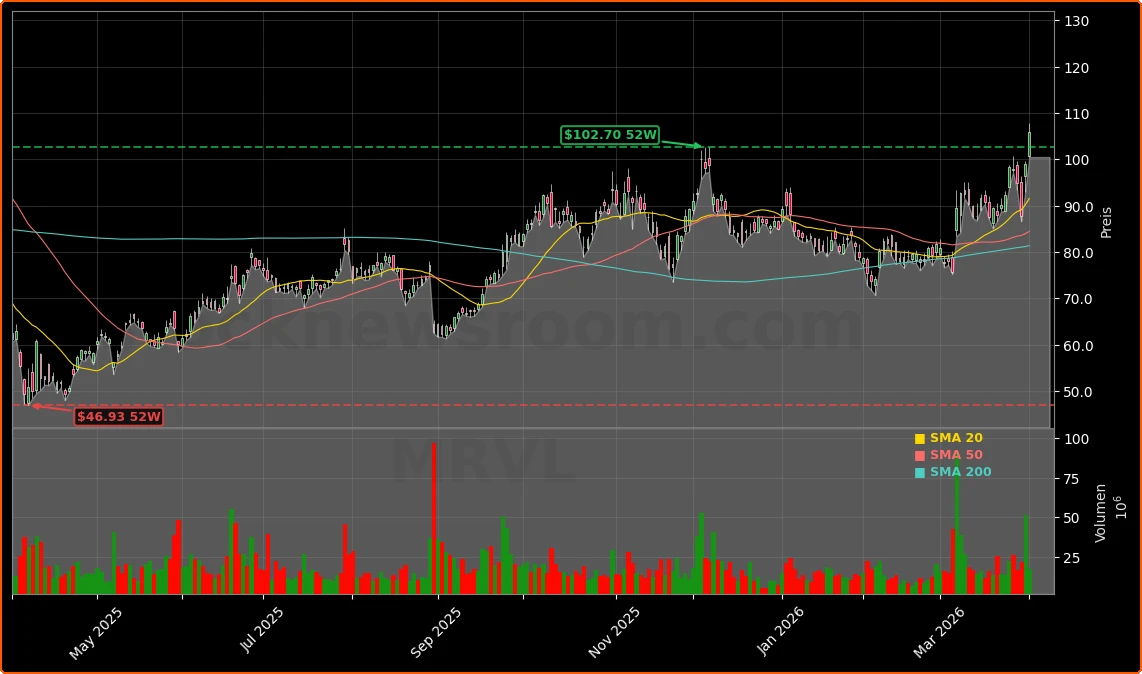
AI infrastructure once again dominated trading on Wednesday, with Marvell Technology shares trading around $105.84, up roughly 6.9% from the prior close, while NVIDIA hovered near $175.80, up about 0.8% on the day. The news of a $2 billion direct investment from NVIDIA into Marvell has pushed MRVL sharply higher over recent sessions as traders reposition around the Marvell NVIDIA Partnership. The deal underscores how central optical connectivity and custom silicon have become to the broader NASDAQ and S&P 500 AI trade.
Marvell has already been benefiting from surging data center demand, with recent reports pointing to 42% year‑over‑year revenue growth and data center now exceeding 70% of total sales. The NVIDIA stake adds a powerful strategic layer: Marvell’s optics, DSPs and custom ASICs are set to be tightly integrated into NVIDIA’s NVLink Fusion and so‑called AI factories. On Wall Street, the partnership is being framed less as a defensive lifeline for Marvell and more as an offensive push by both companies to scale the next wave of AI infrastructure.
What does silicon photonics bring to NVIDIA?
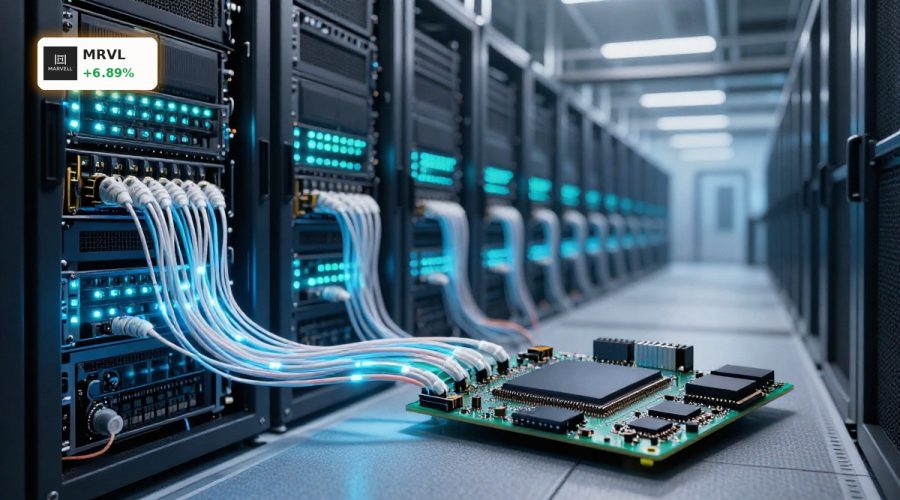
At the heart of the Marvell NVIDIA Partnership is silicon photonics, a technology that moves data between chips using light rather than purely electrical signals. As AI models grow in size and training clusters span tens of thousands of GPUs, traditional copper interconnects increasingly struggle with power consumption and bandwidth limits. Silicon photonics promises higher throughput over longer distances at lower energy per bit, which is crucial for data center operators trying to rein in electricity and cooling costs.
Marvell has built a strong portfolio in coherent optics, DSPs and high‑speed interconnect components that plug directly into these challenges. By aligning with NVIDIA, Marvell’s photonics and custom chips can be designed hand‑in‑hand with GPU roadmaps and NVLink Fusion fabrics. NVIDIA CEO Jensen Huang has framed this as a way to make AI factories easier and more efficient for customers to deploy, as demand for AI compute continues to explode. For investors, this tight coupling suggests that Marvell could become a standardized part of the NVIDIA‑centric AI stack, rather than just another component supplier.
How does the deal reshape competition in AI chips?
The Marvell NVIDIA Partnership also carries important competitive implications across the broader AI chip landscape. NVIDIA is not only securing an optical and custom‑silicon partner; it is also aiming to blunt the influence of rivals like Broadcom, which has been helping hyperscalers including Apple and Alphabet design custom accelerators that can compete directly with NVIDIA’s GPUs. By elevating Marvell’s role inside its ecosystem, NVIDIA is effectively strengthening a friendly supplier while making it less attractive for cloud giants to build fully GPU‑alternative, in‑house solutions.
Analysts at Cantor Fitzgerald recently reiterated an outperform rating on NVIDIA, highlighting the Marvell collaboration as an incremental positive because it opens another avenue to penetrate large hyperscaler customers beyond the core GPU compute sale. For cloud players such as Amazon and Microsoft, Marvell’s custom ASIC capabilities could now be more tightly integrated with NVIDIA GPUs, producing hybrid architectures that preserve NVIDIA’s central role while still allowing tailored accelerators. That dynamic may complicate the competitive calculus for pure‑play ASIC providers and other AI chip challengers.
Is Marvell now a core AI infrastructure play?
With NVIDIA’s backing, Marvell is positioning itself as the “optical plumbing” behind massive AI data centers rather than a niche networking vendor. Its custom silicon business has already scaled to around $1.5 billion in revenue, riding the wave of ASIC‑based AI infrastructure. The $2 billion investment and NVLink Fusion alignment significantly expand Marvell’s total addressable market and deepen its access to the largest cloud and enterprise customers. For U.S. portfolios focused on the AI theme, MRVL is increasingly being mentioned in the same breath as the leading enablers of data center transformation.
Market observers are also paying attention to the broader AI spending backdrop. Industry estimates suggest the AI market has doubled from roughly $200 billion last year to $400 billion this year, with data center silicon alone adding around $200 billion of incremental annual demand compared to six years ago. Foundry capex signals from players like TSMC and aggressive financing rounds for AI cloud providers echo the same message: there is scope for multiple winners in AI infrastructure. In that context, the Marvell NVIDIA Partnership looks less like a zero‑sum maneuver and more like a strategy to grow the overall pie.
Related Coverage
For a detailed look at how traders initially reacted when the news broke, including intraday price action and volume spikes, read “Marvell Technology NVIDIA partnership: +7.7% stock surge after $2B bet”, which dissects whether Marvell can truly become the backbone of optical connectivity for next‑gen AI data centers. The piece also explores how options markets repriced MRVL’s volatility after NVIDIA’s commitment.
Investors tracking the broader semiconductor landscape should also consider how other chipmakers are arming up for the AI arms race. “Intel Fab 34 Deal +8.9% Rally After $14.2B Buyback Shock” examines whether Intel’s combination of capacity expansion and aggressive capital returns can close the AI and foundry gap with rivals, and how that backdrop may influence capital flows across the AI hardware complex.
In sum, the Marvell NVIDIA Partnership elevates Marvell from a secondary networking name to a strategic pillar in NVIDIA’s AI factory blueprint, with silicon photonics and custom ASICs at the center. For investors, the deal reinforces NVIDIA’s ecosystem moat while giving MRVL a clearer path to sustained data center growth. The next few quarters of deployment wins and hyperscaler design‑ins will show whether this partnership can fully capitalize on the surging AI infrastructure spend.