Can a $2 billion Nvidia bet turn Marvell into a core supplier of the optical “plumbing” behind next‑gen AI data centers?

How is Wall Street reacting today?
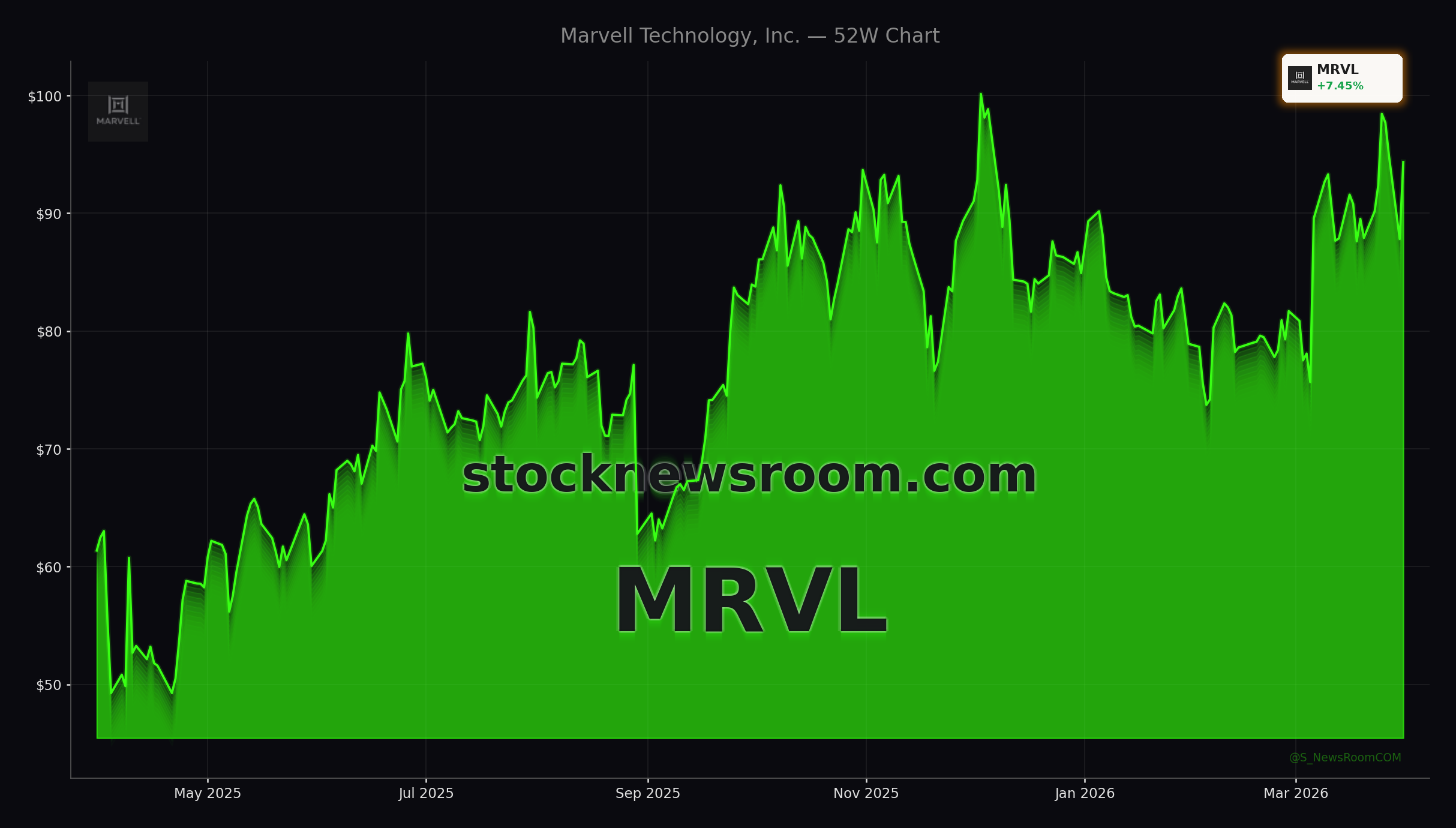
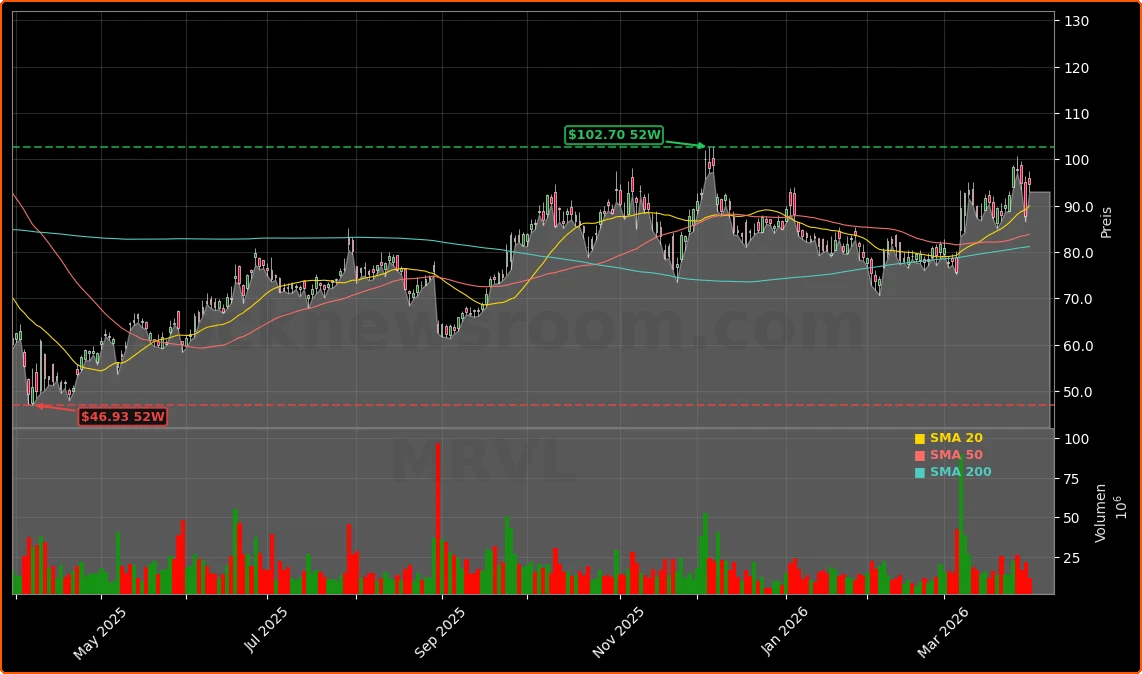
Marvell Technology shares traded around $94.60 in early Tuesday action, up roughly 7.7% from a prior close of $86.85, after the company confirmed a $2 billion strategic investment from NVIDIA. The move follows a strong run for AI‑exposed chipmakers on the NASDAQ, but also comes amid recent volatility that saw many semiconductor and AI‑infrastructure names sell off on profit‑taking.
The new stake gives Nvidia a meaningful financial position in Marvell and immediately reprices expectations for Marvell’s role inside next‑generation AI data centers. Traders on Wall Street highlighted a gap‑up open, a breakout from a recent base on strong volume, and technical resistance near $98 to $100 as key short‑term levels to watch. Some intraday desks flagged the area around $95–$96 as an important zone for confirming whether this latest rally can hold.
Against a backdrop of recent sector weakness in names like Micron, Western Digital and Lam Research, Marvell’s positive divergence stands out. The stock’s move suggests investors see the partnership as more than a one‑off catalyst and instead as a structural shift in AI infrastructure spending.
What exactly is the Marvell Technology NVIDIA partnership?
The core of the Marvell Technology NVIDIA partnership is a $2 billion direct investment by Nvidia into Marvell, alongside a multi‑year technology collaboration. The two companies plan to co‑develop silicon‑photonics and networking solutions aimed at connecting Nvidia GPUs, custom accelerators, and next‑generation AI systems more efficiently.
The deal hooks Marvell’s photonics and custom silicon portfolio into Nvidia’s NVLink Fusion and broader “AI factory” strategy, which aims to interconnect massive clusters of GPUs with ultra‑high‑bandwidth, low‑power links. Silicon photonics replaces traditional copper cabling with optical connections on and between chips, cutting power consumption while boosting throughput—exactly what hyperscale cloud providers need as AI models and data sets explode in size.
This partnership is not Nvidia’s first photonics bet. The GPU leader recently committed roughly $2 billion each to Lumentum and Coherent to accelerate optical modules for its Vera Rubin platform. Marvell, for its part, recently closed its $3.25 billion acquisition of Celestial AI, gaining photonic fabric technology that meshes with Nvidia’s push to eliminate data bottlenecks between accelerators. Taken together, the investments signal that Nvidia is now financing the entire stack: GPUs, custom chips, networking, and the photonic “nervous system” that glues AI factories together.
How strong is Marvell’s AI and financial setup?
Importantly, Marvell entered the Marvell Technology NVIDIA partnership from a position of strength. For fiscal 2026, the company reported revenue of about $8.2 billion, up 42% year over year, with data‑center revenue now the majority of its business. Non‑GAAP EPS climbed to $2.84, an 81% jump, driven by AI‑related design wins and ramping shipments into cloud customers.
Fourth‑quarter revenue reached roughly $2.22 billion, up 22% from a year earlier, with adjusted EPS of $0.80 slightly ahead of expectations. Management guided fiscal 2027 revenue above $11 billion, implying more than 30% growth, and pointed to record bookings and design wins as evidence that AI demand remains robust despite macro uncertainty.
On valuation, Marvell trades at a forward P/E in the low‑20s, below many high‑growth AI peers and below its own historical peaks. According to MarketBeat, the stock carries an average “Moderate Buy” rating from around three dozen brokers, with a consensus 12‑month price target near $117. Oppenheimer recently raised its target to $150 and reiterated an Outperform view, while Jefferies lifted its target to $120 with a Buy rating. Not every voice is bullish—Zacks moved the stock to “Strong Sell” amid concerns about expectations—but the Street’s skew is clearly positive.
Marvell maintains a modest dividend of $0.06 per quarter and completed the Celestial AI deal without taking on heavy new debt, giving it flexibility to keep investing while returning some cash to shareholders. One recent overhang has been CEO Matthew Murphy’s pre‑planned sale of 30,000 shares (around $3 million) on March 26; he still holds roughly 310,000 shares, suggesting continued alignment with long‑term investors.
How does this reshape the AI chip landscape?
For U.S. portfolios already heavy in NVIDIA and Apple, the Marvell Technology NVIDIA partnership widens the investable AI universe beyond pure compute. In the data‑center infrastructure layer, Marvell now competes and collaborates with heavyweights like Broadcom, which sells custom ASICs and networking silicon; Advanced Micro Devices, which is challenging Nvidia in GPUs; and hyperscalers such as Tesla and others that are designing their own AI accelerators for internal use.
Marvell’s differentiator is its combination of custom silicon, high‑speed Ethernet solutions, and emerging photonic fabrics that can be co‑designed with Nvidia and top cloud providers. As AI models become more “agentic”—with many small, specialized models working together—the burden on interconnects and memory fabric increases. Investors looking past the GPU wars see Marvell as one of the few scalable bets on that “plumbing” layer.
Risks remain. Integration of Celestial AI’s technology must go smoothly, and Marvell is heavily exposed to hyperscaler capex cycles that can swing sharply with macro conditions. After a strong AI‑driven rally over the past year, any disappointment in growth or delays in photonics adoption could trigger volatility. Yet Nvidia’s $2 billion capital commitment aligns incentives tightly and reduces some execution risk by securing Marvell’s place inside its ecosystem.
Related Coverage
Investors who want a deeper dive into Marvell’s longer‑term AI trajectory can explore how multi‑year forecasts stack up against today’s volatility in “Marvell AI Forecast: -3.0% Plunge but 2028 AI Boom?”. That analysis examines whether ambitious revenue targets and the company’s XPU roadmap justify staying the course through drawdowns.
For a broader sector view on how massive AI infrastructure bets may reshape balance sheets and valuations across enterprise tech, the article “Oracle Forecast Shock: Can a $300B AI Bet Justify $400?” looks at Oracle’s aggressive AI cloud strategy and the associated risks—offering useful context for comparing different ways to gain exposure to AI data‑center growth.
In the end, the Marvell Technology NVIDIA partnership marks a decisive shift in how Wall Street values the “connective tissue” of AI rather than just the headline GPU winners. For U.S. investors seeking diversified AI exposure, Marvell now sits alongside NVIDIA as a key way to play the build‑out of global AI factories. The next few quarters of design wins, photonics milestones, and data‑center orders will show whether this $2 billion vote of confidence can translate into sustained upside for MRVL shares.