Is the latest Marvell Technology Upgrade the moment this chip name finally gets re-rated as a core AI infrastructure winner?

Why does the Marvell Technology Upgrade matter now?
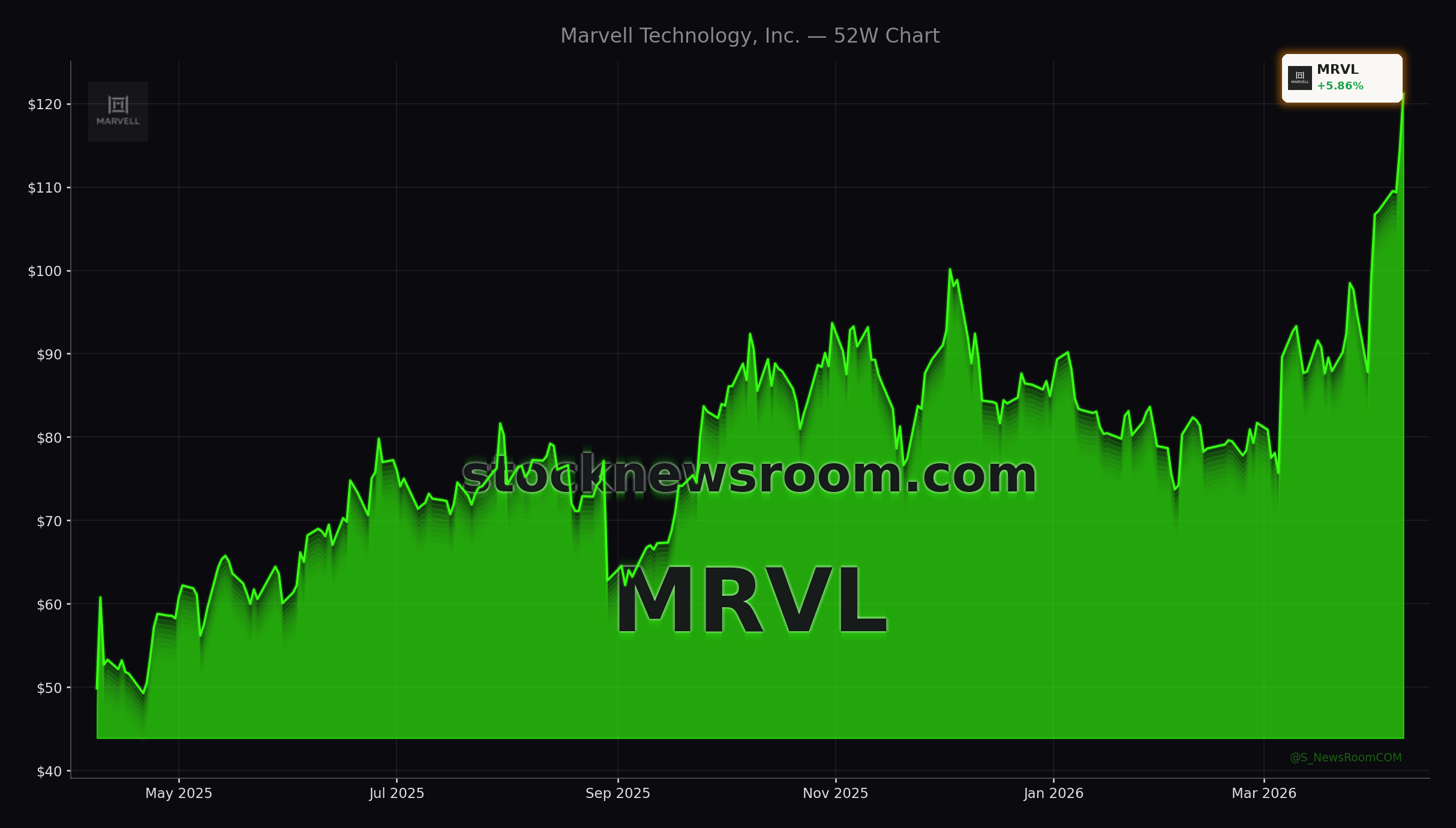
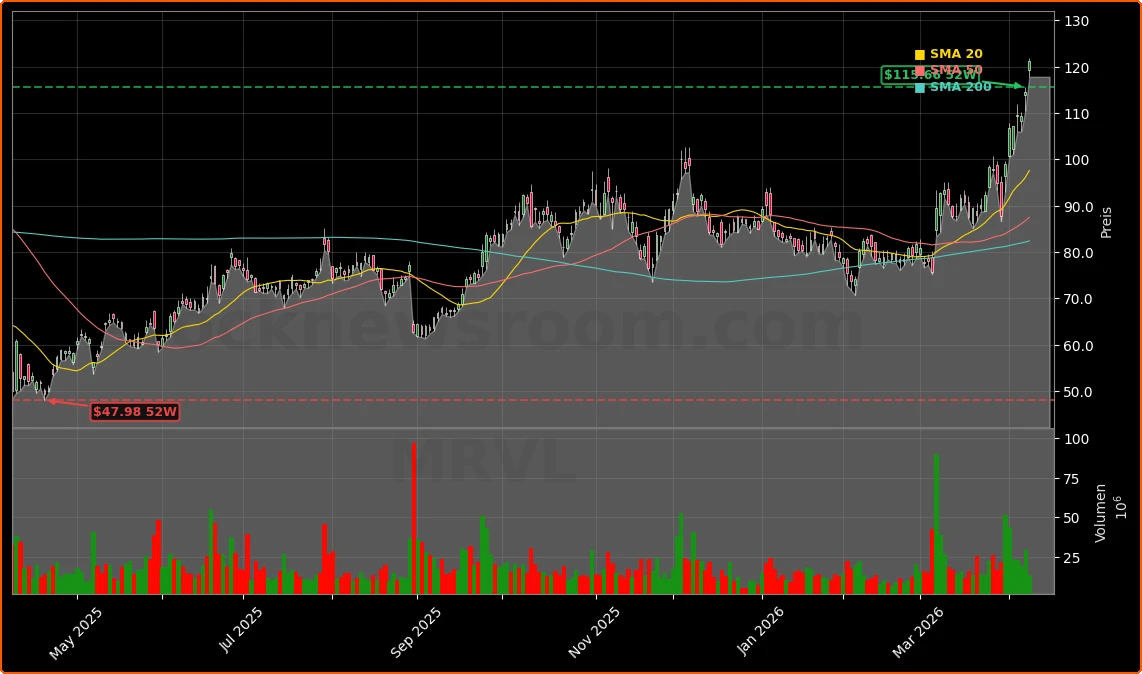
Barclays raised Marvell Technology from Equal Weight to Overweight and hiked its price target from $105 to $150, implying further double‑digit upside from current levels. The bank argues that Marvell should increasingly be valued as an optics and AI infrastructure leader, not a traditional mixed-signal chip company. That shift in narrative arrives as MRVL shares trade around $121, roughly 35% higher year to date and outpacing the broader NASDAQ and S&P 500 indices.
At the heart of the Marvell Technology Upgrade is a bullish view on demand for optical components that move data inside AI data centers. Barclays estimates Marvell’s optical business could grow close to 90% this year and next, even if some share is ceded to rivals such as Broadcom. With hyperscaler capex still flowing into high‑bandwidth networking to support generative AI workloads, Wall Street is increasingly treating optics as a structural growth driver rather than a cyclical niche.
Marvell’s latest quarterly numbers support that thesis. Data center revenue reached about $1.52 billion in its most recent reported quarter, up 38% year over year and now representing roughly 73% of total sales. CEO Matt Murphy has indicated that internal forecasts for data-center growth in the coming fiscal year are already running ahead of prior expectations, a key backdrop for the Marvell Technology Upgrade.
How does the NVIDIA partnership change Marvell’s profile?
Beyond optics, Marvell is gaining attention for its expanding role in custom AI silicon as capacity at Taiwan Semiconductor Manufacturing tightens and cloud giants seek tailored accelerators. A pivotal catalyst was a $2 billion strategic investment from NVIDIA, which is integrating Marvell’s custom accelerators (XPUs) into its NVLink Fusion “AI factory” and AI-RAN ecosystems. That deal combines Marvell’s interconnect and XPU capabilities with NVIDIA’s platform reach, effectively making Marvell a deeper part of the AI stack rather than a peripheral supplier.
This partnership also validates Marvell’s decision to double down on high‑bandwidth interconnects. The company’s $3.25 billion acquisition of Celestial AI, completed in February, significantly enhances its optical interconnect portfolio—crucial for alleviating data bottlenecks between AI accelerators. With a record custom AI design pipeline of more than 50 new opportunities across over 10 customers, management argues that Marvell is well positioned as hyperscalers diversify beyond standard off‑the‑shelf GPUs.
For U.S. investors already heavily allocated to mega‑caps like Apple and Tesla, the Marvell Technology Upgrade highlights a more specialized way to ride the AI infrastructure wave. Instead of competing directly with GPU vendors, Marvell is focused on the connective tissue: custom data‑center silicon, optical modules, and networking chips that underpin large language model training and inference clusters.
What are other analysts and institutions doing?
Barclays is not alone in its positive stance. Benchmark Co. recently reiterated its Buy rating on Marvell, while the broader analyst community shows 36 Buys and no Sell ratings, reflecting a strong bullish consensus. The average target price has been moving higher alongside NVIDIA’s investment and upbeat guidance, although many targets still lag Barclays’ more aggressive $150 call.
Institutional flows underscore that debate. Firms like Stratos Wealth Partners and Arta Finance Wealth Management have increased or initiated positions in Marvell, citing its strengthening role in AI and data‑center infrastructure. IMS Investment Management Services also recently bought a new 20,000‑share stake, treating Marvell as a core play on semiconductor data infrastructure. At the same time, other investors such as Rathbones Group and SteelPeak Wealth have trimmed holdings, and insiders including EVP and Chief Legal Officer Mark Casper have sold shares, reminding investors that valuation and profit‑taking are genuine considerations after the run‑up.
From a risk perspective, MRVL now trades at a rich forward P/E multiple near the high end of the semiconductor group and carries an elevated beta of around 1.8, meaning volatility is likely to remain above market averages. The Marvell Technology Upgrade from Barclays effectively argues that the company’s earnings power is still underappreciated relative to that multiple, but any slowdown in AI data‑center capex or share loss to competitors could test that thesis.
How does Marvell stack up against U.S. chip peers?
Compared with broader AI beneficiaries like NVIDIA and CPU makers, Marvell sits in a more specialized corner of the market focused on custom silicon, cloud networking, and optics. That differentiates it from consumer-focused giants such as Apple and automotive disruptors like Tesla, whose AI narratives revolve around devices and autonomous driving rather than back‑end infrastructure. For portfolio construction, MRVL offers exposure to the “picks-and-shovels” layer of AI: the components that keep data moving and models fed.
Competition remains intense. Broadcom is a formidable rival in optical modules and custom ASICs, while other fabless players court the same hyperscale clients. Yet as TSMC capacity remains tight and cloud providers look to diversify suppliers, Marvell’s expanding pipeline of more than 50 custom AI designs could mitigate some competitive pressure. If management executes on its 90% optics growth opportunity and sustains double‑digit data center expansion, the Marvell Technology Upgrade may prove conservative rather than aggressive.
Related Coverage
For a deeper dive into how the $2 billion NVIDIA partnership reshaped sentiment, including why some on Wall Street now see Marvell as a must‑own backbone of AI infrastructure, read “Marvell NVIDIA Partnership $2B Surge Shocks AI Street”. Investors comparing AI plays across the tech universe may also want to examine the more volatile side of the boom; the recent analysis “Palantir Forecast: -4.8% plunge as AI boom meets bubble fears” explores whether AI enthusiasm is tipping into bubble territory and what that might imply for richly valued names like MRVL.
In sum, the Marvell Technology Upgrade from Barclays crystallizes a broader shift in how Wall Street views the stock—from a cyclical networking name to a structural AI infrastructure winner. For American investors seeking targeted exposure to optical chips and custom data‑center silicon, MRVL is emerging as a high‑beta but potentially high‑reward complement to mega‑cap AI leaders. The next few quarters of data‑center growth and design‑win disclosures will show whether Marvell can grow into its upgraded $150 target and cement its role at the core of the AI build‑out.