
Can the Mastercard BVNK Acquisition turn stablecoins from a crypto niche into the next multi‑billion‑dollar payments rail for Wall Street?
How does the Mastercard BVNK Acquisition change the story for MA?
The Mastercard BVNK Acquisition immediately strengthens the payment giant’s positioning in the fast-growing stablecoin segment, where annual payment volumes already reach hundreds of billions of dollars. BVNK processes more than $30 billion in stablecoin transactions per year and enables businesses to send and receive payments across major blockchain networks in over 130 countries, complementing Mastercard’s reach in more than 200 markets.
Strategically, the deal is aimed at creating full interoperability between traditional card and account-based rails and blockchain-based stablecoins and tokenized deposits. For institutional and fintech clients, this should translate into faster cross‑border settlement, 24/7 availability beyond banking hours, and programmable payment flows tailored to treasury and B2B use cases. For shareholders, the key question is less near‑term earnings contribution and more whether Mastercard can secure a central role as stablecoins and tokenized money scale globally over the next decade.
Why is Mastercard doubling down on stablecoins now?
Management argues that digital currencies are shifting from speculative trading instruments toward practical settlement tools. By absorbing BVNK’s technology stack, Mastercard expects to offer end‑to‑end support for stablecoins, tokenized deposits and tokenized assets on the same network that already processes roughly $9.5 trillion in annual payments volume.
Jorn Lambert, Mastercard Incorporated’s chief product officer, said the company expects most financial institutions and fintechs to roll out digital currency services over time and wants to provide a “best‑in‑class, highly compliant, interoperable offering” with on‑chain rails added to its network. The combined platform will be chain‑agnostic, supporting all major blockchains rather than locking clients into a single ecosystem. This parallels moves from rivals: Stripe acquired stablecoin infrastructure firm Bridge in 2024, and PayPal has pushed into its own dollar-backed token. Against that backdrop, the Mastercard BVNK Acquisition is as much a defensive move to protect core payment economics as it is an offensive bid for new revenue streams.
How does this fit into the competitive landscape?
Traditional card networks and large U.S. fintechs are converging on similar themes: instant settlement, lower FX costs and programmable payments. While PayPal and Stripe are building or buying stablecoin capabilities, Mastercard Incorporated is leveraging its global acceptance network and recent partnerships, including a Crypto Partner Program with more than 80 firms and collaborations with players like Circle, Ripple and Solana.
The Mastercard BVNK Acquisition gives the company crypto‑native payment routing, deeper enterprise integrations and improved off‑ramp and on‑ramp infrastructure between fiat and stablecoins. That could position Mastercard as a preferred partner for neobanks, exchanges and Web3 platforms that still need card rails to reach consumers. For U.S. investors, this broadens Mastercard’s growth narrative beyond traditional card spend, putting it in the same structural innovation bucket that has benefited names like NVIDIA and Apple in other tech verticals.
What should Wall Street watch next?
Adding on-chain rails to our network will support speed and programmability for virtually every type of transaction.
— Jorn Lambert, Chief Product Officer, Mastercard
Conclusion
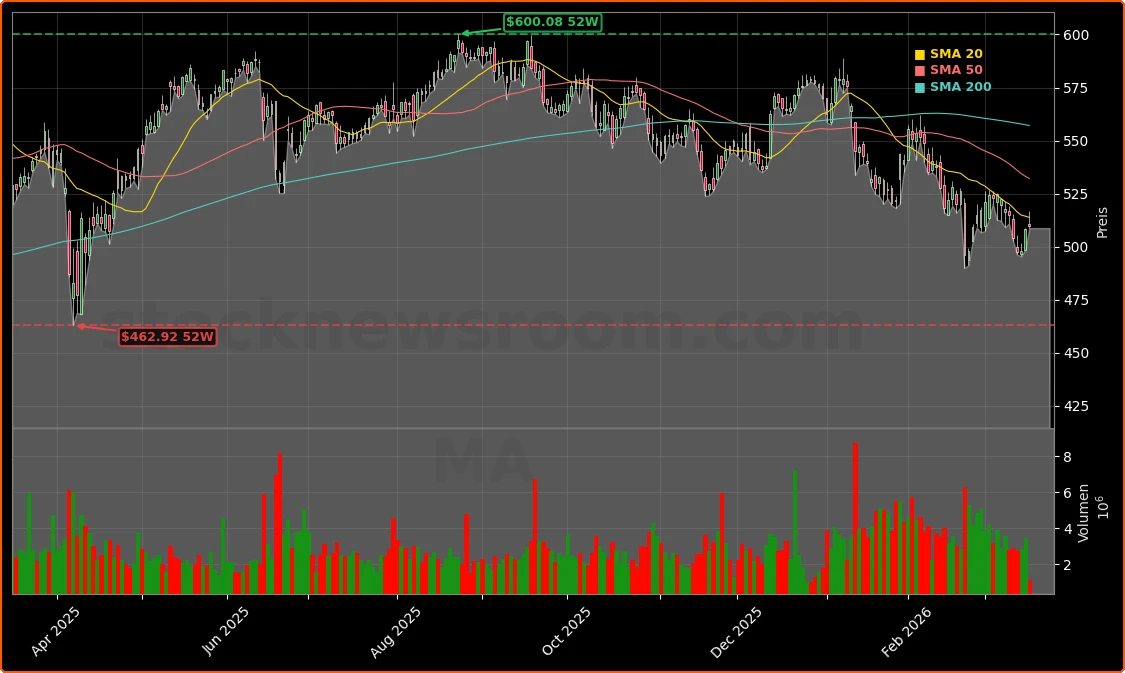
The transaction is expected to close before year‑end, subject to regulatory approvals. Key watchpoints include how quickly Mastercard integrates BVNK’s stack, whether regulators impose additional compliance requirements on stablecoin settlement, and how management frames revenue and cost synergies on upcoming earnings calls.While the stock recently traded around $509.59, modestly above the prior close, analysts have generally viewed Mastercard as a high‑quality compounder within the S&P 500, often assigning it overweight or buy ratings with premium valuation multiples relative to payment peers. Firms like Goldman Sachs, Morgan Stanley and RBC Capital Markets have historically highlighted the company’s resilient cross‑border volumes and pricing power; the expansion into on‑chain payments could add another structural growth leg if execution is strong. For now, investors should expect limited immediate EPS impact but a potentially material long‑term boost to Mastercard’s role at the center of global value transfer, especially as stablecoins and tokenized deposits move into mainstream financial plumbing alongside innovators such as Tesla in other sectors.
Further Reading
- Mastercard Incorporated (MA) stock on Yahoo Finance (Yahoo Finance)
- Mastercard to acquire BVNK to expand digital asset capabilities (Proactive Investors)
- Mastercard says it’s acquiring stablecoin startup BVNK in $1.8 billion bet on future of payments (CNBC)
- Mastercard to buy stablecoin infra firm BVNK for up to $1.8 billion (Reuters)