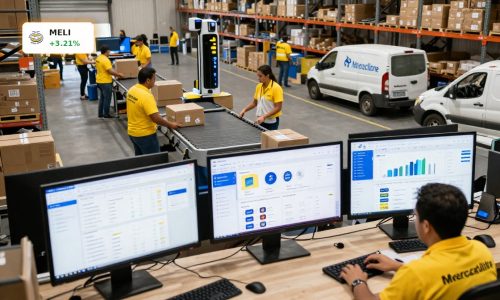
How can MercadoLibre shine in revenue while triggering an over eight percent stock drop?
MercadoLibre Quarter: How Did Revenue and Profit Perform?
In the fourth quarter of 2025, MercadoLibre, Inc. saw significant growth: net revenue increased by approximately 45% on a currency-adjusted basis to about $8.8 billion, surpassing consensus estimates of around $8.5 billion. The company benefited from a sustained boom in online commerce and payment processing, with the e-commerce segment growing by about 37% and the fintech division even expanding by more than 60%.
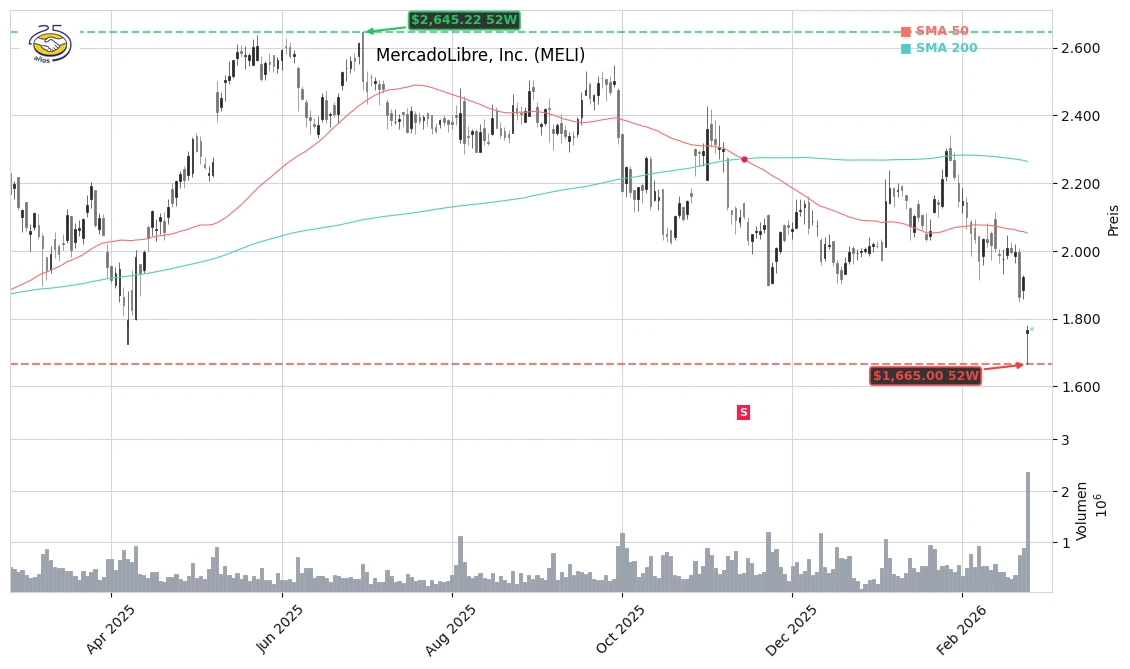
However, the results for the MercadoLibre quarter were weaker on the earnings side. Although operating income rose to approximately $889 million, net profit stagnated at about $494 million. Earnings per share (EPS) amounted to around $9.70 to $11, significantly below analyst expectations, which ranged from over $11 to nearly $12. Both Zacks and Benzinga emphasized that the EPS missed consensus estimates despite revenues exceeding projections. Consequently, the market reaction was strong: the stock experienced its largest intraday drop since 2024, losing as much as 14% at one point.
MercadoLibre: What is Pressuring Margins?
The MercadoLibre quarter particularly highlighted a significant margin compression. The EBIT margin fell below the previous year’s level because the company lowered the threshold for free shipping, continued to expand its logistics infrastructure, and scaled its credit and credit card business significantly. Management reported a margin decline of about five to six percentage points, which was intentionally accepted to attract new users and deepen existing customer engagement within the ecosystem.
Additional pressure comes from the AI initiative: MercadoLibre, Inc. is heavily investing in agent-based AI tools—both to enhance product search and advertising and to manage credit risk at Mercado Credito. At the same time, the company laid off 119 employees in Brazil as part of a restructuring around AI. The market now fears that rising technology and development costs could usher in a phase of persistently lower margins in the short to medium term, while competition with Amazon, local e-commerce providers, and fintech rivals continues to intensify.
MercadoLibre: How Strong is the Ecosystem’s Growth?
Despite the earnings disappointment, structural growth remains impressive. In the MercadoLibre quarter 4/2025, gross merchandise volume (GMV) rose to nearly $20 billion, an increase of about 37% in local currencies. The number of active buyers climbed to approximately 83 million, representing a 24% increase. In terms of payment volume, Mercado Pago reached around $83.7 billion, a growth of over 50%.
The advertising business, Mercado Libre Ads, developed particularly dynamically, growing by about 70% supported by AI-based targeting. In Brazil and Mexico, the marketplace continues to gain market share, while fintech offerings present enormous growth opportunities in a region with low financial inclusion. Additionally, the entry of SQUADRA Investments attracted attention from investors: the Brazilian asset manager established a new position of 89,656 shares, which constitutes about 33.8% of its managed assets and signals strong long-term confidence in the business model.
MercadoLibre: How are Analysts and Investors Responding?
Analyst firms such as Zacks and Seeking Alpha-supported research providers largely view the stock correction as a buying opportunity. Weitz Investment Management and other institutional investors have already used the weaker price level to increase their holdings; overall, institutions now hold significantly over 80% of the outstanding shares. According to MarketBeat, the average price target from the analysts tracked there currently stands at around $2,800 to $2,900, indicating a substantial valuation discount compared to the current price of $1,767.71.
Many studies emphasize that MercadoLibre, Inc. is valued at a forward P/E ratio of under 30, the lowest it has been in years, while the expected earnings growth for 2026 could exceed 50% according to several models. Morgan Stanley, Goldman Sachs, Citigroup, and RBC Capital Markets see the fintech and advertising business as long-term drivers in their Latin America analyses, but they also warn of an environment with structurally higher competition and potentially persistently lower margins.
We are aware of the short-term margin pressure, but we are strategically investing in growth drivers that aim to maximize long-term value for our shareholders.
— Martin de los Santos, CFO of MercadoLibre
Bottom Line
For investors, this presents a classic risk-reward profile: those who criticize the MercadoLibre quarter primarily for margin weakness may remain on the sidelines. In contrast, long-term oriented investors might interpret the current weakness as an entry opportunity into a regionally dominant e-commerce and fintech player with a strong AI pipeline.
Related Sources
- MercadoLibre, Inc. (MELI) Stock Price and Metrics (Yahoo Finance)
- MercadoLibre Stock Drops After Disappointing Q4 EPS (Benzinga)
- MercadoLibre’s Q4 Earnings Miss Estimates, Revenues Rise Y/Y (Zacks Investment Research)
- Why MercadoLibre Stock Crashed on Wednesday (The Motley Fool)