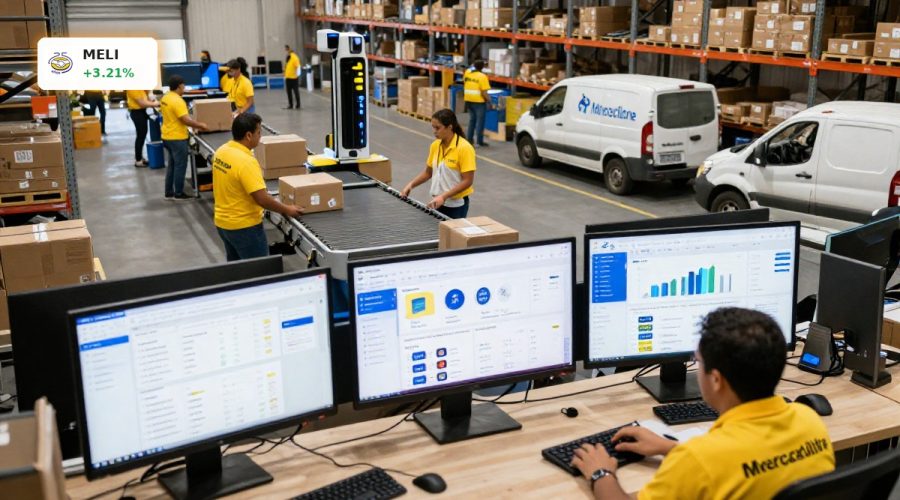
Is MercadoLibre’s aggressive ecosystem strategy building a Latin American giant or quietly eroding the profits investors are paying up for?
MercadoLibre, Inc.: Why the Market Is Nervous While Growth Is Exploding
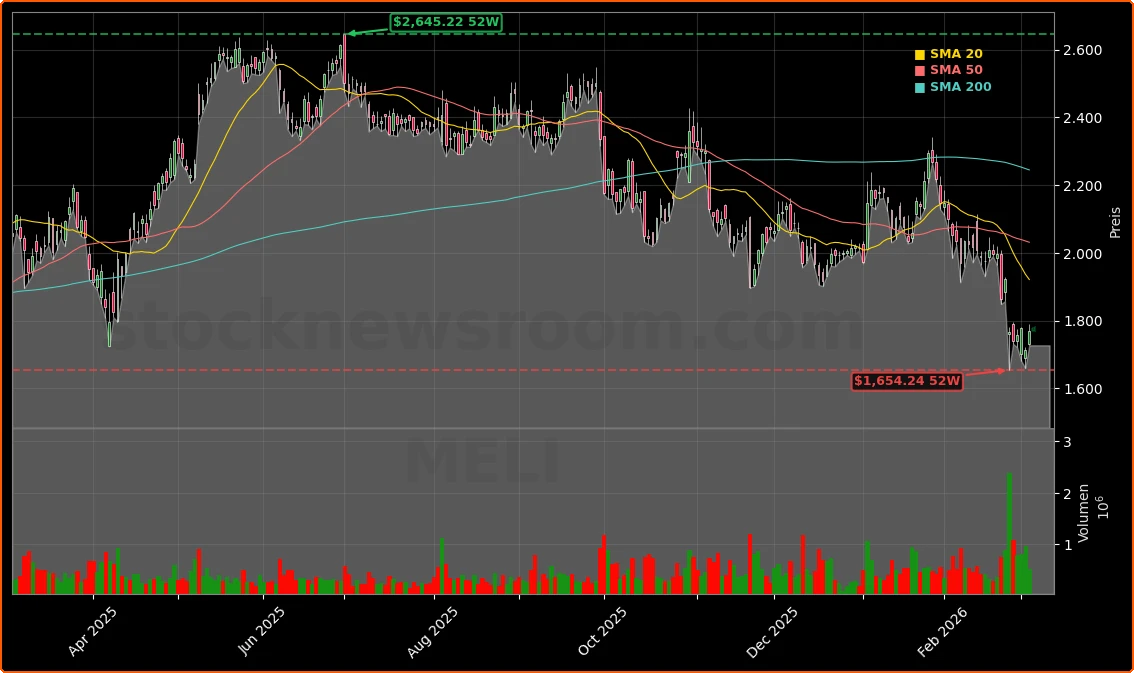
At around $1,769 per share in Thursday’s pre‑market session, MercadoLibre, Inc. sits well below the roughly $1,990 level seen in mid‑February and meaningfully under consensus analyst price targets near $2,785. Over the last 12 months the stock is down about 14%, lagging the S&P 500 despite another year of rapid top‑line expansion. The latest quarter highlighted the core tension inside the current MercadoLibre Strategy: revenue surged 44%–45% year over year to about $8.8 billion, but net income fell 12.5% to $559 million and missed Wall Street’s earnings expectations.
This divergence between sales and earnings is what has driven the recent re‑rating. Investors paying a premium multiple for a high‑growth platform want to see operating leverage, not margin compression. Instead, the company is deliberately leaning into heavier investment – cheaper shipping, more credit risk, tech infrastructure such as AI – to defend and expand its moat across Latin America. That choice has near‑term consequences for EPS, but it could also set up a much more dominant ecosystem if executed well.
Importantly for U.S. portfolios, MELI remains a mid‑cap by Latin American standards but a large‑cap tech and consumer name by NASDAQ standards, with institutional ownership above 87%. That means its volatility and execution are increasingly relevant for global growth and EM allocations, much like what Tesla and Apple represent in their respective domains for U.S. investors.
MercadoLibre Strategy vs. Latin American Macro and Competition
The investment case for MercadoLibre still starts with its structural tailwinds. Latin America continues to trail the U.S. and other developed markets in both e‑commerce and digital finance penetration, a gap management estimates at nearly a decade. That creates a long runway as consumers shift from cash and physical retail to digital platforms. MercadoLibre operates an integrated ecosystem: its flagship marketplace, the Mercado Pago payments and fintech arm, the Mercado Envios logistics network, digital asset management via Mercado Fondo, and a growing credit book under Mercado Credito.
The competitive backdrop, however, has intensified. Regional and global e‑commerce platforms, including Shopee and other international players, have been pushing into key geographies like Brazil and Mexico with aggressive promotions and low‑cost delivery, echoing how NVIDIA and other chip leaders have forced peers into heavy capex cycles. In response, the current MercadoLibre Strategy lowers near‑term profitability to reinforce user habits and raise switching costs.
One of the most visible changes was lowering the free‑shipping threshold to cover more items and customers. That directly pressures gross margin via higher logistics subsidies, but it also accelerates gross merchandise volume (GMV). In the most recent quarter, GMV grew 37% year over year on a currency‑neutral basis, a strong signal that these incentives are indeed driving higher activity. Yet investors are scrutinizing whether this growth is quality growth – i.e., sustainably monetizable – or whether it will fade once subsidies normalize.
On top of that, management is pushing hard in credit and digital banking. In a region where millions are underbanked or unbanked, that could be a multi‑decade opportunity, but it also introduces credit‑cycle risk just as economic conditions in key markets like Argentina remain volatile. Bad loans have already weighed on the stock over the past year, and how the company manages credit discipline from here will be critical to how MercadoLibre Strategy is ultimately judged.
MercadoLibre Strategy: Ecosystem Flywheel or Margin Trap?
At the core of MercadoLibre Strategy is the idea of an ecosystem flywheel. The company wants more buyers, more sellers, more engagement, and more financial relationships feeding each other. Recent operating metrics suggest that, at least so far, this is working. Unique active buyers climbed 24% year over year in the latest quarter, and items sold jumped 43%. On the fintech side, monthly active users grew 27%, while assets under management soared 78%. Total payment volume increased 53% year over year.
This behavior mirrors the trajectories investors have seen in other platform champions like Apple or Tesla: once customers are pulled into the ecosystem – whether through digital wallets, installment loans, or loyalty programs – they tend to become more frequent users of the marketplace. In MercadoLibre’s case, financial services customers are increasingly overlapping with active marketplace shoppers, raising lifetime value per user and improving data quality for risk scoring and personalization.
The risk is that building and reinforcing this flywheel requires heavy upfront spending. Logistics investments, shipping subsidies, AI‑driven recommendation engines, and credit underwriting systems all demand capital and operating expense. That is why the company’s net income dipped year over year despite a near‑50% boost in revenue. Investors must decide whether they are comfortable seeing MercadoLibre Strategy prioritize scale and penetration at the expense of short‑term returns on equity.
For long‑term investors with a 5‑ to 10‑year horizon, the argument in favor is straightforward: the addressable market is vast, the company already enjoys network effects, and management has shown a willingness to trade quarterly optics for strategic positioning. However, for short‑term holders and more valuation‑sensitive funds, this same strategy can look like a margin trap if macro headwinds persist or competitive intensity escalates further.
MercadoLibre and Fintech: Credit Risk vs. Banking Upside
The fintech dimension is increasingly central to MercadoLibre Strategy and to how Wall Street values the stock. Mercado Pago started as a payments facilitator but has evolved into a broader financial services platform. It now encompasses digital wallets, investment products, merchant acquiring, and a growing credit portfolio. In Q4, total payment volume grew more than 50% year over year, evidence that the platform continues to deepen its role in everyday transactions.
One pivotal next step: the planned launch of full digital banks in Mexico and Argentina, two of the company’s largest and most strategically important markets. If successful, these digital banks could unlock a range of higher‑margin products – deposits, savings, credit cards, small business loans – and increase customer stickiness. For U.S. investors, this shift is somewhat analogous to a high‑growth fintech like SoFi aspiring to become a top‑tier bank, aiming for a diversified stream of net interest income layered on top of fee‑based businesses.
Yet the downside is that credit losses can quickly eat into profits, especially in emerging markets with volatile currencies and inflation. Non‑performing loans have already drawn investor concern. The message from management is that they see this as a calculated risk with substantial upside if underwriting models continue to improve and economic conditions in countries like Argentina and Venezuela stabilize. The market, however, is treating this as a “show me” story, where future credit quality data will carry more weight than forward‑looking assurances.
From a portfolio‑construction standpoint, U.S. investors should recognize that MELI’s fintech exposure adds an extra layer of cyclical and regulatory risk on top of its e‑commerce sensitivity. That makes it less of a pure consumer‑internet play and more of a hybrid between an online marketplace and an emerging‑markets bank, which can justify both a higher upside and a higher risk premium compared with large U.S. peers.
MercadoLibre and Institutional Flows: What Smart Money Is Signaling
Recent institutional activity offers another lens on MercadoLibre Strategy. Kemnay Advisory Services, which first bought MELI back in 2020 and had been gradually trimming its position for years, reversed course over the past four quarters and recently added another 1,385 shares in Q4, bringing its stake to 5,623 shares. The firm now allocates about 1.7% of its 13F assets to MELI, signaling renewed conviction after the stock’s pullback since spring 2025.
Other large players, including CI Investments and Insigneo Advisory Services, have also increased their positions, while Fisher Asset Management made only a modest reduction and still holds a sizeable stake worth roughly $177 million. Overall, institutional ownership sits close to 88%, a high figure that underscores MELI’s role as a core holding in global growth and Latin America‑focused mandates.
On the sell‑side, analysts broadly remain constructive despite the recent earnings miss. Multiple research shops rate the stock a “Moderate Buy,” with an average price target around $2,785, implying significant upside from current levels. While specific banks such as Citigroup, Morgan Stanley, or RBC Capital Markets have adjusted individual targets in response to margin trends, the consensus view still treats MercadoLibre as a top‑tier growth story with a rare combination of scale and runway.
For U.S. investors, this mix of high institutional ownership, supportive analyst sentiment, and a stock that has corrected about mid‑teens from a year ago can be attractive – but it also means that disappointment on margins or credit quality could trigger sharp, fast drawdowns as crowded positions adjust. Position sizing and risk management, therefore, are as important as conviction in MercadoLibre Strategy itself.
Valuation, Risk and the Investment Case for MercadoLibre
Valuing MELI today requires balancing robust growth metrics against compressing margins and macro risk. With revenue up roughly 45% year over year and earnings still positive though down about 12.5%, the company fits neatly into a Growth at a Reasonable Price profile. Some equity research platforms score MercadoLibre highly on growth and profitability and see its overall valuation as not excessive relative to peers, particularly when compared with richly valued U.S. e‑commerce names.
On a forward basis, the stock trades at a premium to traditional retailers and many regional banks but at a discount to some high‑growth U.S. internet and fintech names when adjusted for growth rates. The company’s profitability metrics remain solid despite recent compression, and its balance sheet is generally viewed as sound, with manageable leverage. That combination has led some market observers to highlight MELI as a measured way to capture long‑term growth in Latin American consumer and financial digitization.
Risks are real and should not be minimized. Competition from global and regional platforms, the possibility of further deterioration in credit quality, currency volatility, regulatory shifts in key markets, and macro instability in countries like Argentina all pose ongoing challenges. Any stumble in execution – for example, overly aggressive loan growth or mis‑priced shipping subsidies – could prolong margin pressure and force a strategic reset.
That said, the long‑term narrative is compelling: MercadoLibre has built one of the most advanced e‑commerce and fintech ecosystems in the developing world, with strong user growth, a differentiated logistics network, and expanding financial capabilities. For investors comfortable with emerging‑markets risk and multi‑year holding periods, the current dislocation in the share price may present an attractive entry point into a dominant platform that could look much larger and more profitable a decade from now.
Conclusion
Ultimately, the success of MercadoLibre Strategy will be judged on whether management can convert today’s heavy investment in shipping, credit, and AI into expanding margins and durable cash flow once the growth phase matures. That path will not be linear, but for patient investors, the risk‑reward profile still tilts positive.
Further Reading
- MercadoLibre, Inc. (MELI) Stock Price, News, Quote & History (Yahoo Finance)
- 2 Monster Stocks to Hold for the Next 10 Years (The Motley Fool)
- 1 Stock Down 14% to Buy on the Dip (The Motley Fool)
- Insigneo Advisory Services LLC Increases Stake in MercadoLibre, Inc. (MarketBeat)