Is the latest Merck KGaA Forecast a temporary setback before new growth, or the start of a longer earnings squeeze?
Merck KGaA Forecast: What the 2026 Guidance Really Signals for Investors
Merck KGaA is preparing investors for what it openly calls a difficult transition year in 2026. The company now expects group revenue of EUR 20.0–21.1 billion, implying at best a flat top line versus the EUR 21.1 billion reported for 2025 and, on a reported basis, potentially a modest decline. More importantly for equity holders, the guidance for adjusted EBITDA of EUR 5.5–6.0 billion points to an earnings drop of up to roughly 9.8% from the 2025 level of EUR 6.1 billion.
This downbeat Merck KGaA Forecast contrasts with the modestly positive organic trends the group just delivered. In 2025, revenue slipped 0.3% in reported terms, but organic growth – excluding currency and portfolio effects – reached 3.1%. Adjusted EBITDA ticked up 0.6% year on year, and net income landed a little over EUR 2.6 billion, down about 6%. The operating performance was broadly in line with sell‑side expectations, but the guidance reset clearly disappointed.
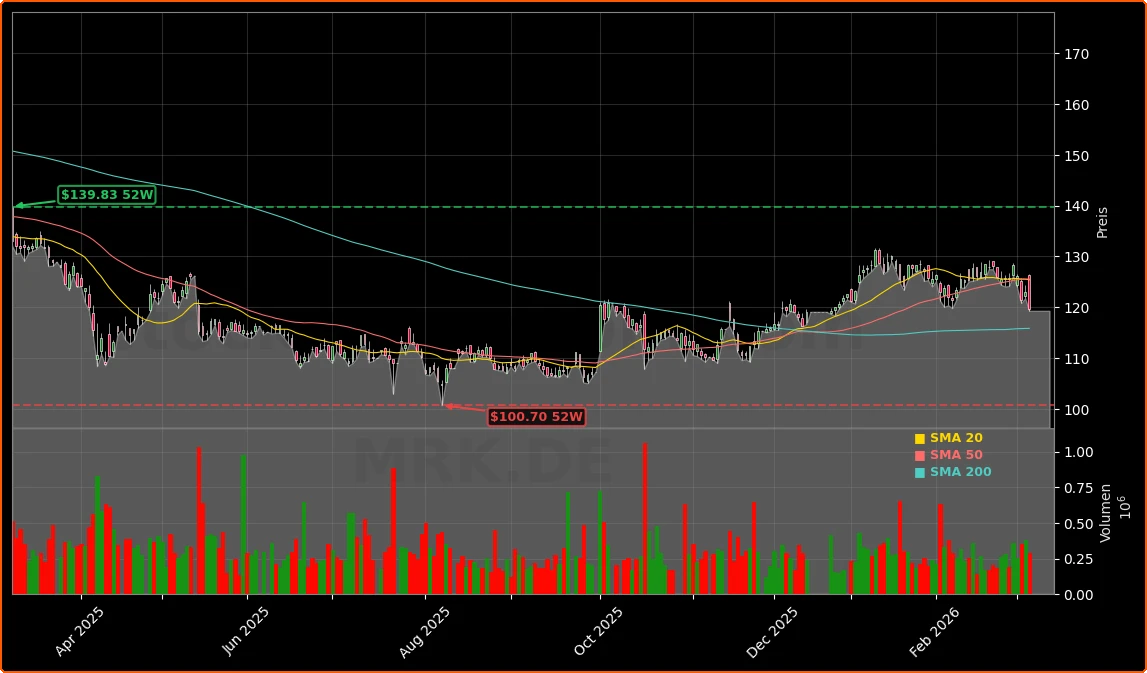
On Thursday, the shares traded around EUR 119–121 (MRK.DE), roughly 15–16% below the 52‑week high of EUR 142.45 and off the year’s lows near EUR 100.70. The intraday swing – an early drop toward EUR 114 in off‑exchange trading followed by a quick recovery – underlines how sensitive the stock has become to forward‑looking commentary. For U.S. investors evaluating Merck KGaA alongside large-cap pharma such as Apple’s healthcare partners, NVIDIA-driven chip beneficiaries and big pharma names listed on the NYSE, the new guidance is the key input for near‑term positioning.
Two factors dominate the Merck KGaA Forecast narrative: FX headwinds and the loss of U.S. Mavenclad exclusivity. Roughly one quarter of the group’s revenue is generated in the United States, and a significantly weaker dollar – amid heightened trade frictions and tariff uncertainties – directly translates into lower reported sales and earnings in euros. Management again flags “substantial” FX headwinds for 2026 after the dollar and Asian currencies already cut into 2025 results.
Merck KGaA in Global Context: How Does It Stack Up Against U.S. Pharma Peers?
From a Wall Street perspective, Merck KGaA occupies an unusual space. It is a diversified science and technology conglomerate combining a prescription drug business (Healthcare), a high‑margin laboratory and process solutions arm (Life Science), and a cyclical electronic materials division serving semiconductors and displays (Electronics). That makes it structurally different from pure-play U.S. pharma companies like Merck & Co., Johnson & Johnson or Gilead Sciences, even though investors often lump them together.
Recent research comparing Gilead Sciences with peers highlighted how some big U.S. drugmakers are dealing with patent cliffs while still posting attractive operating margins and free cash flow. Merck & Co. itself, for example, continues to see strong growth from its oncology franchise, with Keytruda and multiple late‑stage assets underpinning bullish long‑term projections. Several U.S. asset managers, including Victory Capital Management and Miramar Capital, have recently increased positions in Merck & Co. while maintaining a “Moderate Buy” consensus rating with an average Wall Street target around $125–$126 per share.
By contrast, the Merck KGaA Forecast currently signals a temporary earnings step‑down before new growth drivers can fully compensate the loss of Mavenclad. The German group guided 2026 as a year where reported revenue may only match or undershoot 2025 levels despite underlying demand growth in pharma and life science. The drag comes from U.S. generics, FX and delayed customer projects in Electronics. This sets expectations lower than those for faster‑growing U.S. large caps, but also limits downside if the company executes on its diversification strategy.
Notably, Merck KGaA is positioning itself as one of the few European names directly leveraged to the global AI and semiconductor capex wave that Wall Street has celebrated through stocks like NVIDIA and other chip names. For investors who already own high‑beta AI hardware leaders, Merck offers a more defensive, cash‑generative way to access similar end‑markets, albeit with its own industry‑specific risks.
Merck KGaA Healthcare: Mavenclad Patent Expiry and the Search for New Growth
The most immediate fundamental swing factor in the Merck KGaA Forecast is Mavenclad, its oral therapy for multiple sclerosis. The company assumes that from March 2026 onward it will generate essentially no U.S. revenue from Mavenclad because of generic competition following patent expiry. Management has explicitly removed Mavenclad U.S. sales from its 2026 targets, which some analysts at UBS described as making the guidance look weaker at first glance, even though it may be conservative by design.
Mavenclad generated EUR 1.2 billion in global sales in 2025, with North America contributing roughly half of that total. Losing such a cash cow is non‑trivial, especially given the high margin profile of specialty neurology drugs. Investors should expect a visible hit to Healthcare’s profitability as U.S. prices come under pressure and volume shifts to cheaper generics.
Merck KGaA is not standing still, however. The company has been building a pipeline focused on oncology and rare diseases, most notably via the roughly $3.9 billion acquisition of U.S. biotech SpringWorks Therapeutics. That deal is intended to strengthen a newly defined rare‑disease and oncology franchise that, over time, could help offset part of the Mavenclad shortfall. Management has described SpringWorks as a key growth driver for the coming decade, with an emphasis on niche indications and high unmet medical need.
Another potential upside lever to the Merck KGaA Forecast is Pergoveris, a fertility treatment for assisted reproduction. A request for accelerated review is pending with U.S. regulators, but Merck has deliberately excluded any positive contribution from a possible U.S. launch in its 2026 projections. This conservative stance creates optionality: if approval comes through earlier than expected, consensus estimates may have to move up.
For U.S. investors used to watching Merck & Co. navigate the long‑dated Keytruda patent risk, the Mavenclad situation offers a smaller but more immediate version of the same theme: the need for well‑timed pipeline execution and strategic M&A to bridge an earnings gap. The near‑term hit at Merck KGaA looks contained but visible; the medium‑term recovery will depend on how successfully SpringWorks assets and other candidates scale.
Merck KGaA Life Science and Electronics: FX Headwinds Versus AI Tailwinds
Beyond Healthcare, the 2026 Merck KGaA Forecast highlights a more nuanced picture in Life Science and Electronics. The Life Science division – supplying equipment, reagents and process solutions to pharma and biotech clients – saw a clear recovery in 2025 after a post‑pandemic digestion phase. Demand for products linked to drug manufacturing and development picked up, supporting the group’s organic growth.
In Electronics, the story is more complex. Merck KGaA is a key global supplier of specialty materials and chemicals for semiconductor and display manufacturing, and it has played a central role in the development of LCD technology over decades. Management reports that demand tied to artificial intelligence and rising memory chip prices is now driving a double‑digit growth trend in semiconductor materials, with a “very positive” outlook flagged for the coming year.
However, this upside has been partly masked by timing issues. Several large customer projects have suffered delays, causing the Electronics division to post significantly lower revenue in 2025 versus the prior year despite the AI boom. The guidance for 2026 implicitly assumes that these projects gradually normalize, but the group still faces FX pressure because a substantial portion of Electronics revenue is denominated in dollars and Asian currencies.
The net effect on the Merck KGaA Forecast is that Life Science and Electronics provide credible medium‑term growth vectors but cannot fully neutralize the short‑term drag from Mavenclad and FX. For investors who are bullish on the broader AI and semiconductor capex cycle yet wary of the volatility in high‑flying hardware names like Tesla’s suppliers or NVIDIA itself, Merck offers an alternative way to play that theme with a more diversified earnings base and a sizeable dividend yield.
Merck KGaA Management, Dividend and Analyst Views: How Is the Market Reacting?
The upcoming leadership change is another important element in how markets interpret the Merck KGaA Forecast. CEO Belen Garijo, who took the helm in May 2021 and steered the group through the COVID‑19 period and multiple acquisitions, will leave at the end of April to become CEO of Sanofi. Her successor, Kai Beckmann, currently runs the Electronics division and has deep experience in the semiconductor and materials business – a signal that the supervisory board wants to emphasize the growth potential of that segment over the next decade.
Despite the lower earnings outlook, Merck KGaA plans to keep its dividend stable at EUR 2.20 per share. At the current price near EUR 120, that implies a forward dividend yield of roughly 1.8–1.9%, below some high‑yield U.S. pharma names but acceptable given Merck’s balance sheet strength and diversified cash flows. For income‑oriented investors who already own strong dividend names on Bank of America’s US1 list and similar quality baskets, Merck could function as a complementary European holding with a more industrial tilt.
On the sell‑side, initial reactions to the guidance have been mixed. JPMorgan analyst Richard Vosser explicitly noted that the outlook sits below prior market expectations and predicts that consensus estimates will need to be revised downward. UBS analysts commented that the guidance looks “a bit weak” at first, while pointing out that Mavenclad has been removed from the internal targets, making the underlying forecast less alarming than headline numbers suggest. Both perspectives reinforce the view that Merck is bracing investors for a reset year rather than signaling structural deterioration.
At the trading desk level, some European strategists describe Merck as a kind of “anti‑DAX” stock: when the German blue‑chip index sells off sharply, Merck often holds up relatively well because of its defensive business mix and global footprint. Technical analysts in the region currently see fair value in a trading range centered around EUR 120, with downside support in the EUR 113–115 area and medium‑term upside potential toward EUR 135–140. Those levels roughly translate into a favorable risk‑reward profile: about 10% downside to key support versus 15–20% upside to the range of many 12‑ to 18‑month targets.
For U.S. dollar‑based investors, it is worth noting that the recent dollar weakness, which pressures Merck KGaA’s reported earnings, simultaneously makes the euro‑denominated shares cheaper in dollar terms. That currency dynamic cuts both ways: prolonged FX headwinds can suppress EPS growth but can also create more attractive entry points if one expects eventual mean reversion in exchange rates.
Given the combination of a conservative Merck KGaA Forecast, a stable dividend, and exposure to secular growth in pharmaceuticals and semiconductors, the name is likely to stay on the radar of global value and quality‑growth managers. Institutional ownership remains high, mirroring the situation at Merck & Co., where more than three quarters of shares are held by professional investors, underscoring the appeal of large, diversified healthcare platforms in institutional portfolios.
Conclusion
Overall, the updated Merck KGaA Forecast paints 2026 as a year of consolidation and portfolio rebalancing rather than one of aggressive growth. For long‑term investors, the key questions are whether SpringWorks and other pipeline assets can fill the Mavenclad gap, how fast delayed semiconductor projects ramp back up, and whether the incoming CEO can deliver on the promise of the Electronics and Life Science franchises. While near‑term earnings momentum will be under pressure, the structural positioning in high‑value pharma niches and AI‑linked materials, combined with a disciplined capital allocation and a defended dividend, suggests that the current weakness could evolve into a strategic accumulation opportunity rather than a reason to exit.
Further Reading
- Merck KGaA (MRK.DE) Quote and Profile (Yahoo Finance)
- How Does Gilead Sciences Stock Stack Up Against Its Peers? (Trefis)
- Victory Capital Management Inc. Has $397.27 Million Stake in Merck & Co., Inc. (MarketBeat)
- Merck & Co., Inc. Stock Price Down 1.4% – Should You Sell? (MarketBeat)