Can Meta’s $27 billion Nebius bet and fresh 20% job cuts really buy it a lead in the AI infrastructure arms race?
How does Nebius reshape Meta AI Infrastructure?
Meta has signed one of its largest single technology contracts ever, locking in up to $27 billion of specialized AI cloud capacity from Netherlands-based Nebius over five years. The deal calls for $12 billion of dedicated AI computing capacity to be delivered starting in early 2027, using large-scale deployments of NVIDIA’s Vera Rubin platform across multiple data center locations. Meta has also committed to buy up to an additional $15 billion of capacity that Nebius plans to sell to third parties if that demand fails to materialize, effectively giving Meta a right of first refusal on incremental compute.
The agreement is a cornerstone of Meta AI Infrastructure strategy, which already spans in‑house chips, massive greenfield data centers in the U.S., and external partners such as AMD and Nebius. For Nebius, the contract validates the so‑called “neocloud” model, where AI‑first data centers compete directly with hyperscalers for the most compute-hungry workloads.
Why is Meta cutting up to 20% of jobs now?
At the same time, Meta is preparing what could be its biggest restructuring in years. Internal discussions point to layoffs affecting roughly 20% of the company’s nearly 80,000 employees, or around 16,000 jobs. Management has told senior leaders to plan for operating with a substantially smaller workforce, framing the exercise as a way to offset soaring AI capital expenditures that could reach $115–$135 billion in 2026 alone and as much as $600 billion cumulatively by 2028 for data centers.
The prospective cuts follow the 2022–2023 “year of efficiency,” when Meta eliminated about 21,000 positions. This new wave would be interpreted as the clearest signal yet that Meta AI Infrastructure is not just a growth story but a cost and productivity lever: roles that can be automated or streamlined by AI are being targeted, while resources are redirected to core AI research, Superintelligence Labs, and large-scale model deployment.
How are analysts reading Meta AI Infrastructure bets?
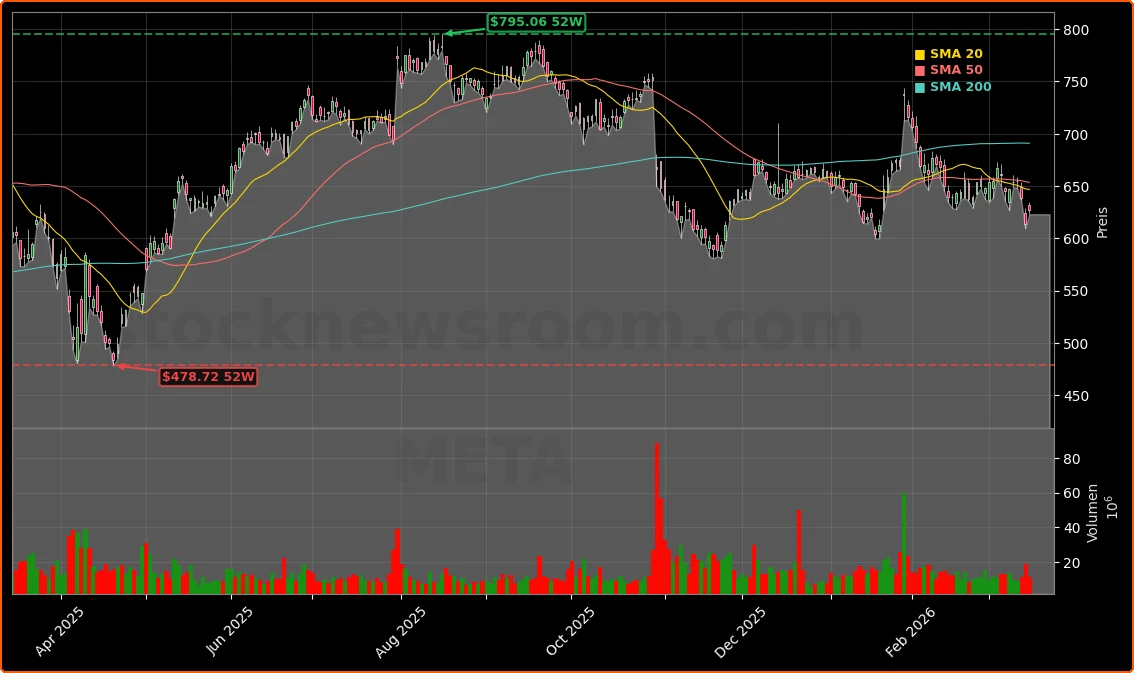
Wall Street is largely applauding the combination of heavy AI capex and aggressive cost discipline. Bank of America rates Meta “Buy” with a price target of $885, arguing that trimming 20% of staff could save $7–8 billion annually and protect margins even as AI spending accelerates. JPMorgan keeps an “Overweight” rating and an $825 target, calling Meta one of its preferred mega-cap AI names despite elevated R&D intensity versus Microsoft and Alphabet.
Other firms highlight that Meta’s four flagship apps, each with more than 2 billion users, give it unmatched ad reach to monetize new AI tools, from generative ad creation to conversational assistants. Zacks Investment Research notes that while Reddit is growing faster in some digital ad niches, Meta’s scale and balance sheet give it more room to fund an aggressive Meta AI Infrastructure roadmap without sacrificing long‑term earnings power.
What does this mean versus Alphabet and Microsoft?
Meta’s moves land in the middle of a broader hyperscaler arms race. Together with Alphabet, Amazon and Microsoft, Meta is guiding toward nearly $700 billion in combined capex in 2026, with roughly three quarters of that tied directly to AI infrastructure. Unlike Apple and Tesla, which are focused more on device ecosystems and autonomy, Meta is concentrating its spend on social‑driven AI use cases and ad-tech optimization rather than hardware.
For U.S. investors, the Nebius contract is also a read‑through for the entire AI supply chain. A multi‑year, $27 billion commitment from Meta supports demand visibility for GPU vendors like NVIDIA, networking specialists, power and cooling providers, and storage makers. Seeking Alpha and Investopedia both highlight Nebius as a major beneficiary, joining Microsoft as another top-tier customer, which reinforces the durability of the AI data center build‑out narrative on the NASDAQ and across the S&P 500 technology sector.
Conclusion
Ultimately, Meta AI Infrastructure is emerging as the company’s defining capital allocation theme: billions flowing into data centers and cloud partners, partially funded by billions of dollars in operating-cost savings from layoffs and efficiency gains. For long‑term shareholders, the key question is whether those infrastructure bets can translate into higher monetization per user faster than dilution from increased capex hits earnings. The next few quarters of guidance and any confirmation of the 20% headcount reduction will be crucial signposts for how this high‑risk, high‑reward strategy plays out on Wall Street.
Further Reading
- Meta Platforms, Inc. on Yahoo Finance (Yahoo Finance)
- Meta’s $27B AI Cloud Deal Sends Nebius Group Stock Soaring (Investopedia)
- More Big Tech Layoffs Loom as Meta Mulls 20% Cut to Its Workforce (Investopedia)
- RDDT vs. META: Which Digital Advertising Stock Has an Edge Right Now? (Zacks Investment Research)