Is Meta’s aggressive AI build-out a sustainable cash machine for investors or the start of a dangerously expensive arms race?
Meta Platforms as an AI market driver on Wall Street
Meta Platforms has quietly become one of the most important engines behind the current AI cycle on Wall Street. Together with the other US hyperscalers, Meta is part of the small group of cloud and internet giants that collectively represent roughly 70% of the AI infrastructure market. Recent industry guidance suggests that hyperscalers will lift combined capital expenditures toward the $700 billion range this year, roughly a 70% year‑over‑year increase, largely driven by AI data centers, networking, and custom silicon. Meta AI Strategy is at the center of this investment wave.
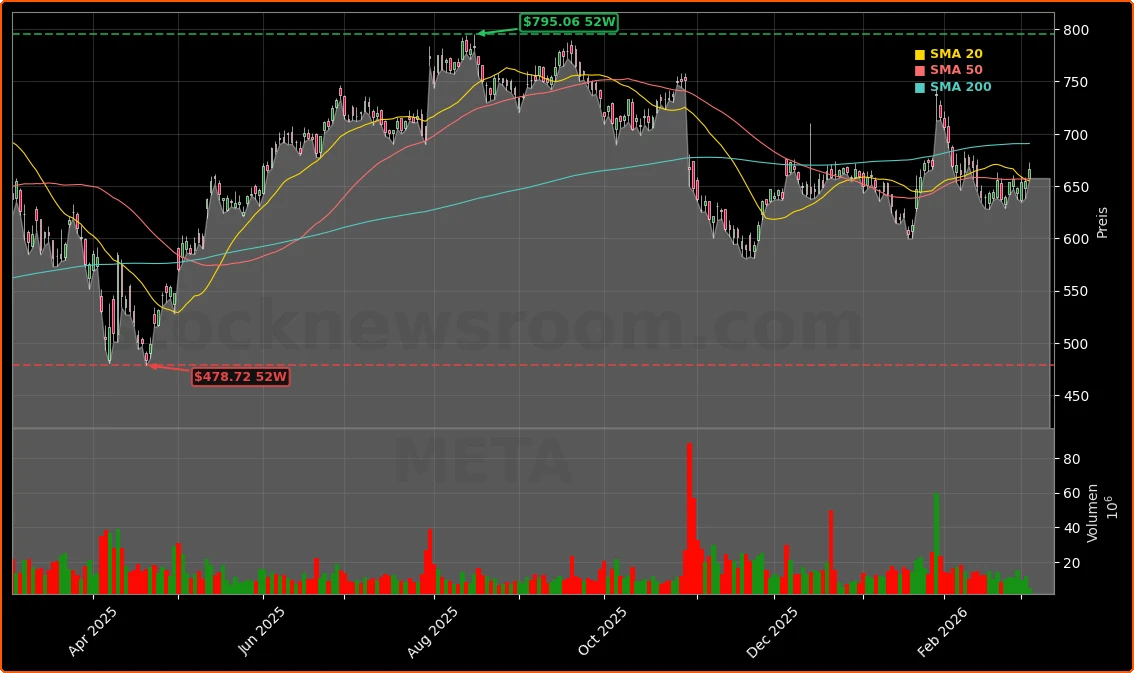
At a share price of about $666.64 versus a prior close of $655.08, Meta remains a key contributor to the NASDAQ‑100’s long‑term outperformance. Together with names like NVIDIA and other mega‑cap techs, Meta has helped fuel more than a 500% gain in the Nasdaq‑100 over the past decade. Unlike many AI narratives still in early monetization, however, Meta combines AI ambition with one of the strongest free‑cash‑flow profiles in global equity markets, making it a cornerstone of many S&P 500 and growth portfolios.
For US investors, this dual identity – high‑growth AI spender and cash‑rich platform company – is essential. A recent survey of financial researchers highlighted profitability, momentum, and value as the only equity factors expected to work consistently going forward. Meta screens well on all three: margins remain high despite heavy AI investment, the stock’s price momentum is strong, and on many cash‑flow metrics the company still looks inexpensive relative to its earnings power. That combination shapes how the Meta AI Strategy should be evaluated: not as a speculative moonshot, but as capital allocation by an already elite cash generator.
Meta AI Strategy in infrastructure: chips, capex and energy risk
The Meta AI Strategy on infrastructure has three pillars: massive compute build‑out, diversified chip partnerships, and long‑dated power security. On compute, Meta has committed to multi‑year spending that puts it shoulder to shoulder with Amazon, Microsoft, and Alphabet in the race to build out AI data centers. The company is a large customer of NVIDIA’s AI GPUs and has also emerged as a crucial partner for Advanced Micro Devices (AMD).
Several recent transactions underline this. Multiple institutional investors have highlighted Meta’s multi‑year Instinct GPU deal with AMD as a central growth driver for AMD’s data center business. Finviz reported that AMD and Meta agreed on an AI infrastructure expansion program worth over $100 billion in compute value, including up to six gigawatts of AI computing capacity and up to 160 million performance‑based warrants that give Meta the right to buy AMD shares at a discount if certain milestones are met. MarketBeat further noted that funds such as Wisconsin Capital Management and Laffer Tengler Investments increased their AMD stakes partly because of this partnership, reinforcing how central Meta is to the non‑NVIDIA AI ecosystem.
At the same time, Meta’s in‑house chip efforts have not been smooth. The company reportedly canceled development of its most advanced custom AI training chips after design challenges, pivoting instead to a simpler internal solution. This is the second AI training chip design Meta has scrapped, showing that even with partners like Broadcom, world‑class custom AI silicon is hard to execute. For investors, this has two implications: Meta is likely to remain dependent on external vendors such as NVIDIA and AMD for high‑end AI training in the medium term, and its capital intensity could remain elevated as it pays market prices for the latest accelerators.
A critical but less discussed part of the Meta AI Strategy is energy. AI data centers are power‑hungry, and Meta, Amazon, Microsoft, Alphabet, xAI, Oracle, and OpenAI are meeting at the White House to sign a commitment to build, bring, or buy their own power supply for new AI data centers. The White House emphasizes that these companies will shoulder rising AI‑related energy costs so that US households are shielded from higher electric bills. For Meta, whose demand for data centers is largely price‑inelastic with respect to energy in the next 12–24 months, this means its capex path will not be derailed by near‑term energy price swings – but long‑term opex and capex for power solutions will matter.
This is where Meta’s nuclear power bet becomes relevant. The company has signed a significant prepayment and power purchase agreement with Oklo for a future small modular reactor (SMR) project in Ohio. Under the arrangement, Meta prepays for a portion of the electricity that Oklo plans to produce, giving Oklo crucial upfront capital and giving Meta a potential long‑term, low‑carbon baseload power source for AI data centers. While Oklo is still pre‑commercial and carries regulatory and execution risk, the deal illustrates how deeply the Meta AI Strategy is intertwined with energy infrastructure, not just chips and servers.
Meta Platforms and AI content: feeding the models
Running powerful AI infrastructure is only part of the equation; it must be fed with high‑quality data. Meta AI Strategy has therefore expanded into content licensing deals to train and improve its AI models and products. A key step is the three‑year, roughly $50 million‑per‑year licensing deal with News Corp. Benzinga reports that this agreement will allow Meta to use News Corp’s journalism to power AI products and training, complementing earlier arrangements News Corp signed with OpenAI. The deal reportedly sits alongside other Meta arrangements with publishers such as USA Today, CNN, and Reuters.
This move underscores the intensifying AI content arms race among Big Tech. As regulators, courts, and publishers push back against unlicensed scraping of news and other content, formal licensing deals are becoming both a legal shield and a competitive edge. For Meta, the cost of $150 million over three years is minor in the context of tens of billions in annual free cash flow but could significantly improve the quality and breadth of its generative AI and recommendation models. It also positions Meta as a more predictable, compliant partner for media companies compared with pure scraping‑based approaches.
Beyond content, Meta is also reinforcing organizational capabilities. The company has created a new applied AI engineering team within Reality Labs, the division responsible for VR, AR, and related hardware. This team is designed to translate foundational AI work into consumer‑facing experiences across headsets, smart glasses, and potentially future AR products. Moody’s has affirmed Meta’s long‑term issuer rating at Aa3, highlighting both strong fundamentals and the company’s capacity to finance this AI push internally without compromising balance sheet strength.
Investors should note that Meta is simultaneously fighting AI‑related risks. Legal actions against scam advertisers and misuse of its platforms are ongoing, reflecting reputational and regulatory challenges tied to generative content and automated ads. The Meta AI Strategy must therefore strike a balance: aggressive model training and deployment on one side, and robust controls, detection tools, and legal enforcement on the other.
Meta AI Strategy in products: smart glasses and the next interface
The product side of the Meta AI Strategy is increasingly visible in smart glasses. The Ray‑Ban Meta smart glasses are one of the company’s clearest attempts to bring AI assistants and multimodal perception into a mainstream wearable. Early retail partners in the United States report that sell‑through has exceeded expectations. As of the latest quarter, Meta’s smart glasses are available in roughly 300 stores, with plans to reach the entire chain by the end of Q2. That rapid expansion suggests genuine consumer interest rather than a mere tech demo.
What matters for investors is not just unit volume but economics and ecosystem potential. Retail feedback indicates that the majority of Ray‑Ban Meta smart glasses sold come with prescription lenses, and most of those prescriptions attach premium lens options. Overall transaction values for a Meta AI smart glasses purchase rank among the highest in the store’s product mix. That suggests that if Meta can maintain strong partnerships with EssilorLuxottica and other optical players, its AI‑enabled eyewear could support attractive revenue per user and deepen engagement beyond the smartphone.
Strategically, smart glasses align with Zuckerberg’s long‑term vision of AR as the successor to smartphones. In that context, Meta AI Strategy is not just about serving more targeted ads on Facebook or Instagram; it is about embedding AI agents into devices that see and hear the world, enabling context‑aware assistance, real‑time translation, and content capture. If successful, this could widen Meta’s competitive moat against rivals like Apple, which is approaching spatial computing from a more premium headset angle, and Tesla, which is bringing AI into physical products like cars and robots rather than everyday wearables.
Still, the risk is significant. Reality Labs has historically been a heavy loss‑maker, and smart glasses could follow the same path if adoption slows or the hardware cycles outpace monetization. Meta’s renewed emphasis on efficiency since Zuckerberg’s so‑called “Year of Efficiency” memo – which drove layoffs, a leaner structure, and a return‑to‑office push – helps, but investors must recognize that the product side of the Meta AI Strategy remains a multi‑year, high‑uncertainty bet.
Profitability, capital discipline and valuation versus peers
From a portfolio perspective, any assessment of Meta AI Strategy must tie back to profits and valuation. Meta today is one of the most profitable companies in the world, with high free‑cash‑flow yields even after a major rebound in the share price. That puts it in a different category from many younger AI plays that are still burning cash to chase growth. In the current macro environment, where factor research points to profitability, momentum, and value as the most durable drivers of returns, Meta’s profile is attractive.
Meta’s story over the last two years also includes a cultural and financial pivot. After a period of heavy metaverse spending and investor skepticism, Zuckerberg’s “Year of Efficiency” reshaped the cost base: headcount reductions, flattening of management layers, and changes in working models. This discipline has been widely cited in Silicon Valley and may have influenced similar restructuring decisions at other tech firms. For Meta shareholders, the result has been operating leverage and the ability to fund the Meta AI Strategy while still returning capital via buybacks and potentially dividends, without the balance sheet strain seen in more leveraged peers.
Compared with other mega‑caps, Meta occupies a middle ground. It lacks the cloud dominance of Amazon Web Services or Microsoft Azure but is now a major hyperscale AI customer, shaping demand patterns for NVIDIA and AMD hardware. It does not have the integrated hardware‑software ecosystem of Apple but is pushing aggressively into an alternative interface with smart glasses. It also faces regulatory and antitrust scrutiny similar to its peers, but its business mix is still heavily advertising‑driven. Recent commentary from The Motley Fool emphasizes that Meta’s core ad business is already benefiting from AI: better targeting, improved measurement despite privacy headwinds, and more automated creative optimization. That near‑term monetization helps underpin the AI investment cycle.
Analyst sentiment reflects this constructive view. While the article flow around Meta has recently included insider sales – such as CFO Susan Li’s roughly $36.4 million stock sale through a family foundation under a pre‑arranged plan – overall assessments stress that the stock remains slightly undervalued, supported by strong fundamentals, robust cash generation, and a solid credit rating. Brokerages like TD Cowen and RBC Capital Markets have been generally positive on the broader AI infrastructure deals involving Meta, particularly its collaboration with AMD, viewing them as evidence of Meta’s commitment to staying at the forefront of AI compute rather than ceding the field to rivals.
Meta’s AI strategy blends massive infrastructure commitments, long-dated power contracts, and ambitious hardware bets, all financed by one of the strongest free-cash-flow machines in global equities.
— StockNewsroom Research
Conclusion
From a risk perspective, investors must juggle several factors: escalating capex for chips, networks, and power; execution risk in custom silicon and nuclear energy partnerships; regulatory and legal scrutiny around content and privacy; and the inherently uncertain payoff from AR/VR hardware. On the other hand, Meta’s balance sheet strength, free‑cash‑flow generation, and discipline since the efficiency pivot provide a substantial cushion. For diversified investors, especially those using structured products such as the recent Bank of Montreal Buffer Enhanced Notes linked to a basket including Meta, Microsoft, NVIDIA, Apple and Tesla, Meta remains a core AI exposure within a risk‑managed framework.
Further Reading
- Meta Platforms, Inc. (META) on Yahoo Finance (Yahoo Finance)
- Meta Platforms CFO Susan Li sells $36.4M in shares (Investing.com)
- Meta reportedly signs $50 million News Corp deal as Big Tech’s AI content arms race heats up (Benzinga)
- Meta prepayment puts spotlight on Oklo’s long-term SMR potential (Simply Wall St)
- Advanced Micro Devices, Inc. (AMD) partners with Meta for AI infrastructure expansion (Finviz)