
Can Meta’s aggressive AI strategy and Muse Spark rollout turn a $135 billion capex scare into its next growth engine?

How is Meta AI Strategy moving the stock?
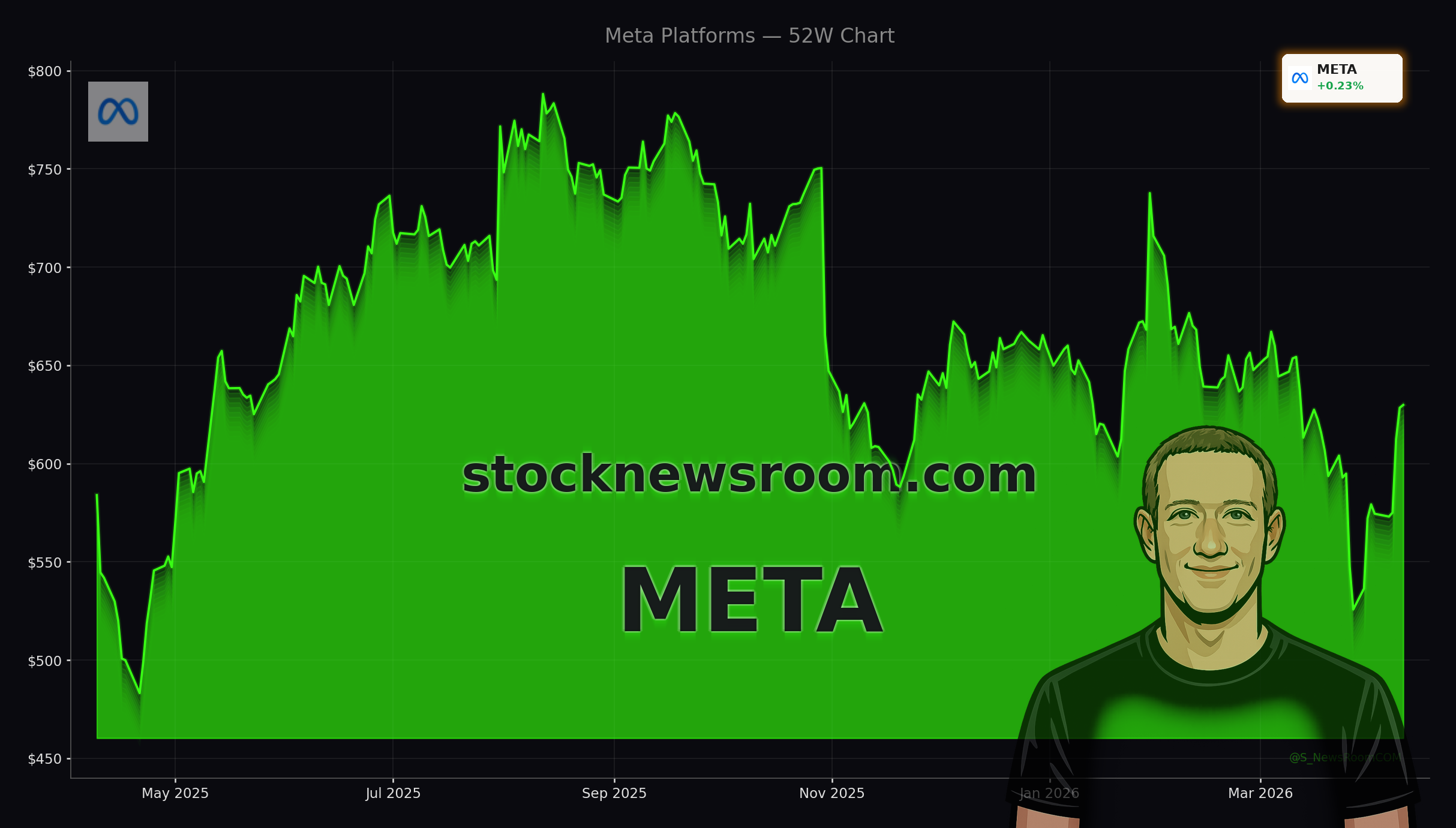
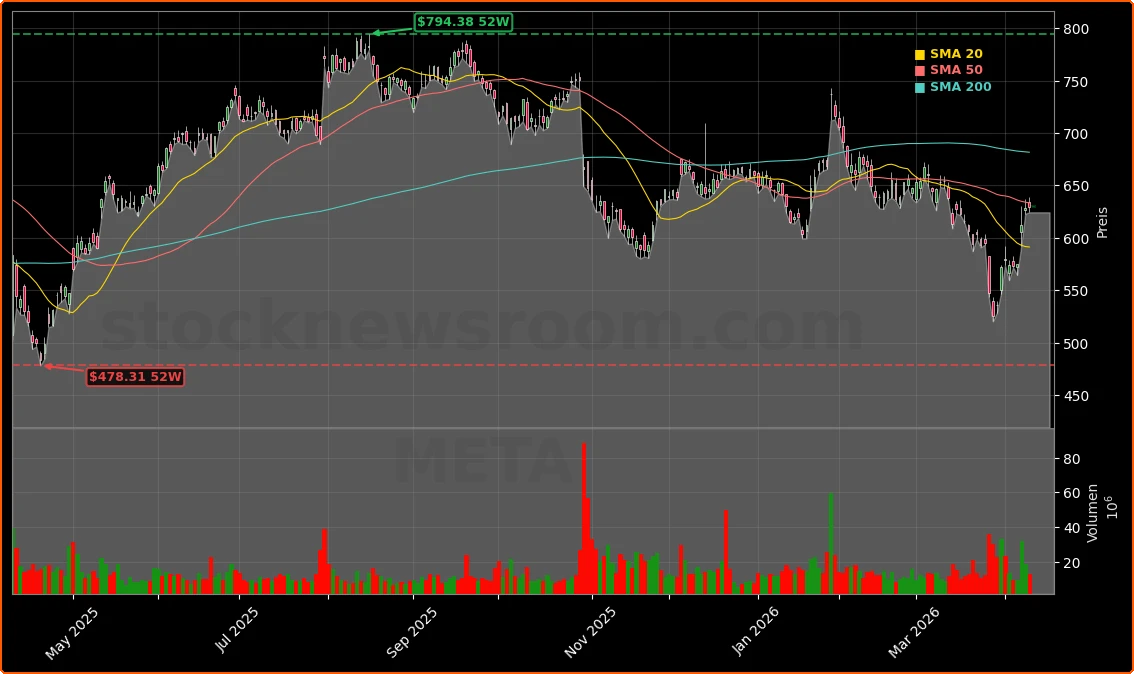
Meta Platforms, Inc. (META) closed Friday at $629.86, up 0.23% on the day and slightly higher in after‑hours trading at $630.41. That leaves the stock well off its late‑March lows but still below its early‑year peak, after a drawdown that reached roughly 20% at one point as investors balked at management’s plan for roughly $135 billion in infrastructure and AI-related spending over the coming years. The launch of Muse Spark, however, has triggered a sharp sentiment shift, with shares gaining nearly 10% across the last five sessions and outperforming the S&P 500 and Nasdaq over the same period.
Wall Street’s initial rerating of Meta in Q1 centered on fears of rising capex colliding with a potentially softer ad environment, especially among small and medium‑sized businesses that dominate its customer base. Now the Meta AI Strategy is giving traders a more concrete reason to model long‑term monetization from that spending. With 3.98 billion monthly users across Facebook, Instagram, WhatsApp, and Messenger, even modest improvements in engagement, ad conversion, or new AI‑driven services could support earnings power that justifies today’s elevated valuation relative to the broader market.
How strong is Muse Spark versus rivals?
Muse Spark, the first flagship model from Meta Superintelligence Labs, powers the standalone Meta AI app and the meta.ai website, with rollouts planned across WhatsApp, Instagram, Facebook, Messenger, and future AI glasses. Unlike the open‑source Llama family, this model is closed‑source and designed around the idea of “personal superintelligence” tightly coupled to Meta’s social and commerce graphs. On published benchmarks, Muse Spark posts an Intelligence Index score of 52 — behind Google’s Gemini 3.1 Pro and OpenAI’s GPT‑5.4 at 57, and slightly below Anthropic’s Claude Opus 4.6 at 53 — but it performs particularly well in health-related tasks and multimodal reasoning.
That profile fits the Meta AI Strategy: not chasing every benchmark crown, but emphasizing real‑world usefulness, tool use, and speed at consumer scale. The model supports visual chain‑of‑thought, multi‑agent orchestration, and efficient inference, which matters when you serve responses across billions of feeds and chats. While Muse Spark still trails leading models in some abstract reasoning and advanced coding tests, the gap has narrowed enough that typical users are more likely to notice better recommendations, smarter assistants, and richer creative tools than subtle benchmark deltas.
What does Meta AI Strategy mean for capex fears?
The core of the recent sell‑off was not a broken business model but investor discomfort with Meta’s AI buildout. Management has committed to massive spending on GPUs, data centers, and networking, partnering with suppliers like NVIDIA, AMD, Arista Networks, and neocloud provider CoreWeave. CoreWeave alone recently expanded its contract with Meta by $21 billion, underlining the scale of compute Meta is locking in for the next phase of its AI roadmap.
These commitments arrived just as macro uncertainty rose and the Federal Reserve’s path grew less clear, prompting fears that Meta could be overbuilding into a slowdown. The Meta AI Strategy is management’s answer: deploy that infrastructure not just for vanity projects but to deepen the company’s AI inference layer across ads, content ranking, commerce, and new consumer products. With 2025 revenue of $201 billion, up 22% year over year, and trailing 12‑month earnings of roughly $23.49 per share, Meta is already demonstrating that smarter AI recommendations and products like Advantage+ ads can support strong top‑line growth and robust margins.
Valuation remains a key piece of the puzzle. Meta trades around a forward P/E of 18, a discount to peers like Alphabet at roughly 23x and Microsoft at around 19.6x. For many institutional investors, that spread implies skepticism that Meta can convert today’s spend into durable, higher earnings. If the Meta AI Strategy keeps narrowing model performance gaps and improves monetization across its apps, that discount could gradually close, offering upside even without multiple expansion to “Magnificent Seven” averages.
How does Meta compare with other AI leaders?
In the AI infrastructure race, chipmakers and cloud providers like NVIDIA, AMD, Broadcom, and hyperscalers are capturing headlines and market gains. A recent AMD rally was driven in part by a major GPU supply deal with Meta, highlighting that Meta sits on the demand side of this buildout rather than selling the picks and shovels. At the same time, networking specialist Arista Networks has become a key partner for Meta’s high‑performance data centers, underscoring how the company is weaving together best‑of‑breed components rather than trying to vertically integrate every layer.
Among consumer platforms, Meta now looks better positioned than Apple or Tesla to monetize general‑purpose AI at scale, thanks to its global ad network and social graph. While other mega‑caps have leaned heavily into AI copilots for productivity or autonomous driving, the Meta AI Strategy is built around attention, engagement, and commerce — domains where small improvements in click‑through or conversion can translate into billions of dollars. For retail investors, that makes Meta closer to NVIDIA as an AI bellwether than a speculative small‑cap, but with a business model anchored in advertising and social engagement instead of chips.
Related Coverage
For a deeper dive into how Meta’s $21 billion CoreWeave agreement fits into the broader Meta AI Strategy and shapes its long‑term compute footprint, read Meta AI Strategy Boom: $21 Billion CoreWeave Bet Shocks Wall St. If you want to see how the AI buildout is affecting adjacent infrastructure players, including chip and networking leaders, take a look at Broadcom AI Forecast +4.7%: Is the AI Boom Just Starting?, which explores whether today’s AI‑driven gains leave room for another leg higher.
Muse Spark shows that the Meta AI Strategy is beginning to translate massive capex into tangible product advances and renewed investor confidence. For long‑term portfolios, Meta offers a way to own consumer‑facing AI scale at a valuation below many Big Tech peers. The next few quarters — as Muse Spark rolls across apps and new AI services emerge — will reveal whether this strategy can turn current nerves into lasting multiple expansion and earnings growth.