Is the Meta Platforms AI Strategy a visionary pivot that will pay off, or a costly gamble that reshapes the whole company?

Is Meta’s AI pivot changing the stock’s risk profile?
Meta now ranks among the most AI-exposed names in the S&P 500 communication services sector, alongside Alphabet and Netflix. Management is pouring tens of billions of dollars into AI infrastructure, custom chips and frontier models, while also restructuring its Metaverse ambitions. The Meta Platforms AI Strategy is designed to both supercharge the core ad business and reduce long-term reliance on third-party vendors and human moderators.
On the business side, Meta is already seeing tangible benefits. Across Facebook, Instagram, WhatsApp and Threads, AI-driven tools are improving ad targeting, automating campaign setup and even generating creative assets. Average price per ad rose around 9% in 2025, and the company has been converting close to 58% of revenue into operating cash flow, giving Mark Zuckerberg ample dry powder to fund AI bets. Yet that cash is now being recycled into massive capex, including hyperscale data centers and in-house AI accelerators that aim to reduce dependence on suppliers like NVIDIA.
Analysts at Barclays expect Meta, alongside Amazon, Alphabet and Microsoft, to help drive roughly $700 billion of combined AI infrastructure spending in 2026, warning that Meta’s free cash flow could temporarily drop by nearly 90%. That trade-off—near-term cash burn for long-term AI leverage—is at the core of how Wall Street is repricing big tech this year.
Will AI-driven layoffs reshape Meta’s workforce?
The most controversial element of the Meta Platforms AI Strategy is its link to potential large-scale job cuts. Reuters recently reported internal planning scenarios for layoffs affecting up to 20% of Meta’s nearly 79,000 employees. While the company dismissed the report as speculative, the logic is clear: AI tools that automate internal workflows and content review could allow Meta to operate with a significantly leaner workforce.
Bernstein analyst Mark Shmulik argued that a 20% headcount reduction would not necessarily signal distress but rather an AI-driven productivity pivot similar to recent moves at Block. For shareholders, such cuts could support earnings per share in the medium term by offsetting rising AI capex. For employees—and for regulators already skeptical of big tech’s social impact—another major downsizing tied directly to AI is likely to be a flashpoint.
Meta is also reshaping its vendor ecosystem. The company confirmed it is rolling out more advanced AI systems for content enforcement across its apps, with plans to reduce reliance on external contractors and third-party moderation vendors. New models will increasingly handle detection of terrorism content, child exploitation, drugs, fraud and scams, while Meta insists that community standards themselves are not changing. For investors this could lower long-run operating costs, but it introduces execution risk if AI systems miss harmful content at scale, especially as Meta faces a child safety trial in the U.S. accusing it of privileging profits over protection.
What happens to Horizon Worlds and the Metaverse bet?
Meta’s Metaverse strategy is also being reshaped under the weight of AI spending and user apathy. Reality Labs, home of the Quest headsets and Horizon Worlds, has posted multibillion-dollar operating losses quarter after quarter with limited traction. Meta initially announced that it would shut down Horizon Worlds’ VR version for its Quest devices by mid-June, keeping only a mobile variant alive. That move was widely interpreted as taking the foot off the Metaverse pedal to redirect resources into AI.
But after vocal pushback from the small but devoted VR community, CTO Andrew Bosworth signaled a partial reversal, saying existing VR experiences will remain available on headsets “for the foreseeable future.” The episode underscores the strategic tension: Meta can’t fully abandon a vision that drove its 2021 corporate rebrand, but investors now clearly prefer the Meta Platforms AI Strategy over another decade of Metaverse capex with uncertain payoff. Compared with Apple’s more measured spatial computing rollout and Tesla’s AI-heavy robotics ambitions, Meta appears determined to keep VR alive, yet increasingly as a side bet rather than the main story.
At the same time, Meta is leveraging its scale to secure AI infrastructure advantages. Corning recently announced a multiyear, $6 billion partnership to supply advanced optical fiber and multicore solutions for Meta’s AI data centers, indicating the size and duration of Meta’s build-out. For utilities and power suppliers like Constellation and NextEra, the resulting data-center electricity demand has been a quiet tailwind, part of the broader AI re-rating that has even pushed some utility price-to-earnings ratios above Meta’s own.
How should investors read the Meta Platforms AI Strategy?
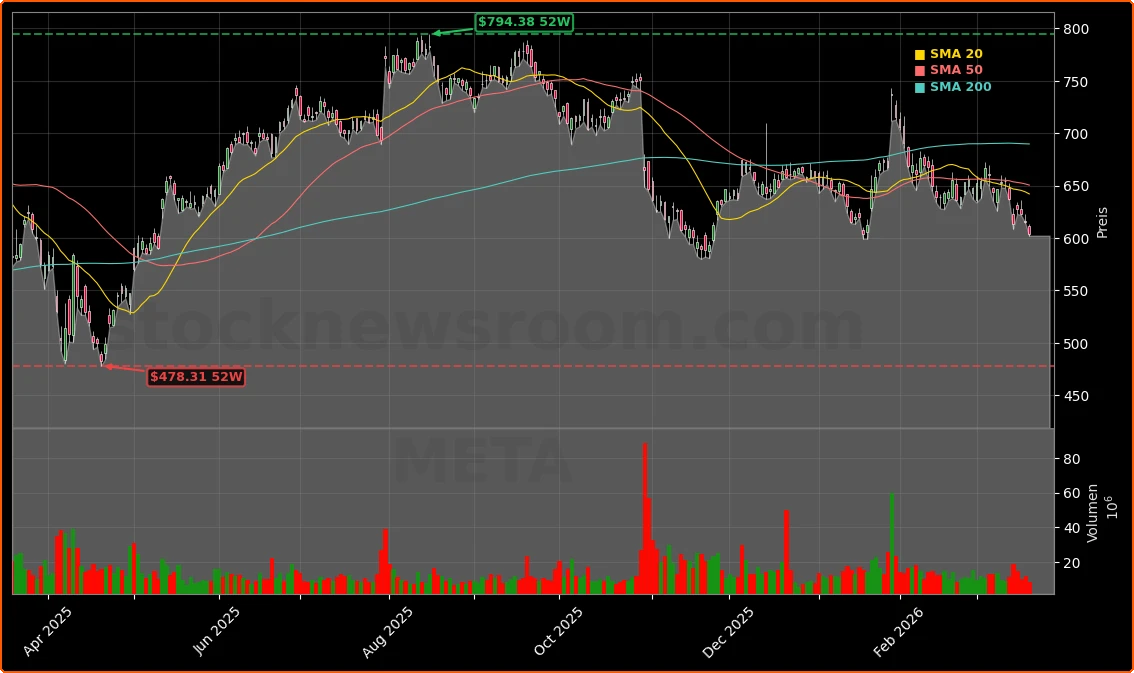
On valuation, Meta trades at a price-to-earnings multiple around the low 20s, now below richly priced infrastructure beneficiaries and closer to broader S&P 500 tech averages. Research shops such as Zacks have flagged the stock’s roughly 6x price-to-sales ratio as stretched versus its historical range, especially with free cash flow under pressure, but still see long-term upside if AI continues to boost engagement and monetization.
For long-term investors, the bull case is straightforward: Meta’s unmatched social reach—more than 3.5 billion daily active users—gives it a huge data advantage to train models like Llama and the delayed “Avocado” frontier system. Even with launch delays, many on Wall Street view slower, more careful deployment as a positive signal of quality control in a field where overhyped, undercooked AI releases can quickly backfire. If Meta successfully turns its AI stack into both a margin enhancer and a platform for new consumer experiences, the Meta Platforms AI Strategy could justify today’s valuation and more.
Related Coverage: A deeper dive into capex and workforce implications can be found in this analysis of Meta’s $27 billion Nebius bet and planned layoffs, which frames the company’s AI pivot as a high-stakes growth engine with material human costs. For a sector-level angle, this look at Palantir’s mortgage platform push shows how AI is reshaping financial services, offering a useful comparison for investors weighing cross-industry AI opportunities.
In the end, the Meta Platforms AI Strategy now defines the company more than the Metaverse ever did, combining aggressive infrastructure spending, potential workforce reductions and a pivot to AI-driven safety systems across its apps. For U.S. investors, the key question is whether these moves can sustain Meta’s cash-cow ad engine while opening new growth avenues in consumer and enterprise AI. The next few quarters of model rollouts, content enforcement performance and any confirmed layoff plans will show whether this ambitious strategy can keep Meta among Wall Street’s core long-term AI holdings.