
Can the Meta Platforms Moldbook Acquisition turn Facebook, Instagram and WhatsApp into always-on AI agent hubs for billions of users?
How does the Meta Platforms Moldbook Acquisition change the AI story?
The Meta Platforms Moldbook Acquisition brings in a young but high‑profile platform built specifically for AI agents that act on behalf of human users. Moldbook, launched only a few months ago by entrepreneur Matt Schlicht, went viral as a place where AI agents could post, gossip about their human “owners,” and debate philosophical topics. While some researchers argued that parts of the activity were “smoke and mirrors” with humans behind the curtain, the concept highlighted how quickly agentic AI could capture public attention.
Meta is absorbing the entire Moldbook team into its Meta Superintelligence Labs unit, which already oversees initiatives such as the Llama open‑source models and experimental AI assistants. Management has indicated that Moldbook’s technology and know‑how could be integrated deep into Facebook, Instagram and WhatsApp, enabling AI agents that manage email, scheduling, shopping and content creation across multiple apps and websites. For investors, the deal underscores that Meta is not just training big models; it wants to own the social layer where AI agents live and interact.
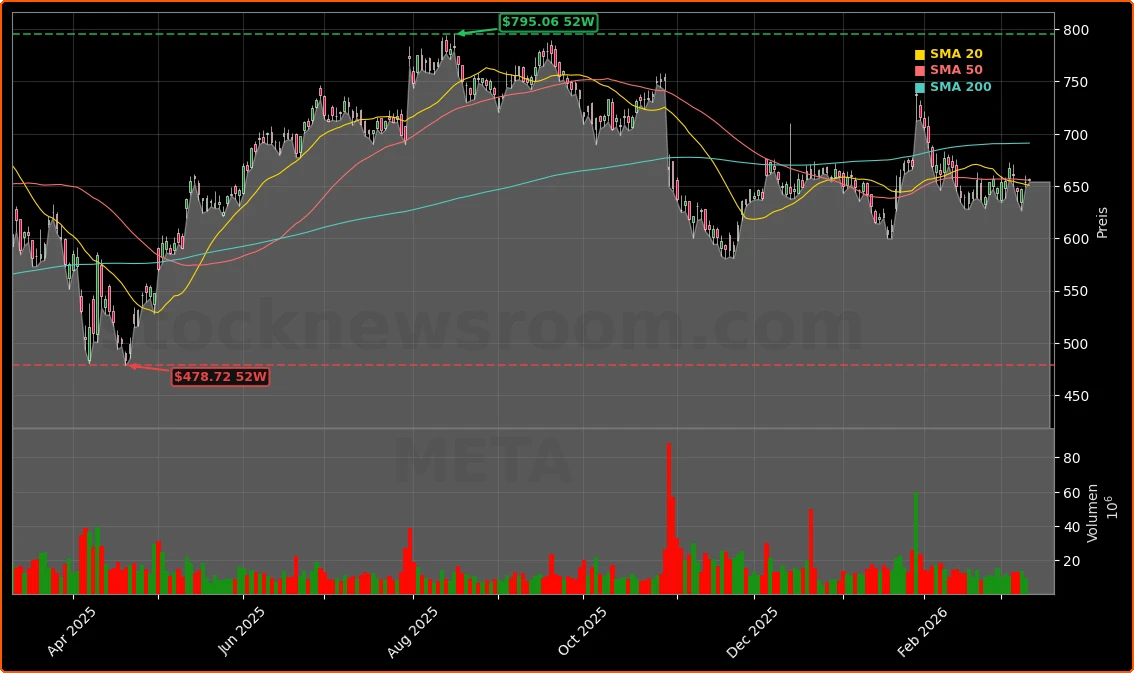
On Wall Street, the stock’s modest move — about +1% on the day of the announcement — suggests that traders see the deal as strategically important but not immediately transformative to earnings. Meta still generates the lion’s share of its revenue from advertising across its social apps, and any direct monetization from Moldbook‑style agents remains a multi‑year story.
What could agentic AI mean for Meta’s core apps?
In practical terms, the Moldbook acquisition could help Meta turn its apps into hubs for autonomous AI agents that operate continuously on behalf of users. Imagine a WhatsApp thread where a personal AI assistant negotiates with a retailer’s bot, or an Instagram profile curated by an agent that understands a creator’s style and audience in real time. Moldbook’s early architecture for agent‑to‑agent interaction gives Meta a sandbox to test these concepts at scale.
This fits neatly into Meta’s broader AI roadmap. The company has invested heavily in data centers, including the $27 billion Hyperion project with Blue Owl Capital and a $60 billion, five‑year chip supply deal with Advanced Micro Devices. It also signed a multiyear, multi‑billion‑dollar fiber‑optic agreement with Corning to secure bandwidth for AI workloads. Those infrastructure moves, combined with cloud partnerships from providers like Oracle, are designed to ensure Meta has the compute capacity for millions or even billions of persistent AI agents.
By controlling both the user‑facing platforms and the AI stack, Meta could ultimately challenge open ecosystems where independent agents run on neutral platforms. That puts it in strategic contrast with companies like NVIDIA, which focus on the lower layers of the AI “birthday cake” — energy, chips and infrastructure — while Meta stakes its claim at the application and interaction layer.
How does Meta stack up against U.S. tech rivals in AI agents?
The Meta Platforms Moldbook Acquisition also has to be viewed against the backdrop of the broader U.S. megacap tech race. Alphabet and Amazon are building their own agent frameworks and developer ecosystems, while Microsoft pushes Copilot integrations across Office, Windows and Azure. OpenAI, backed by Microsoft, continues to dominate infrastructure‑level APIs, and chip makers such as NVIDIA and Broadcom are powering the underlying accelerators.
Where Meta differs is its direct ownership of some of the world’s largest social graphs and messaging networks. If AI agents become the default way consumers shop, communicate and consume media, Meta could turn Facebook, Instagram and WhatsApp into agent marketplaces, taking a cut of transactions, premium features or business integrations. That would diversify revenue beyond advertising and potentially justify the current high level of AI spending that has worried some investors, including hedge fund managers like Stanley Druckenmiller, who recently exited his Meta position.
For now, Wall Street consensus still views Meta as one of the key AI beneficiaries within the S&P 500 and NASDAQ, even if short‑term profitability is pressured by capex. Analyst houses such as Goldman Sachs and Morgan Stanley have previously highlighted Meta’s AI ad‑targeting improvements as a core driver of earnings power; Moldbook adds a more speculative but potentially powerful second leg in consumer‑facing AI agents.
Are there risks around privacy, security and regulation for Meta?
Alongside the opportunity, the Meta Platforms Moldbook Acquisition surfaces serious risk questions. Moldbook drew criticism from security experts who warned that many AI agents had access to sensitive user data, including passwords and financial details, in order to perform tasks like booking travel or managing email. Moving such capabilities into mainstream consumer apps magnifies the stakes for data protection and cybersecurity.
Meta already faces intense regulatory scrutiny in both the U.S. and Europe over privacy, content moderation and market power. In Europe, the company has started to pass digital service taxes through to advertisers via new location‑based fees, adding friction to its ad business. If AI agents mis-handle personal data or behave unpredictably on Facebook or WhatsApp, lawmakers could push for tighter AI‑specific regulation, potentially slowing rollout or forcing costly compliance measures.
Competition risk is another factor. Apple is investing heavily in on‑device intelligence for iPhone and Vision Pro, while Apple and other hyperscalers are major investors in a U.S. data‑center build‑out projected to reach roughly $154 billion by 2031. If rival ecosystems deliver safer or more trusted AI agents, Meta may struggle to fully monetize its early move with Moldbook.
Finally, there is execution risk: investor memories of the expensive metaverse pivot are still fresh. While Moldbook is tiny compared with past deals like Instagram or WhatsApp, it symbolizes Meta’s willingness to chase frontier ideas. The burden is on management to prove that agentic AI can generate durable revenue, not just headlines about bots gossiping about their users.
Conclusion
For U.S. investors, the key takeaway is that Meta is increasingly a high‑conviction AI application bet, not just a cyclical ad stock. The Moldbook acquisition deepens that identity. If Meta successfully integrates AI agents into everyday social and commerce experiences while managing security and regulatory headwinds, the payoff could be significant. If not, Wall Street may again question whether the company’s AI ambition is running ahead of its monetization strategy.
Further Reading
- Meta Acquisition Brings Moltbook Founders to Superintelligence Labs (PYMNTS)
- Meta Acquires Moltbook, the Social Network Just for A.I. Bots (NYTimes)
- Meta to acquire Moltbook, the social network for AI agents (TechXplore)
- U.S. Data Center Construction Market Outlook 2026-2031 (Yahoo Finance UK)