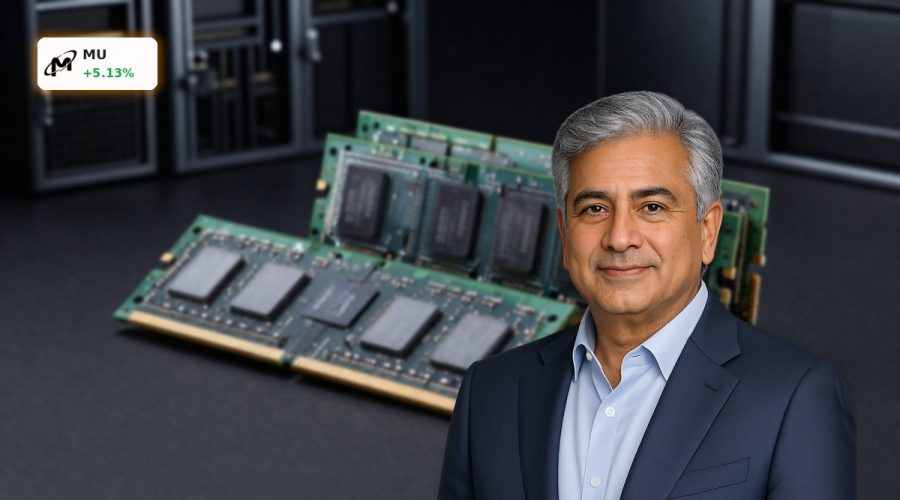
Can Micron Earnings keep powering the AI memory boom, or is today’s rally already pricing in years of growth?
How crucial are Micron Earnings for markets?
On Wall Street, Micron now trades as a core proxy for the AI infrastructure trade, alongside GPU leader NVIDIA and hyperscale data-center players. The company’s results and guidance are widely viewed as a real-time barometer for demand in DRAM, NAND and high-bandwidth memory (HBM), especially for AI servers and emerging humanoid robotics. Traders are watching Micron Earnings not just for the backward-looking numbers, but for any signal on pricing, capacity utilization and supply discipline through 2026.
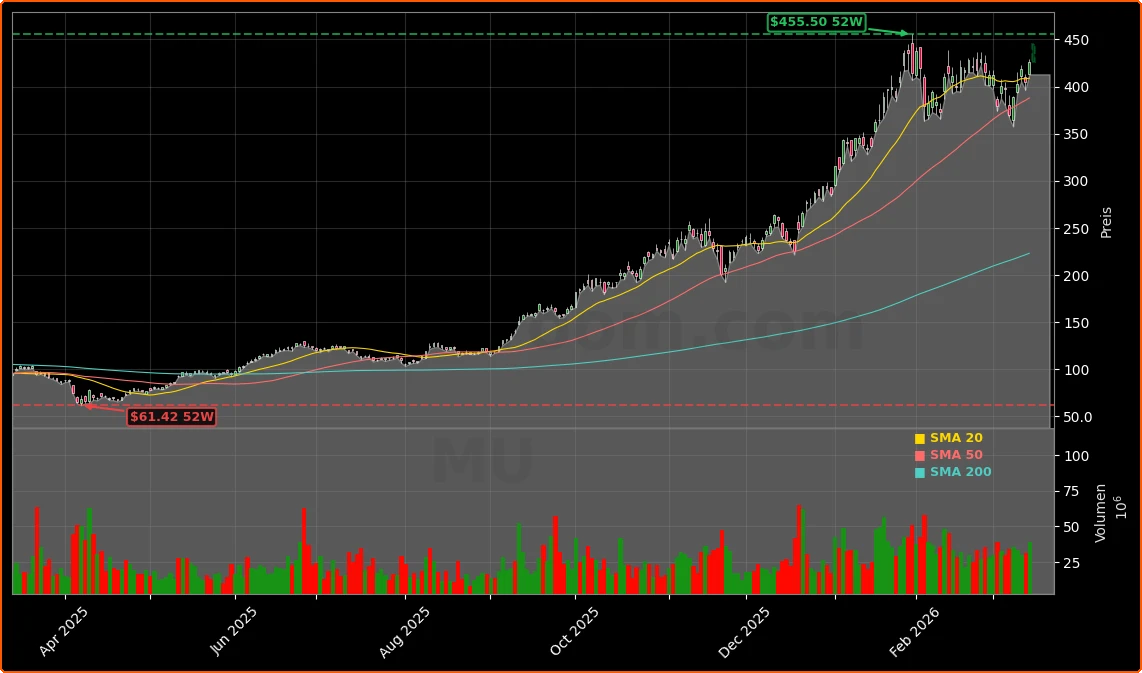
Recent trading reflects those expectations: chip and AI-infrastructure stocks have been leading the Nasdaq 100 higher, with Micron among the top gainers. Over the last year the stock has climbed more than 300%, and implied volatility suggests options traders expect another large swing after the print, with some bullish desks flagging the potential for fresh 52‑week highs if guidance surprises positively.
What is driving the AI memory shortage?
The most important question heading into Micron Earnings is whether the AI-driven memory crunch is easing or intensifying. Explosive demand for DRAM and HBM used in AI servers has pushed Micron’s recent revenue growth sharply higher, while tight supply has supported pricing power across its portfolio. Management has indicated that Micron has already sold out its HBM supply for calendar year 2026, and expects a “tight supply environment” to persist beyond that period.
The imbalance spans multiple end markets. Advanced humanoid robots and autonomous systems require high-performance memory both for compute and for persistent storage of complex information. Industry estimates suggest it could take roughly three years before Micron can fully meet demand for specialized memory used as the “brain” and “memory” of these robots. Similar constraints are affecting scale-up plans at manufacturers such as Tesla, where insufficient supply of suitable memory chips can slow the rollout of more capable robotic platforms.
How is Micron expanding capacity in Taiwan?
To address this chronic shortage, Micron is doubling down on Taiwan. The company has completed the acquisition of Powerchip Semiconductor Manufacturing Corporation’s Tongluo P5 site, gaining roughly 300,000 square feet of cleanroom space for advanced DRAM and HBM production. Micron plans to begin retrofitting immediately, targeting meaningful product shipments from the site by fiscal 2028, with a second, comparable facility expected to break ground at the same location by the end of fiscal 2026.
Investors will listen closely during Micron Earnings for updated capex timelines, expected returns and any commentary on government incentives. The Taiwan build-out is part of a broader global expansion strategy designed to support AI workloads, from cloud training clusters powered by NVIDIA accelerators to edge devices and data-rich applications at companies like Apple. While the new Taiwanese capacity will not materially contribute to revenue for several years, it underpins Micron’s claim that it can be a long-term winner in AI memory.
How does Micron stack up against SanDisk?
Another focus around Micron Earnings is the competitive race with SanDisk in the AI memory ecosystem. Both companies are exposed to the same secular tailwinds: DRAM, NAND and emerging high-bandwidth solutions that feed AI training and inference. Micron offers a diversified portfolio across DRAM, NAND flash and HBM, while SanDisk is concentrated in NAND but is working with SK Hynix on High Bandwidth Flash (HBF), a potential next-generation standard for AI inference.
Over the past 12 months SanDisk’s stock has soared roughly 12‑fold, handily outpacing Micron’s 330% gain and capturing more bullish price targets from many Wall Street analysts. Still, Micron trades at a lower forward earnings multiple, around the low teens, which some investors see as a relative value opportunity given its broader product mix and critical role in the AI server stack.
What are analysts watching in Micron Earnings?
Heading into the report, major banks such as Goldman Sachs, Morgan Stanley and Citigroup are highlighting three key swing factors: the durability of AI-related demand through 2026, the pace of margin expansion as pricing remains firm, and the risk that overexpansion could trigger another downcycle later in the decade. Several firms emphasize that Micron’s cyclicality is the main reason its valuation remains below that of faster-moving peers like SanDisk, despite similar growth trajectories.
Conclusion
For US investors, Micron Earnings will help clarify whether the stock still offers an attractive risk-reward after an extraordinary run and aggressive capacity commitments in Taiwan. A strong outlook could reinforce Micron as a cornerstone AI infrastructure holding in growth-oriented portfolios, while any hint of slowing demand or looming oversupply would likely spark profit-taking across the broader semiconductor complex.
Further Reading
- Micron Technology, Inc. (MU) on Yahoo Finance (Yahoo Finance)
- Here’s How Much Micron Stock Is Expected to Move After Earnings (Investopedia)
- Micron Doubles Down on $1.8 Billion Taiwan Plan. But This Investment Is More Important. (Barron’s)
- Micron Completes Acquisition of PSMC’s Tongluo P5 Site in Taiwan (Investing News Network)
- Should You Buy Micron Before Earnings? Here’s the 1 Thing That Matters. (The Motley Fool)