
Can Micron Earnings really justify trillion‑dollar dreams, or is AI memory euphoria setting investors up for a harsh reality check?

Can Micron Earnings match the hype?
Expectations for Micron Technology, Inc. have rarely been higher. For fiscal Q2 2026, Wall Street is looking for roughly $19.2–$19.8 billion in revenue, up from about $8.1 billion a year ago, implying growth of around 140%–150%. FactSet and other estimates cluster near $19.7 billion in sales and more than $9 in adjusted EPS, with some bullish forecasts stretching above $10 per share.
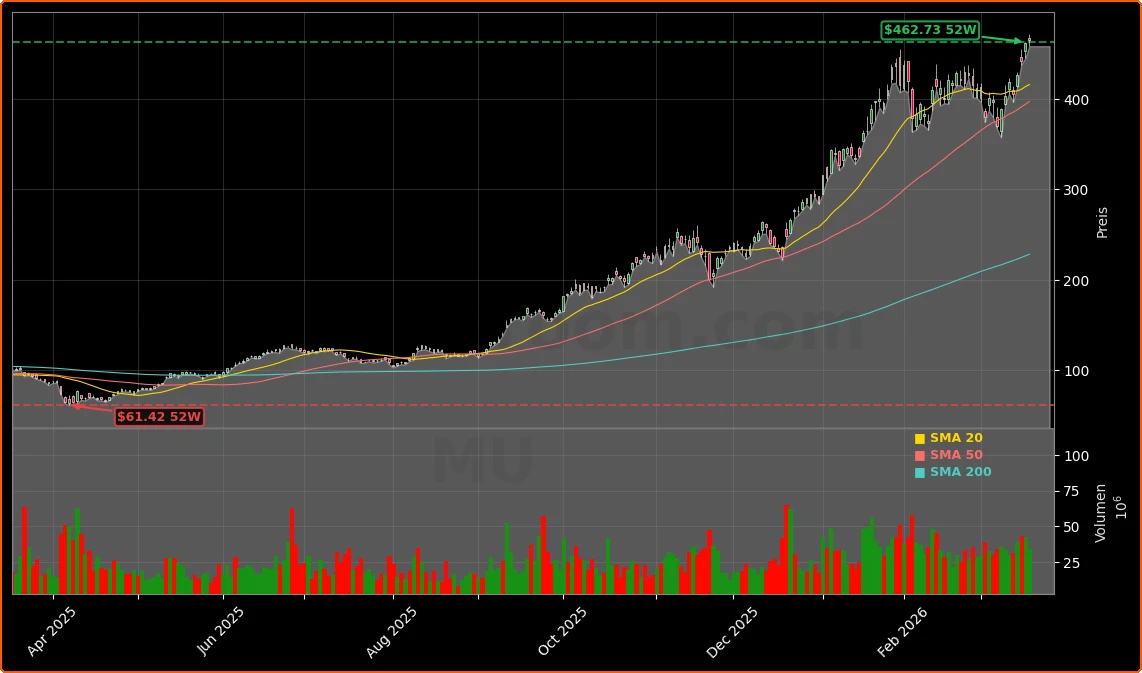
Options markets are signaling an 8%–9% implied move after the print, reflecting how pivotal Micron Earnings have become for the broader AI trade. The stock has rallied more than 300% over the past year, and its market capitalization has pushed past $500 billion, putting the memory specialist in the same conversation as mega‑cap AI infrastructure players like NVIDIA. Traders are effectively asking whether this quarter can confirm that Micron is on a sustainable path toward potentially joining the $1 trillion club in coming years.
Polymarket and other prediction venues show odds near 100% that Micron will at least beat the current EPS consensus. The real swing factor for the share price is how far management is willing to raise full‑year guidance and how long it believes current pricing strength in DRAM, NAND and especially high‑bandwidth memory (HBM) can last.
How is AI demand reshaping Micron Technology?
The backdrop for Micron Earnings is a global memory crunch driven by AI data centers. Large cloud and hyperscale customers are ramping spending aggressively as they build out clusters for generative models, autonomous agents and advanced inference workloads. Industry checks indicate that demand for HBM and high‑density DRAM is far outpacing supply, allowing Micron to command steep price increases.
Recent commentary from large cloud providers and AI leaders points to a multiyear investment wave. Amazon’s AWS unit, for example, is talking about a path toward hundreds of billions in annual cloud revenue, while Chinese and U.S. platforms alike race to train larger, more memory‑hungry models. Micron has reportedly locked in its entire 2026 HBM output with key customers, including platforms tied to next‑generation NVIDIA architectures that require multiples of the memory content of prior GPU generations.
Analysts at Deutsche Bank expect DRAM market tightness to persist through at least 2027, citing structurally higher silicon intensity in AI workloads. Meanwhile, Micron is boosting capital expenditure to expand HBM capacity, adding a second fab in Taiwan and developing its massive New York megafab for the next decade. Investors will be looking for updated capex numbers and any signs the company is willing to lean even harder into this shortage while maintaining discipline.
What are analysts expecting from Micron Technology now?
Into Micron Earnings, Wall Street’s tone is decisively bullish but increasingly cautious about expectations getting too far ahead of fundamentals. TD Cowen’s Krish Sankar, who rates the stock Buy, recently lifted his price target to $500 and projected EPS above $10 for the February quarter, well ahead of the Street. RBC Capital’s Srini Pajjuri also raised his target to $525, arguing that higher memory pricing and AI‑driven demand could support the upcycle into 2027.
Options positioning leans to the upside, with call activity outpacing puts and traders pricing a potential range roughly between $430 and $510 by the end of the week. At the same time, portfolio managers warn that the biggest risk around Micron Earnings may simply be the high bar. The stock trades at a single‑digit forward P/E on current estimates, but those estimates have been revised sharply higher for several quarters in a row. Any hint that gross margins are peaking near the high‑60% range, or that HBM pricing is plateauing sooner than expected, could trigger profit‑taking.
For U.S. investors already overweight AI beneficiaries like NVIDIA, Apple and Tesla, Micron now represents a core way to play the memory bottleneck rather than the compute chips themselves. How management frames supply risks in Taiwan, the impact of U.S. tariffs, and the trajectory of cloud and enterprise AI spending will shape not just Micron’s path, but sentiment across the entire AI‑infrastructure complex.
In summary, Micron Earnings are set to test whether the company can keep outrunning expectations in the midst of a historic memory supercycle. If guidance extends the runway for double‑digit growth and robust margins into 2027, the stock’s leadership role in the NASDAQ and S&P 500 AI trade could strengthen. The next few quarters will reveal whether Micron can turn today’s shortage and pricing power into durable cash flow that rewards long‑term shareholders.