
Are Micron Earnings signaling a durable AI memory super‑cycle or the setup for another classic semiconductor boom‑and‑bust?

How did Micron Earnings beat Wall Street?
The latest Micron Earnings for fiscal Q2 2026 easily cleared already lofty expectations. Revenue jumped to $23.86 billion, up roughly 196% from $8.05 billion a year earlier and well ahead of consensus around $20 billion. Adjusted earnings reached $12.20 per share, versus estimates in the high‑$8 to low‑$9 range, as pricing power and tight supply boosted profitability.
Micron’s gross margin roughly doubled from the prior year, landing in the mid‑70% range, helped by sharp price increases across its core memory lines. DRAM average selling prices rose by a percentage in the mid‑60s, while NAND prices climbed in the high‑70s. Operating cash flow surged to roughly $11.9 billion, underscoring how dramatically the company’s earnings power has recovered from the last downcycle.
The strong Micron Earnings report was accompanied by a shareholder‑friendly move: management raised the quarterly dividend by 30% to $0.15 per share, payable in April to shareholders of record at the end of March. For income‑oriented investors in the semiconductor space, that signals confidence that current cash flows are sustainable even as spending ramps.
Why did Micron stock fall after record results?
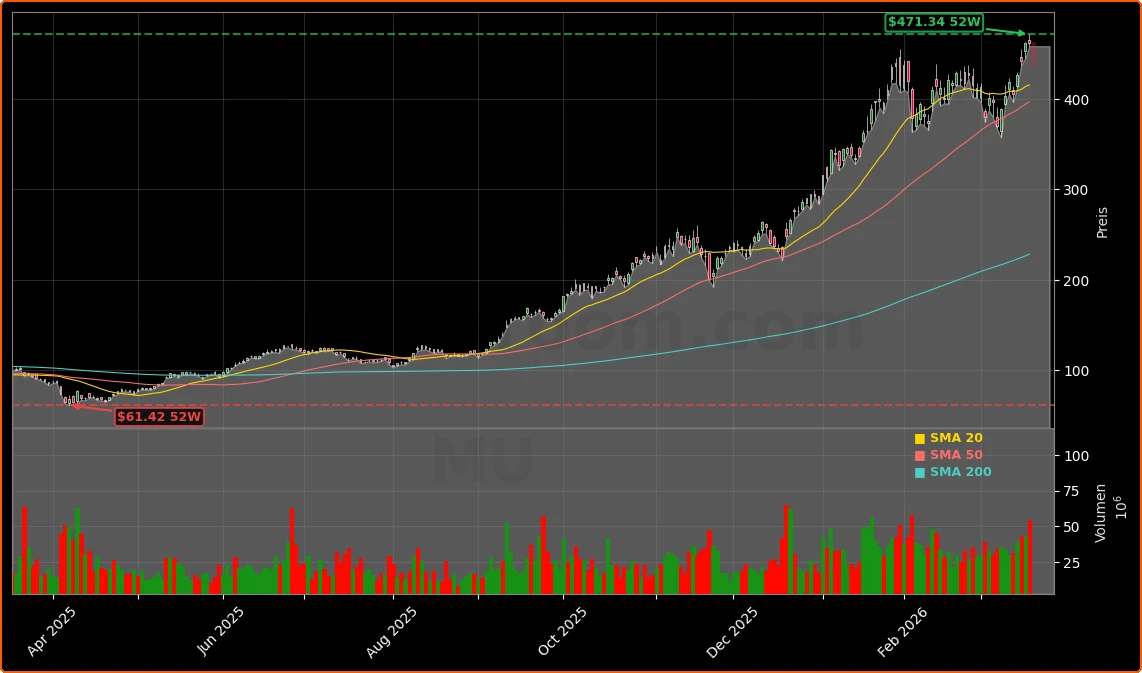
Despite printing one of the strongest Micron Earnings reports in its history and closing at a fresh 52‑week and all‑time high of $471.34 intraday, shares dropped in after‑hours trading to the low‑$440s and recently traded around $437.44 pre‑market, roughly 5% below Wednesday’s close. That pullback comes after the stock has more than quadrupled over the past 12 months and gained roughly 350%, outpacing most high‑profile AI beneficiaries such as NVIDIA and mega‑cap platforms like Apple.
Several factors appear to be driving the near‑term pressure. First, expectations were extraordinarily high; multiple strategists described the quarter as “as good as it gets,” which raises the bar for future Micron Earnings. Second, management outlined a steep increase in capital expenditures, with fiscal 2026 capex expected to exceed $25 billion and to step up “meaningfully” again in fiscal 2027 to support new HBM and DRAM capacity. That heavy spending stoked worries that the industry could overshoot demand later in the decade, reviving memories of past boom‑and‑bust cycles.
Deutsche Bank’s Melissa Weathers argued that investors are prudently cautious given historical memory busts, even if she views current “cycle peak fears” as premature. Other observers noted that short‑term profit‑taking is also in play, as some funds choose to lock in substantial gains after Micron’s parabolic run within the NASDAQ and S&P 500 technology cohort.
What does guidance say about the AI memory cycle?
Micron’s outlook suggests that, for now, the AI super‑cycle in memory is still accelerating. For fiscal Q3 2026, management guided revenue to around $33.5 billion, plus or minus $750 million, more than 200% above the prior‑year quarter and far ahead of Street estimates near $24 billion heading into the print. Adjusted EPS is projected around $19.15 (±$0.40), again dramatically above prior expectations.
Chief Executive Sanjay Mehrotra told investors that supply‑demand conditions for both DRAM and NAND are likely to remain tight beyond calendar 2026 and that AI has turned memory into a “strategic asset” for hyperscalers and enterprise customers. With GPUs from NVIDIA and other chipmakers requiring ever‑larger pools of high‑bandwidth memory, Micron expects structurally higher pricing and utilization in its fabs.
Wedbush’s Matt Bryson emphasized that memory remains a largely supply‑driven business: long lead times for new fabs and tools mean that additional capacity from Micron and its Asian rivals will not materially hit the market until 2027–2028. Until then, AI servers, data‑center refreshes, and even automotive and edge‑AI devices from players like Tesla could keep the market tight, supporting elevated Micron Earnings power.
How does Micron compare for US portfolios?
For US investors, Micron now sits alongside names like NVIDIA and the big cloud platforms as a core way to play the AI infrastructure build‑out. Unlike diversified chip designers, Micron is a purer bet on memory pricing and volume, which can amplify both upside and downside versus broader NASDAQ peers. Its recent move into the top tier of US tech market caps underscores how central memory has become to the AI theme.
Still, the stock is not without risk. The aggressive capex plan implies tens of billions of dollars in new clean‑room and fab construction across the US and Asia, which could pressure free cash flow if memory prices normalize faster than expected. Macroeconomic shocks—such as disruptions in energy supply chains that affect chip production costs—could also add volatility. Analysts at firms like Reuters‑covered desks have warned that the heavy investment plans may eclipse even outstanding Micron Earnings in the eyes of more conservative investors.
Within a diversified US portfolio, Micron today looks more like a high‑beta AI cyclical than a classic defensive semiconductor name. Investors will be watching margins, capex discipline, and any early signs that hyperscaler demand is slowing, especially as other AI‑linked giants such as Alphabet and Apple ramp their own in‑house silicon and memory procurement strategies.
Related coverage: how does this fit the AI race?
The explosive Micron Earnings highlight how critical infrastructure suppliers have become in the AI arms race, echoing themes in recent coverage of mega‑cap platforms. For example, Alphabet’s massive data‑center and model‑training initiatives, explored in detail in an in‑depth look at Alphabet’s $185 billion AI strategy and its risks, show how hyperscalers are locking in long‑term capacity across chips, memory, and power. Together, these stories point to a multi‑year capex boom across both cloud operators and their key hardware partners, with Micron’s record quarter underscoring just how profitable that build‑out can be for well‑positioned suppliers.
In the AI era, memory has become a strategic asset for our customers, and we are investing in our global manufacturing footprint to support their growing demand.— Sanjay Mehrotra, CEO of Micron Technology, Inc.
In summary, Micron Earnings confirm that the AI memory boom is translating into record revenue, margins, and cash flow even as the company commits to unprecedented levels of investment. For US investors, the stock now embodies both the upside of the AI infrastructure super‑cycle and the classic cyclicality of the memory market. The next few Micron Earnings reports will be crucial in showing whether tight supply, pricing power, and disciplined capex can keep this AI‑driven momentum intact.