Is the Micron Forecast finally matching the AI memory supercycle hype or is the stock already priced for perfection?
Is the Micron Forecast catching up to the rally?
Micron has transformed from a classic cyclical memory play into a core beneficiary of the AI infrastructure build-out led by hyperscalers such as Microsoft, Amazon, Alphabet and Meta Platforms. Shares have exploded more than 300% over the past 12 months, powered by relentless demand for high-bandwidth memory (HBM), DRAM and NAND used in GPU clusters from NVIDIA, Advanced Micro Devices and Intel.
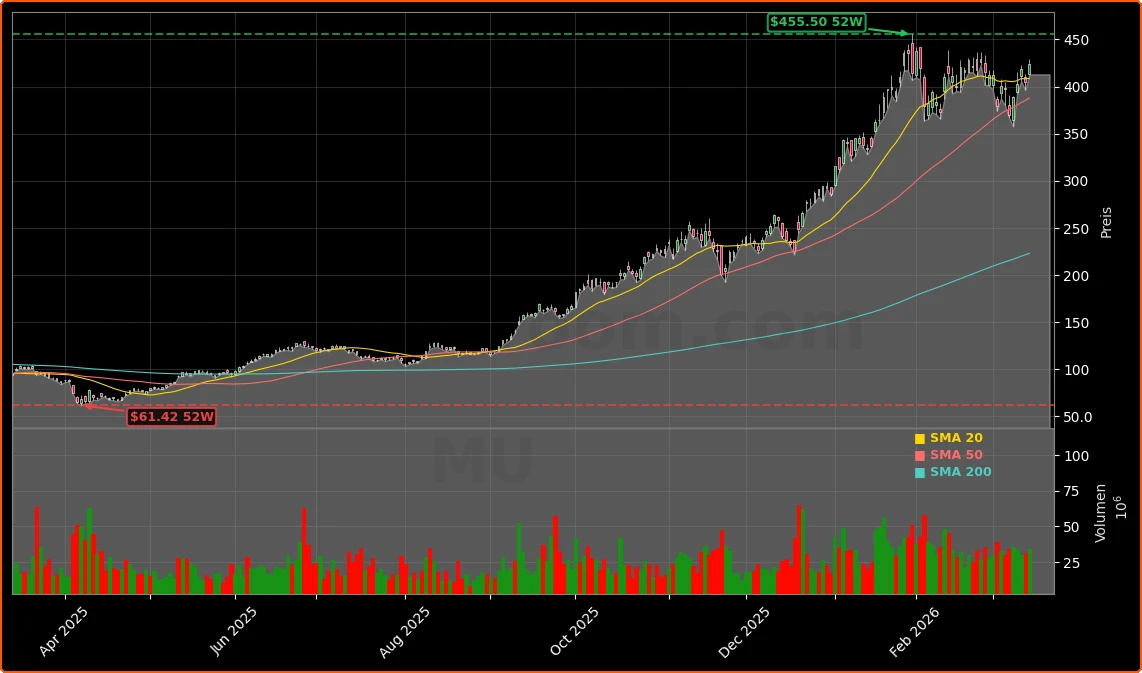
Technically, MU is trading well above its 20-day moving average and has twice bounced off a long-term uptrend line, suggesting a W-shaped recovery pattern. Traders now see the $440 area as a crucial resistance level: a sustained breakout above that zone would confirm the pattern and open room for a new leg higher toward recent peaks. At $424.25, the stock is already extended, but momentum and positioning into earnings on March 18 keep the Micron Forecast tilted to the upside in the near term.
Options flows reflect this tension. There is elevated put activity around current levels, pointing to short-term hedging, while longer-term positioning and sentiment remain broadly constructive given the company’s AI leverage and earnings trajectory.
How does AI reshape the Micron Forecast?
The core of the bullish Micron Forecast is the AI memory supercycle. Management expects the HBM market to grow around 40% annually through 2028 to roughly $100 billion, driven by large language models and accelerated computing workloads. Micron is already sold out of HBM capacity for 2026, with order books stretching into 2027, effectively locking in a multi-year demand runway.
This demand shock has collided with constrained supply. HP Enterprise recently signaled that the global memory shortage will last well into 2027, confirming that expanded capacity is taking years, not quarters, to come online. As a result, contract prices for DRAM have jumped as much as 60% and NAND by nearly 40% in the early months of 2026. Wedbush now expects both DRAM and NAND pricing to inflate by 30%–50% year over year, pushing Micron’s gross margin toward the high 60s.
Unlike prior cycles, HBM is not behaving like a commodity. Integration complexity, tight qualification with GPU vendors like NVIDIA and high capital intensity create a high barrier to entry. Together with Samsung and SK hynix, Micron forms a tight oligopoly in advanced AI memory, and that dynamic underpins the most optimistic Micron Forecasts for revenue and earnings through the latter half of the decade.
What are analysts like Wedbush and Citi pricing in?
Wall Street has been racing to catch up with Micron’s fundamentals. Wedbush analyst Matt Bryson raised his price target from $320 to $500 and reiterated an Outperform rating, the most aggressive Micron Forecast on the Street today. His channel checks after Chinese New Year showed no demand deterioration, supporting expectations that Micron will beat Q2 earnings and guide Q3 above consensus.
Other firms including Citi, Stifel, UBS, Susquehanna and Aletheia have also lifted their targets in recent days, citing stronger-than-expected HBM and DDR5 pricing and robust AI data center demand. The broader analyst community is overwhelmingly positive: 38 Buy or Strong Buy ratings versus just a handful of Holds and Sells. Zacks Investment Research upgraded Micron to its top Rank #1 (Strong Buy), arguing that Micron is a better AI play than Palantir given its diversified revenue base and more attractive valuation.
Valuation is part of the story. Even after its run, Micron trades at roughly 13x forward earnings, a discount to many AI leaders such as NVIDIA and well below premium hardware names like Apple or Tesla on a growth-adjusted basis. Bulls argue that if Micron continues beating earnings and the Micron Forecast for fiscal 2027 EPS keeps moving higher, a re-rating toward broader tech multiples could justify prices well beyond $500.
How strong are Micron’s earnings and margins?
Micron’s December-quarter (Q1 FY2026) numbers provided the fundamental backbone for the bullish Micron Forecast. Revenue jumped 56.6% year over year to $13.64 billion, beating estimates by nearly 6%, while non-GAAP EPS of $4.78 topped consensus by more than 21%. GAAP gross margin expanded to 56% from 38.4% a year earlier, showcasing powerful operating leverage as pricing improved.
The Cloud Memory Business Unit was the standout, delivering $5.28 billion in revenue at a 66% gross margin and a remarkable 55% operating margin. For Q2 FY2026, Micron guided to $18.7 billion in revenue and non-GAAP EPS of $8.42, with gross margin expected to reach about 67%. Several Micron Forecast models now assume triple-digit revenue growth and EPS growth above 400% for the fiscal year as AI deployments accelerate.
Strategically, Micron is investing heavily to sustain its technology edge. Its partnership with Applied Materials at the new EPIC Center in Silicon Valley aims to speed development of next-generation DRAM and HBM, tightening the link between equipment innovation and memory scaling. That positions Micron to capture a larger share of value as AI workloads proliferate across cloud, enterprise, automotive and edge devices.
Micron’s technology leadership and sold-out AI memory capacity through 2027 have turned a historically cyclical stock into one of the clearest structural growth stories on Wall Street.
— StockNewsroom.com analysis
Conclusion
For U.S. investors, Micron now sits at the intersection of two powerful themes: the AI build-out that has driven the NASDAQ-100 to repeated highs, and a structural supply constraint that favors scale players. The next earnings print on March 18 will be a key test of whether current expectations are still too low or finally in line with reality.
Further Reading
- Micron Technology, Inc. (MU) Stock Price, News, Quote & History (Yahoo Finance)
- Micron Technology price target boosted on stronger-than-expected memory pricing (Yahoo Finance Canada)
- Micron Faces Upcycle as Analysts Boost Price Targets (StocksToTrade)
- Micron Q2 Earnings Preview: Expect Another Monster Quarter (Seeking Alpha)