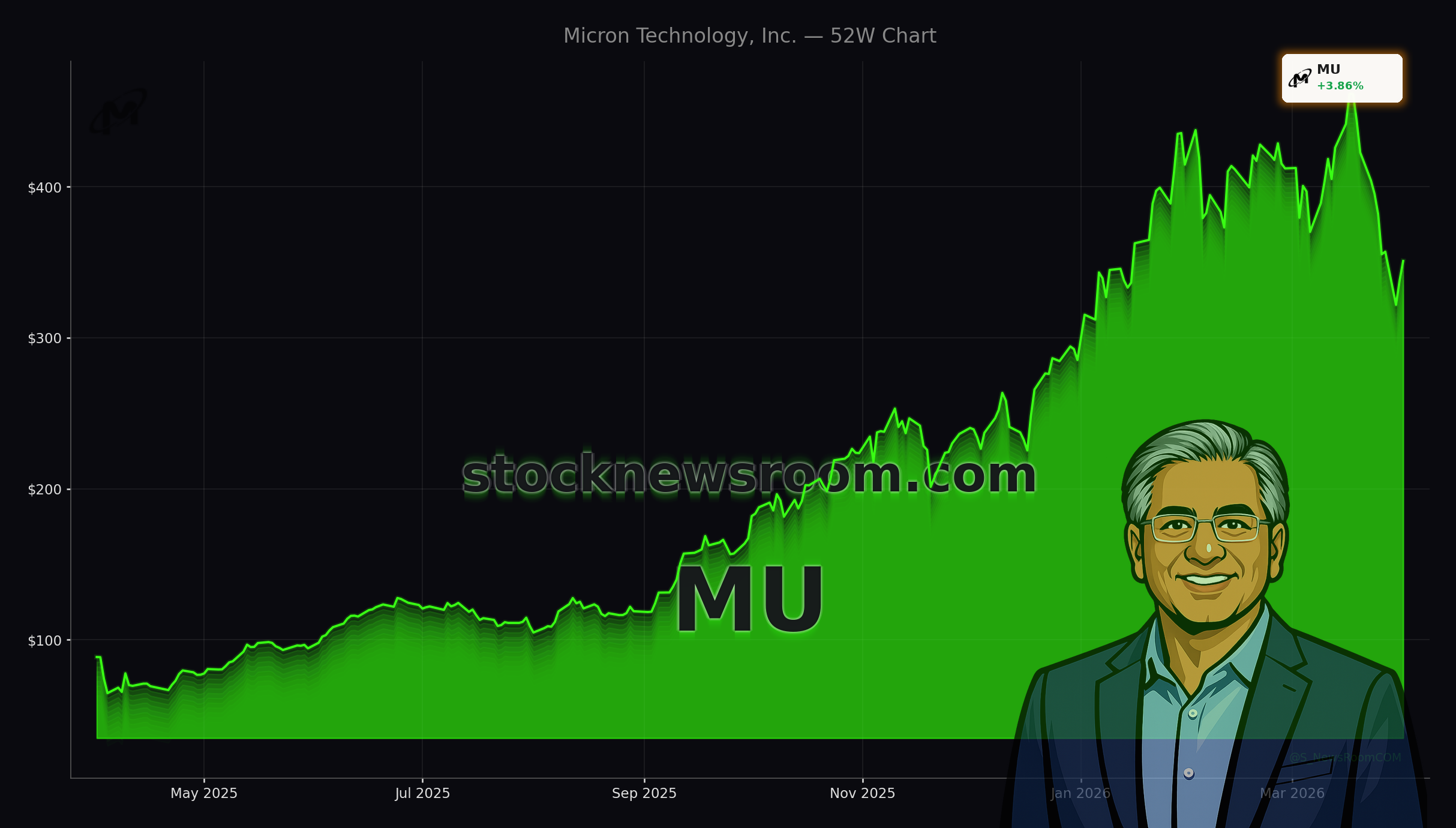

Is the Micron Tender Offer just balance-sheet housekeeping, or a high-conviction bet on an extended AI memory supercycle?

How does the Micron Tender Offer change the story?
Micron Technology has confirmed that its cash tender offers for multiple tranches of senior notes expired at 5:00 p.m. New York time on March 31, 2026. The Micron Tender Offer targeted any and all of its 5.300% notes due 2031, 5.650% notes due 2032, two 5.875% series due 2033, and 5.800% and 6.050% notes due 2035. The company expects to accept all validly tendered notes and settle on April 3, effectively pulling forward debt reduction and modestly lowering interest expense over the coming years.
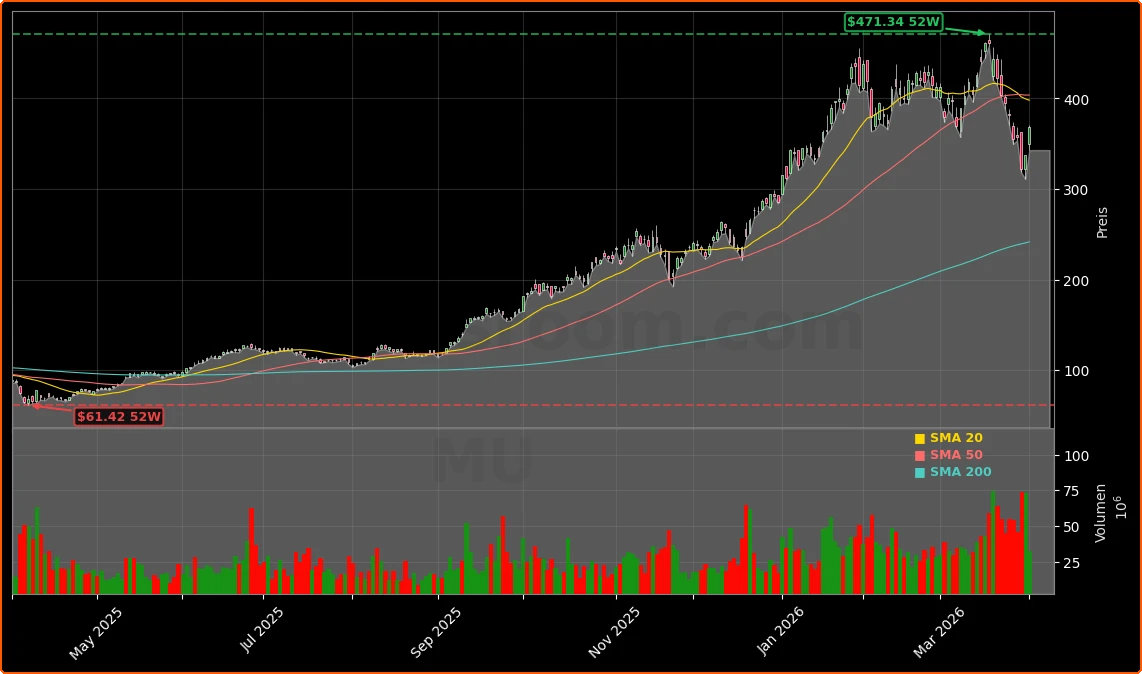
On a day when MU is trading around $368.29, up roughly 9% from Tuesday’s close and breaking through a short-term resistance band near $360, the Micron Tender Offer is being read as a strategic clean-up move rather than a distress signal. The stock remains below its recent highs but has rebounded sharply from the late-March pullback that followed fears Google’s TurboQuant AI breakthrough could reduce memory demand.
Is Micron using AI cash flows to de-risk?
Investors have been scrutinizing Micron’s heavy capital spending plans for high-bandwidth memory (HBM) and advanced DRAM, which underpin generative AI infrastructure at hyperscalers and specialized cloud players like CoreWeave. Strategists at Charles Schwab recently highlighted that upward revisions to technology sector earnings estimates for 2026 are being driven disproportionately by Micron and NVIDIA, underscoring how central both companies have become to the AI narrative for the NASDAQ and the S&P 500.
Portfolio managers such as Stephen North of Federated Hermes expect Micron’s free cash flow to multiply over the next several years, arguing that the stock has shifted into the small group of free-cash-flow growth leaders that funds will increasingly favor. From that angle, the Micron Tender Offer looks like balance-sheet housekeeping ahead of a strong cash generation phase, giving management more flexibility if the AI cycle proves longer and stronger than current consensus assumes.
What about Google TurboQuant and AI efficiency risk?
The recent sell-off in memory names was triggered by Google Research unveiling TurboQuant, an AI inference approach that promises faster performance and larger context windows. The market initially feared that greater compute efficiency might reduce the need for DRAM and HBM capacity, hitting Micron’s long-term demand curve. However, Jevons’ paradox offers a different lens: when a technology becomes more efficient, overall usage often rises rather than falls.
Applied to AI, cheaper and faster inference can unlock new use cases across cloud, enterprise and consumer applications. That, in turn, may pull in more accelerators, more high-bandwidth links and more memory – supporting not only Micron but also ecosystem players such as Apple, Tesla in autonomous and edge compute, and AI cloud platforms deeply tied to NVIDIA. Recent analysis from Zacks flags Micron as a momentum name for April, arguing that easing geopolitical stress and resilient AI demand could support further upside even after the latest bounce.
How does Micron stack up versus other chip leaders?
For US investors building or rebalancing AI baskets, Micron increasingly sits alongside GPU and CPU leaders rather than second-tier cyclicals. A recent Trefis comparison argued Micron offers stronger revenue and operating income growth at a more attractive valuation than Texas Instruments, positioning it as a higher-beta but higher-upside way to play secular data growth. Meanwhile, a Seeking Alpha review contends the market is too early in calling a peak for Micron, with tight supply, pricing power and normalized positioning all supporting the case that MU is more likely to touch $400 than revisit $250 in the near term.
Micron is also a top holding in AI-focused ETFs such as the Roundhill vehicle, which owns most of the heavyweights in the space, from NVIDIA and Microsoft to Amazon and Meta. That ETF ownership creates a feedback loop: as flows return to AI and mega-cap tech, incremental passive capital tends to find its way into MU alongside its larger platform peers.
What are Wall Street analysts saying now?
Sell-side sentiment remains broadly constructive. Zacks reports that Wall Street bulls are still leaning optimistic on Micron, reflecting a favorable average broker rating and a cluster of Buy recommendations. Recent commentary from firms like Goldman Sachs and Morgan Stanley has highlighted Micron’s leverage to AI memory demand and the prospect of margin expansion as supply remains disciplined across DRAM and NAND. While specific targets vary, several large banks have framed the current consolidation below $400 as a pause within an ongoing uptrend.
At the same time, investors are monitoring the risk side of the ledger: elevated capex, potential overbuild in HBM, and technological curveballs like TurboQuant that could shift how AI workloads are architected. The Micron Tender Offer helps mitigate some of that risk by locking in a leaner liability structure just as the company shoulders massive investment obligations.
Related Coverage
For a deeper dive into how Micron’s latest volatility fits into the broader AI cycle, including its record AI quarter and the sharp sell-off that shook investor confidence, see Micron Forecast +2.8%: Can the AI Boom Outrun the Plunge Shock?. That analysis unpacks whether recent weakness has reset expectations enough for another leg higher.
To understand how another key infrastructure vendor is riding the AI wave, read Marvell NVIDIA Partnership $2B Surge Shocks AI Street. The piece explores whether Marvell’s deepening ties with NVIDIA could position it as an essential backbone supplier for next-generation AI data centers.
In the end, the Micron Tender Offer underscores a company using its rising AI cash flows to strengthen the balance sheet while staying aggressively invested in future growth. For US investors, MU now offers a leveraged way to play both the structural AI memory upcycle and improving free cash flow dynamics. The next quarters of demand data, pricing trends and further balance-sheet moves will show whether this combination can ultimately carry the stock toward the much-discussed $400 mark.