
Will the Microsoft Cloud Regulation be a growth driver for AI – or a brake in Europe and Japan?
Microsoft: How Strong is the AI and Cloud Engine?
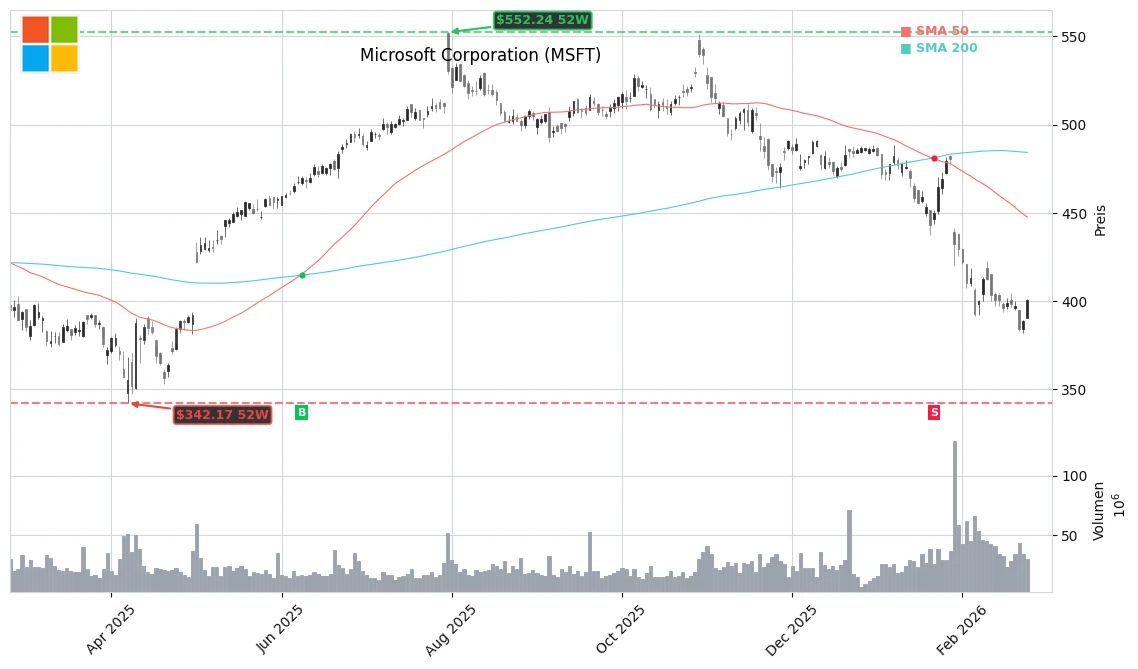
The stock of Microsoft is up about 3% today to $400.73, continuing its recovery from the correction of recent weeks. Although the stock is still some distance from its 52-week high, several market participants see a bottom forming for the software and cloud heavyweight. Analysts expect a rebound towards $550 to $600 once the full effects of massive AI investments are reflected in the numbers starting in the second and third quarters of 2026.
The company is considered one of the most important hyperscalers globally and is investing billions in new data centers, particularly in AI infrastructure. A focus is on the healthcare sector, such as a new medical center in Texas that aims to accelerate diagnostics and drug development using generative AI. Simultaneously, Microsoft is investing in ecosystems, for example, through a significant stake in the British robotaxi startup Wayve, which aims to scale autonomous driving software globally. However, this growth story is inextricably linked to questions surrounding Microsoft Cloud Regulation.
Microsoft Cloud Regulation: What is Europe Planning?
During his “AI Tour,” CEO Satya Nadella emphasized in Munich and London that European customer data will, upon request, be processed and stored exclusively in European data centers. The core of this promise is a “European data boundary,” which Microsoft assures will provide more sovereignty to politics and businesses. Customers will be able to keep their data in separate cloud environments isolated from global structures, including strong encryption and private clouds.
At the same time, the company is opening its previously cloud-based AI development service “Foundry” to local systems. This move responds to concerns that critical applications – from administration to industrial production – should not be entirely dependent on US-centered structures. Germany’s head Agnes Heftberger points to control mechanisms in public cloud offerings and partnerships in cybersecurity as additional components of Microsoft Cloud Regulation in Europe.
A balancing act remains: Nadella emphasizes that a sovereign cloud without access to global threat data for cyber defense would create a “massive vulnerability.” In this way, Microsoft attempts to connect national sovereignty requirements with the necessity for globally interconnected security analyses – a central conflict point in the discussion about future cloud regulations.
Microsoft: Antitrust Risks in Japan’s Cloud Market?
While Europe discusses data sovereignty, competition is at the forefront of Microsoft Cloud Regulation in Japan. The Japan Fair Trade Commission is investigating whether Microsoft has effectively prevented local customers from using competing cloud services. Allegations suggest that its own or third-party software can only be operated to a limited extent on platforms outside of Azure. Investigators have searched the Tokyo office of Microsoft Japan; the company emphasizes that it is fully cooperating.
Japan is a key market in the global cloud and AI boom. Major industrial groups and banks are driving demand for scalable infrastructures, while US companies like Microsoft, Amazon, and Alphabet compete for market share. Market researchers expect the Japanese cloud market to nearly double by 2029, reaching a triple-digit billion volume. Against this backdrop, the authority signals that it intends to take stronger action against potential abuse of power by hyperscalers, in line with international trends.
For Microsoft Corporation, a more strictly regulated environment in Japan could affect not only contract clauses but also the technical interoperability of Azure services. The company must prepare for the possibility that the ongoing antitrust review could set a precedent for future regulations in other Asian markets, further fueling the global discussion around Microsoft Cloud Regulation.
Microsoft: How Do Analysts Assess the Risks?
Despite regulatory uncertainties, the tech giant remains a favorite among many firms. Morgan Stanley views AI-driven market disruptions as an opportunity for stock pickers and clearly counts Microsoft among the beneficiaries with strong pricing power in the software and cloud business. Citigroup and RBC Capital Markets predominantly rate the stock as “Buy,” citing the high visibility of cloud revenues and the close cooperation with OpenAI as growth drivers for Azure.
Several research firms see price targets around $590 to $600, indicating significant upside potential from current levels. While strategists like Michael Hartnett from Bank of America caution against blindly accepting the enormous AI capex budgets of hyperscalers, the consensus remains positive: Microsoft is seen as one of the few players capable of monetizing high investments in AI infrastructure through broad platform effects – from Office to Dynamics to the gaming division.
This raises the question for investors of whether the recent stock decline primarily reflects valuation normalization and AI skepticism, or whether regulatory interventions could seriously impact margins. Current signals suggest that the market is pricing Microsoft Cloud Regulation more as a manageable risk than as a structural threat.
Bottom Line
In summary, Microsoft Corporation finds itself in a tension between aggressive AI initiatives and increasing Microsoft Cloud Regulation in key markets. The commitment to a European data boundary and cooperation with antitrust authorities in Japan aim to build trust without stifling the growth of Azure and AI services. If this balancing act succeeds, the combination of a recovering stock and structural AI growth could remain attractive for long-term investors.
Related Sources
- Microsoft Corporation (MSFT) on Yahoo Finance (Yahoo Finance)
- White House to host Big Tech in pledge to rein in power costs (Reuters)
- AI Panic Selloffs: Prime Time for Stock Pickers (Wall Street Pit)
- Microsoft, Nvidia-Backed Wayve Gets $1.5 Billion Funding Boost For Robotaxi Tech Rollout (Benzinga)