
Can Microsoft’s massive Copilot push and $72 billion AI build-out really turn into the next leg of its growth story?
Is Microsoft’s AI pivot paying off for investors?
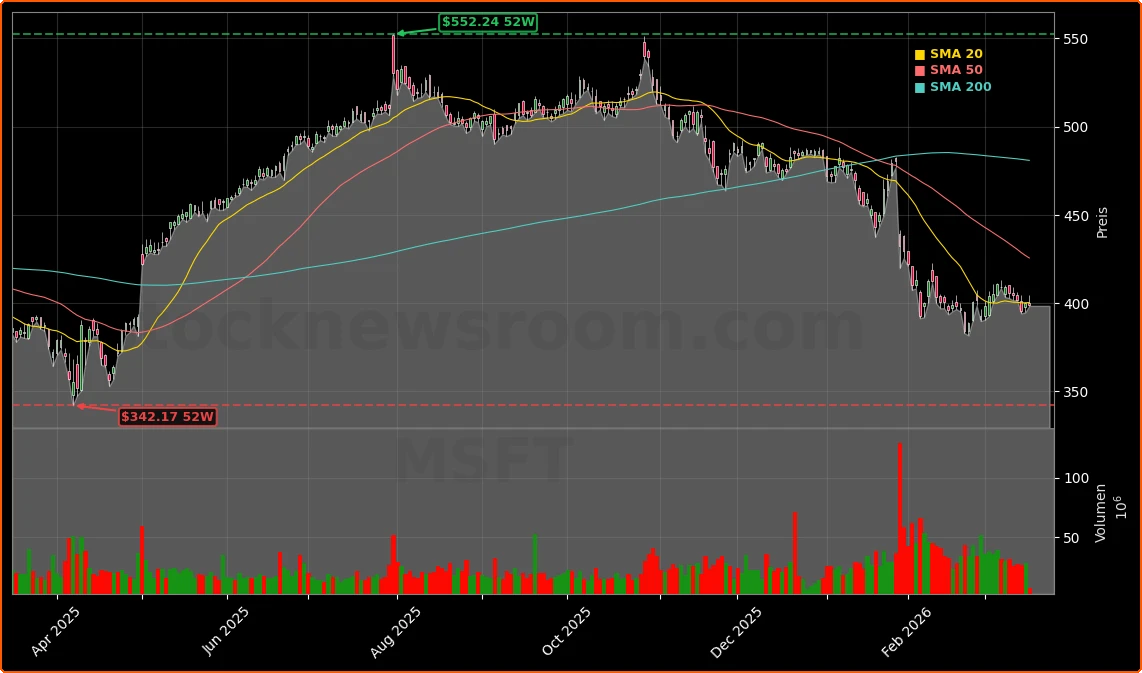
Microsoft Corporation shares trade near record territory, down a fraction at $399.12 on Tuesday afternoon, as investors digest an aggressive AI build-out that has pushed capital expenditures to roughly $72 billion over the past two quarters. A key test of the Microsoft Copilot Strategy is whether those data center dollars can be converted into sticky, high-margin software revenue across Office, Azure and Windows.
Copilot adoption remains modest relative to Microsoft’s installed base. Management has disclosed about 15 million paying Copilot accounts versus more than 450 million Microsoft 365 commercial seats. That gap underscores both the early stage of AI monetization and the upside if even a small share of existing users migrate to higher-priced plans.
On the Street, sentiment remains broadly constructive. Analysts tracked by MarketBeat maintain a consensus “Moderate Buy” rating with an average price target close to $592, while Goldman Sachs and Barclays both see room for substantial upside, each reiterating Buy or Overweight ratings alongside $600 targets.
How is Microsoft Copilot Strategy being reorganized?
Management is now reshaping the Microsoft Copilot Strategy at an organizational level. A recent internal shake-up unifies the teams behind Microsoft 365 Copilot and the consumer Copilot app, eliminating the split between commercial and consumer groups that often led to overlapping features and user confusion. Jacob Andreou has been elevated to executive vice president of Copilot, overseeing design, product, growth and engineering, while Mustafa Suleyman will focus more on proprietary models and the company’s push toward so-called superintelligence.
For users and CIOs, the goal is a single, coherent Copilot experience across Outlook, Teams, Windows, Edge and other surfaces, rather than a patchwork of slightly different assistants. Internally, a more integrated approach should allow Microsoft to ship features faster as underlying AI models improve and to leverage data and feedback loops across business and consumer products.
This coherence push matters as rivals scale quickly. Google’s Gemini and OpenAI’s ChatGPT now serve hundreds of millions of users, raising the bar for responsiveness, reasoning quality and integrations. Microsoft’s own proprietary models have at times lagged leading benchmarks, making tighter product coordination and better allocation of scarce compute all the more critical.
Will the $99 E7 Copilot tier boost margins?
The most visible near-term monetization lever in the Microsoft Copilot Strategy is pricing. From May 1, Microsoft will roll out a new Microsoft 365 E7 enterprise plan at $99 per user per month, roughly 65% higher than its prior top-tier bundle, with Copilot deeply embedded. A flagship feature is Copilot Cowork, which taps Anthropic’s Claude Cowork to orchestrate multi-step workflows across data silos like Teams and Outlook.
Barclays, which reaffirmed its Overweight rating and $600 target in March, argues that E7 strengthens the “Office plus Add-On” ecosystem and should expand Microsoft’s wallet share as AI copilots and agents begin to lower labor costs and encourage platform consolidation. William Blair also keeps an Outperform stance, highlighting an expanding addressable market as enterprises standardize on a smaller number of AI platforms.
However, competition is intense. ChatGPT already counts more than 50 million paying subscribers, with management at OpenAI targeting up to 220 million by 2030, while Alphabet and Apple are racing to embed AI agents across their ecosystems. Microsoft must prove that its integrated, enterprise-grade Copilot can keep knowledge workers inside the Microsoft 365 environment instead of defecting to standalone tools.
What supports Microsoft’s AI infrastructure bet?
Beyond software, Microsoft is investing in foundational technologies to sustain its AI ambitions. New datacenter networking approaches, including MicroLED-based optical links and hollow core fiber, are designed to cut energy usage and costs while boosting bandwidth for AI workloads. The company is also developing custom silicon like the Maia 200 AI inference accelerator on advanced 3-nanometer processes, aiming to improve Azure AI economics over time.
These infrastructure moves position Microsoft alongside hyperscale peers such as NVIDIA and cloud rival Tesla‘s AI initiatives in terms of capital intensity, but with a different focus: renting out computing capacity and selling higher-value software on top. For long-term shareholders, the central question is whether Copilot subscriptions and Azure AI services can scale fast enough to outrun capex and support the premium valuation relative to the S&P 500 and NASDAQ.
Conclusion
Ultimately, the Microsoft Copilot Strategy now rests on three pillars: a unified product experience, aggressive enterprise pricing, and a massive infrastructure build. If those elements align, Microsoft could consolidate its role as the default AI platform for global enterprises.
Further Reading
- Microsoft Corporation on Yahoo Finance (Yahoo Finance)
- Microsoft seeks more coherence in AI efforts with Copilot reorganization (WSJ)
- Microsoft’s new $99 Copilot tier points to a high-stakes AI monetization push (The Motley Fool)
- Using inexpensive MicroLEDs, Microsoft networking innovation aims to make datacenters more efficient (Microsoft Source)
- Why Microsoft (MSFT) is a Top Stock for the Long-Term (Zacks Investment Research)