
Is the radical MicroStrategy Bitcoin strategy a brilliant leverage on the crypto market or a risky balancing act on the edge?
How is MicroStrategy performing in the stock market?
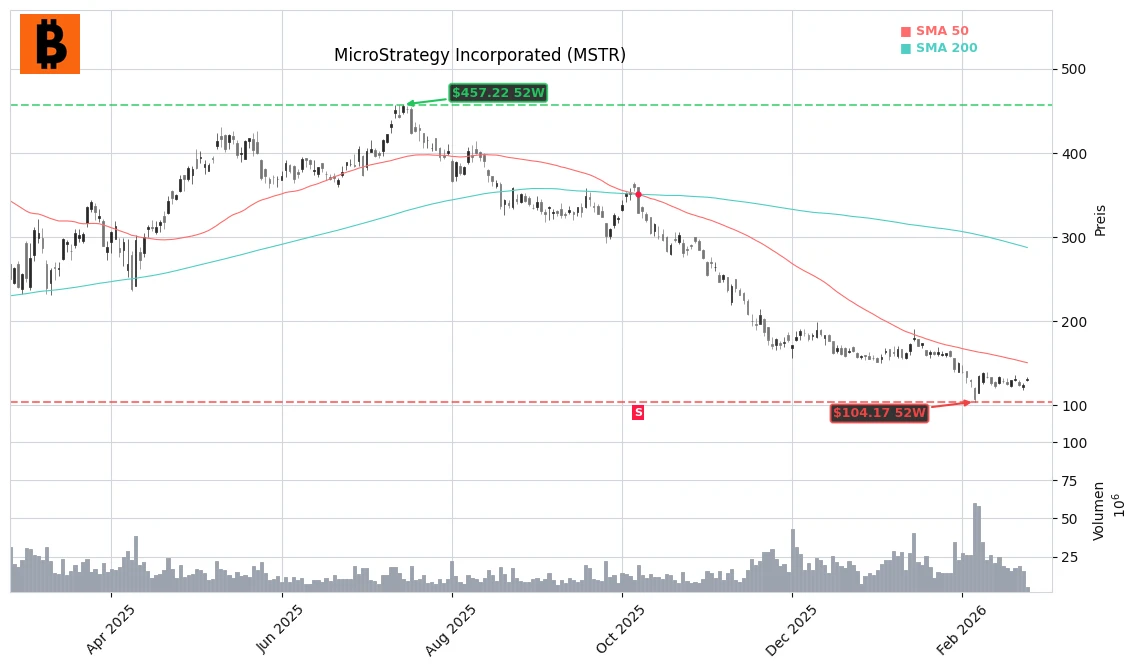
The stock of MicroStrategy Incorporated (MSTR) surged on Wednesday, last trading at around $131.76, up from $124.61 the previous day. This represents a daily increase of 5.74%. The stock is moving away from the support zone around $100 to $110, which has been tested multiple times in recent weeks. However, it is still more than 75% away from its high of over $540 in November 2024—so there is no talk of new highs.
Over a twelve-month period, the stock has recorded a loss of well over 50%. Various analyses indicate that MicroStrategy has underperformed compared to Bitcoin itself and many traditional tech stocks. Nevertheless, the stock remains a proxy for the crypto market: when the BTC price rises, the stock often reacts disproportionately—when it falls, the leverage effect of the balance sheet amplifies the setbacks.
At the same time, the MicroStrategy Bitcoin strategy remains the central driver of the investment story. Investors are evaluating the stock less by traditional software metrics and increasingly as a leveraged Bitcoin proxy with additional corporate risk.
What does the 100th Bitcoin purchase mean for MicroStrategy?
With the recent transaction, MicroStrategy Incorporated has reached the milestone of 100 official purchase announcements since August 2020. Between February 17 and 22, the company sold 297,940 common shares, raising approximately $39.7 million net. The total proceeds were used to acquire 592 Bitcoin at an average price of $67,286 per coin.
In total, MicroStrategy now holds 717,722 Bitcoin, for which approximately $54.56 billion has been paid. The average acquisition price is around $76,020 per BTC. With the current Bitcoin price slightly above $66,000, this results in a book loss of about $10,000 per coin—totaling around $7 to $8 billion. Despite this massive difference, management remains committed to the MicroStrategy Bitcoin strategy and continues to use stock sales as the primary funding source for additional purchases.
According to the company, an additional approximately $7.84 billion is available through an ongoing stock ATM program, along with billions more through various series of perpetual preferred shares. This underscores that the MicroStrategy Bitcoin strategy is long-term in nature and that the company intends to continue expanding its BTC holdings—regardless of short-term price fluctuations.
Why is MicroStrategy the most shorted large-cap stock?
Notably, MicroStrategy Incorporated is now considered the most shorted large-cap stock on Wall Street. According to data from Goldman Sachs and FactSet, about 14% of its market capitalization is sold short, making MicroStrategy currently a favorite among short sellers, even ahead of Coinbase. However, the high short ratio should not be understood as a vote on the company’s survival but rather stems primarily from a popular arbitrage trade.
Many hedge funds are betting on the so-called basis trade: they buy physically backed Bitcoin ETFs—such as the large US spot ETFs—and simultaneously short MicroStrategy stock. The background is that the stock has historically traded at a significant premium to the pure value of its BTC holdings. Professional investors speculate that this premium will decrease over time.
So far, this bet has not fully paid off. While Bitcoin ETFs have lost over 25% since the beginning of the year, MicroStrategy’s decline is slightly less. For investors, this means that alongside the fundamental discussion around the MicroStrategy Bitcoin strategy, the dynamics between long ETF positions and short positions in the stock play an increasingly important role—a potential short squeeze remains a risk for the opposing side.
How does the new MicroStrategy Yield ETP work?
The MicroStrategy Bitcoin strategy is receiving additional attention through a new exchange-traded product from 21Shares. The company has launched an ETP that provides European investors access to a variable, perpetual preferred stock of MicroStrategy. This so-called Variable Rate Series A Perpetual “Stretch” Preferred Stock (STRC) is secured by the company’s Bitcoin holdings.
The 21Shares Yield ETP aims to act as a cash flow bridge between the traditional financial system and MicroStrategy’s BTC assets. Investors receive a variable dividend set at 11.25% per annum, which is backed by MicroStrategy’s large Bitcoin treasure. This expands the ecosystem around the MicroStrategy Bitcoin strategy: in addition to the stock and options on it, investors now have a structured product that combines yield and crypto exposure.
Meanwhile, analysts remain relatively optimistic. Several firms, such as Zacks, report predominantly “Buy” ratings and a median price target around $325—well above the current price. Investment banks like Goldman Sachs primarily analyze the short and arbitrage flows in the stock, while traditional IT coverage takes a back seat due to the dominance of the Bitcoin theme.
Michael Saylor has effectively transformed MicroStrategy into a highly leveraged Bitcoin fund—with all the opportunities and risks that this model entails.
— Independent Market Observer
Bottom Line
In summary, the MicroStrategy Bitcoin strategy remains radical and consistent: the company uses every market weakness for further purchases and accepts high book losses as part of the plan. For investors, this means a highly volatile but clearly positioned investment that fluctuates significantly more than Bitcoin itself. Those who believe in a long-term BTC supercycle will find a leveraged proxy in MicroStrategy—the upcoming quarterly results and the development of short interest will show whether this bet pays off.
Related Sources
- MicroStrategy Incorporated (MSTR) on Yahoo Finance (Yahoo Finance)
- Is Strategy (MSTR) a Buy as Wall Street Analysts Look Optimistic? (Zacks Investment Research)
- Strategy shows no fear — it keeps adding to a losing bitcoin position as prices drop (MarketWatch)
- Strategy’s Bitcoin Accumulation Accelerates: More Upside Ahead? (Zacks Investment Research)