
Is MicroStrategy’s ultra-leveraged Bitcoin strategy a visionary masterstroke or a high-risk bet that could still unravel?

Is MicroStrategy now a Bitcoin tracking stock?
MicroStrategy Incorporated was once a niche enterprise analytics provider, but since 2020 it has effectively transformed into a leveraged proxy on Bitcoin. Under executive chairman Michael Saylor, the company has accumulated roughly 762,099 BTC, worth about $51 billion at recent prices, equivalent to nearly 4% of the circulating supply. For many Wall Street traders, MSTR now trades less like a typical NASDAQ software name and more like a high-beta Bitcoin ETF with corporate debt on top.
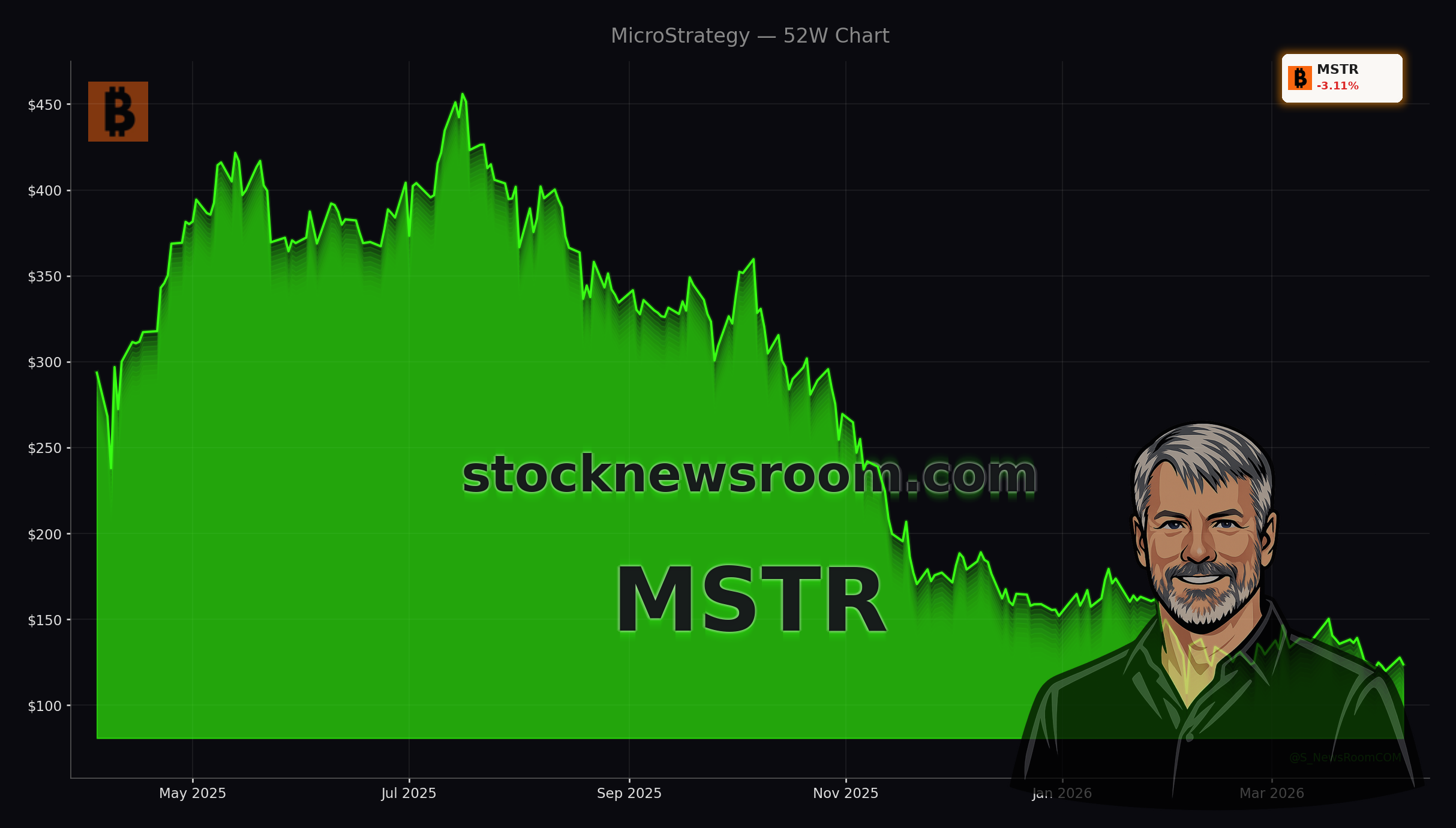
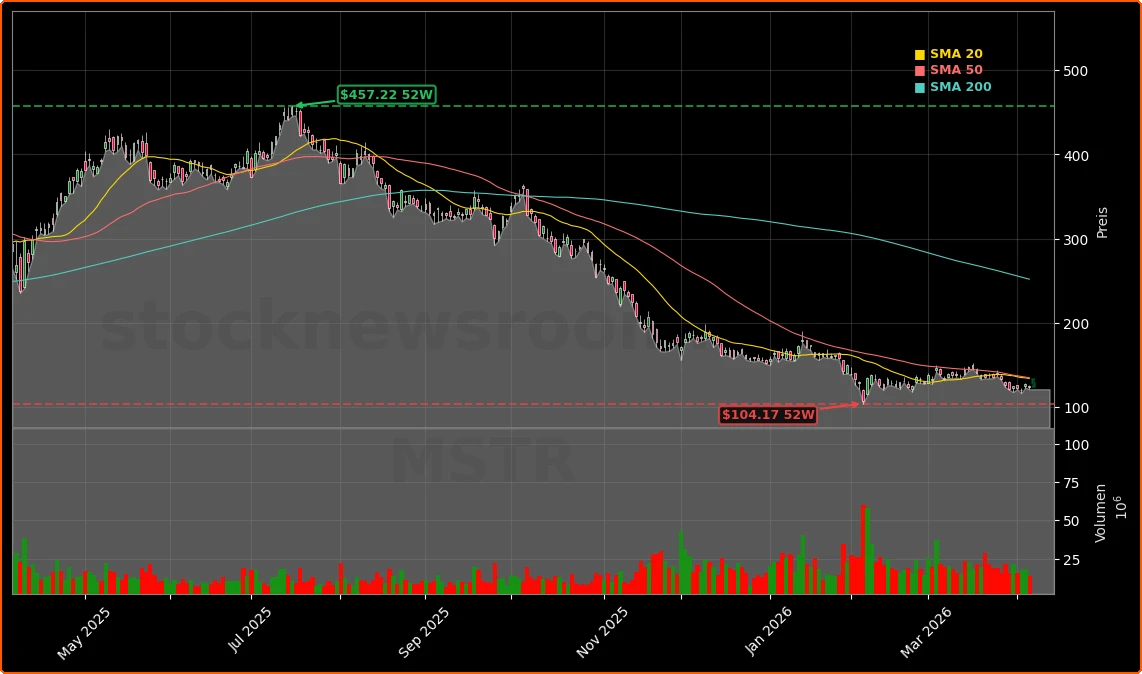
On Tuesday, MSTR closed at $123.72, off from a prior close of $130.70, even as Bitcoin has been volatile after a 45% drawdown over the last six months from recent peaks. Yet pre-market indications around $133.77 (up more than 8%) show just how quickly sentiment can reverse when crypto bounces. Technical traders on platforms like TradingView continue to frame MicroStrategy primarily through support and resistance zones tied directly to Bitcoin levels, underscoring how dominant the MicroStrategy Bitcoin Strategy has become in shaping the stock’s price action.
How extreme is Michael Saylor’s Bitcoin target?
Saylor has laid out one of the boldest price targets in modern market history: he sees a path for Bitcoin to reach $21 million per coin by 2046. With Bitcoin currently trading above $67,000, that implies upside of more than 31,000% over roughly two decades. At that level, Bitcoin’s fully diluted market capitalization would approach $441 trillion, dwarfing today’s roughly $30.6 trillion U.S. GDP and even the multi-trillion-dollar valuations of mega-cap leaders like NVIDIA, Apple, and Tesla.
The intellectual backbone of this call is Saylor’s belief that virtually all real-world assets – real estate, equities, commodities, even intellectual property – will be tokenized on public blockchains. In his view, Bitcoin becomes the neutral, decentralized reserve asset against which everything else is priced and settled. If $500 trillion in global assets ultimately sits on-chain and Bitcoin is the base collateral and medium for transactions, demand could, in theory, drive prices to levels that sound unimaginable today. The MicroStrategy Bitcoin Strategy, therefore, is not just about a store-of-value narrative; it is a bet on Bitcoin as the monetary foundation of a tokenized global economy.
Can the MicroStrategy Bitcoin Strategy really scale?
There are major practical obstacles to Saylor’s vision. Even if asset tokenization accelerates, Bitcoin does not automatically become the world’s unit of account. In a simple transfer scenario – investor A buys a tokenized asset with BTC, investor B immediately sells that BTC for dollars – net demand can be neutral. For Bitcoin to approach Saylor’s $21 million target, it likely would have to function as a true global currency or reserve standard, displacing fiat systems at a scale that would require unprecedented political coordination.
Smaller economies in particular might resist a Bitcoin standard because they currently rely on weaker local currencies to make exports more competitive. Leveling the playing field with a hard, global digital currency could erode export advantages and hit domestic living standards. That makes a uniform global Bitcoin standard far less probable than a world where BTC coexists alongside dollars, euros, and other fiat units. A more modest but still aggressive scenario is Bitcoin ultimately matching the current $32 trillion value of all above-ground gold, implying a BTC price around $1.52 million – roughly 2,170% upside from current levels. For investors, the MicroStrategy Bitcoin Strategy essentially expresses that high-conviction “digital gold” thesis in listed equity form.
How are Wall Street and insiders positioned on MicroStrategy?
Sell-side coverage recognizes both the upside optionality and the concentrated risk. Research aggregators such as TradingKey describe MicroStrategy as a Bitcoin treasury plus business intelligence company with relatively healthy underlying fundamentals and a long-term growth story, while still calling out the extreme dependence on BTC prices. Several analyst frameworks now model MSTR almost entirely on a sum-of-the-parts basis: net Bitcoin holdings minus debt, plus a modest valuation for the legacy software business, often at a steep discount to pure-play cloud peers.
Insider activity has been active in 2026. Multiple Form 144 filings detail planned and executed sales by senior figures, including Wei-Ming Shao and Jarrod M. Patten, covering tens of thousands of Class A shares and several hundred thousand dollars in proceeds. These sales are largely tied to vested options and restricted stock units, but they still feed the debate on whether executives are prudently diversifying or signaling caution as volatility in both MSTR and Bitcoin remains elevated. ETFs that hold MSTR continue to market the name as a high-octane Bitcoin proxy for investors who cannot or will not hold crypto directly.
Related Coverage
For a deeper dive into how the company recently added leverage to its already aggressive crypto stance, read MicroStrategy Bitcoin Strategy: $330M Surge Bet on BTC, which analyzes the latest debt-funded Bitcoin purchases and what they mean for equity holders. For broader context on regulated crypto infrastructure and how exchanges are evolving alongside corporate balance-sheet bets like MicroStrategy, see Coinbase Australia License Boom: AFSL Shock for Rivals, exploring how Coinbase’s expansion could reshape access to digital assets globally.
Ultimately, the MicroStrategy Bitcoin Strategy turns a midcap software company into a leveraged, publicly traded wager on Bitcoin’s long-term role in the financial system. For U.S. and global investors willing to stomach extreme volatility, MSTR offers a way to express a high-conviction Bitcoin thesis inside a brokerage account, but the concentration risk is equally clear. The next major move in Bitcoin – whether toward Saylor’s digital gold scenario or another deep drawdown – will likely determine whether this strategy looks visionary or reckless in hindsight.