
Is the MicroStrategy Bitcoin Strategy turning this latest crypto sell-off into a rare buying window for high-risk believers?

How is MicroStrategy repositioning after the sell-off?
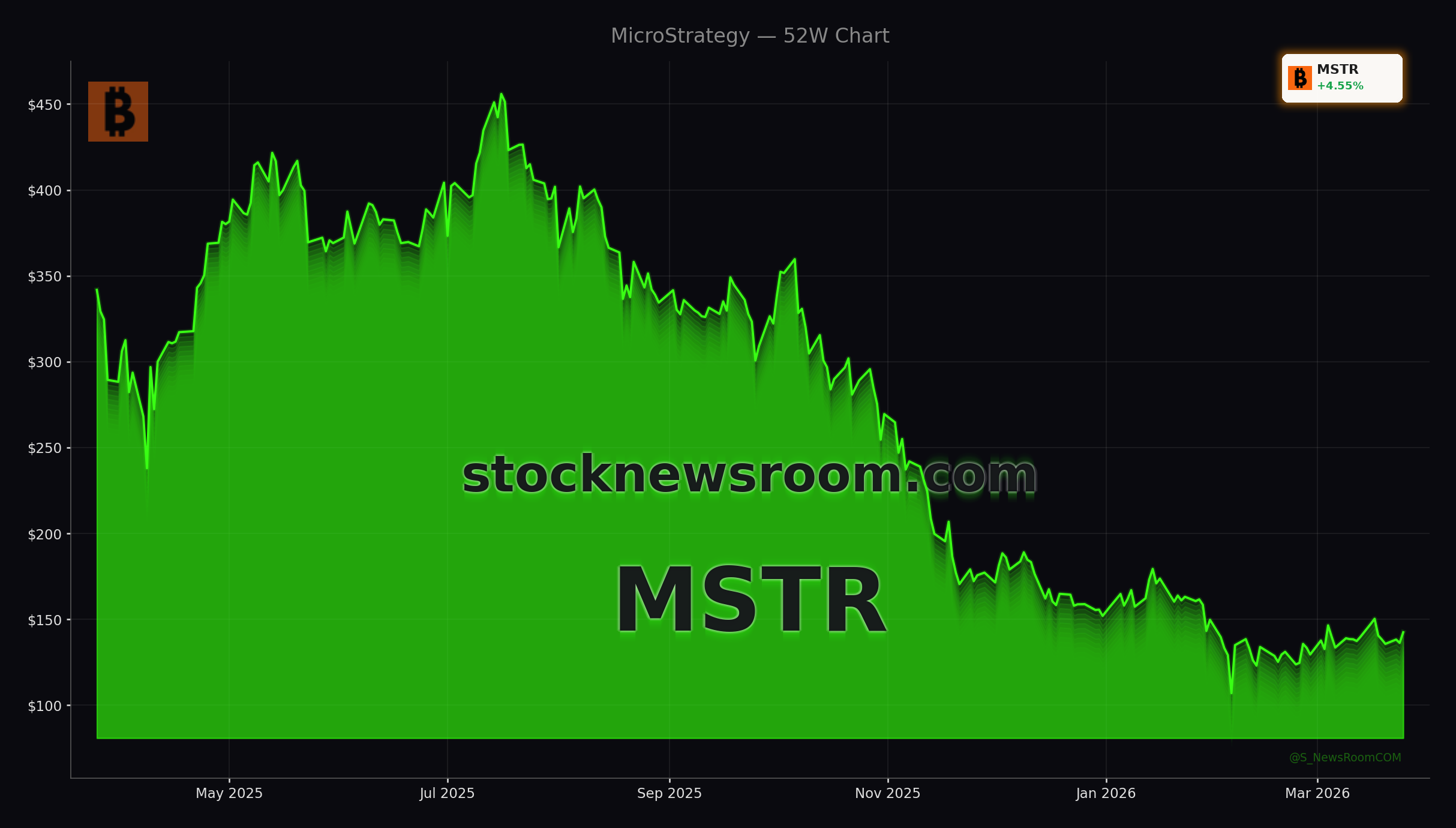
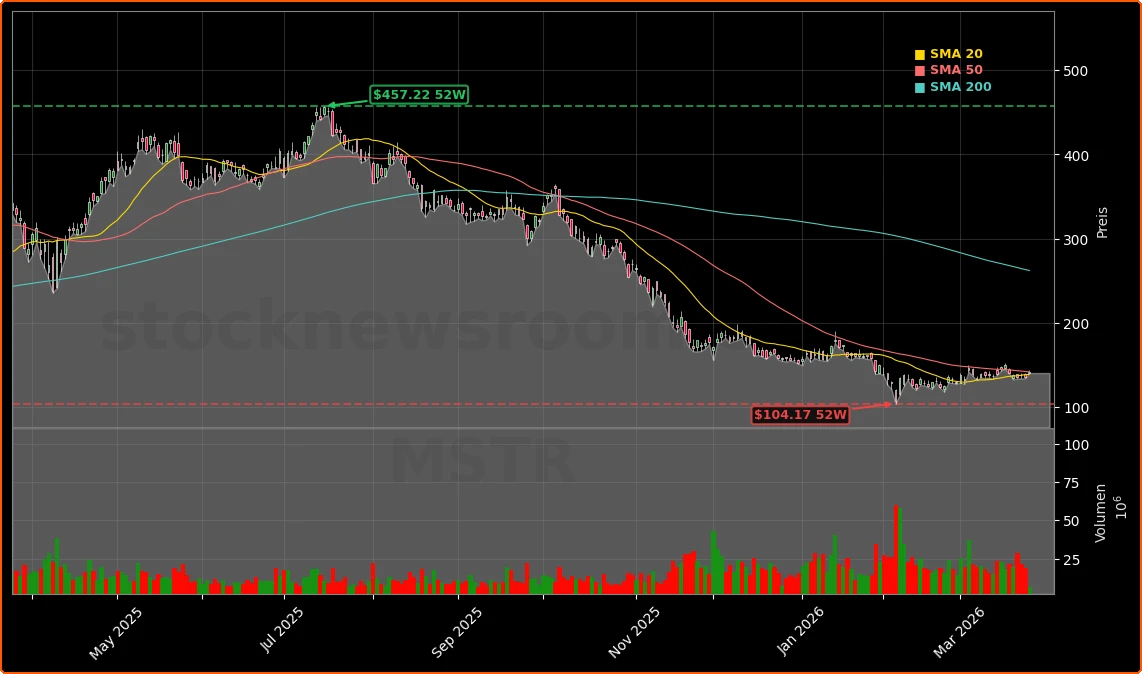
MSTR shares around $141 remain more than 50% below their six‑month peak, reflecting the brutal drawdown in Bitcoin since late 2025. Year to date, the stock is down sharply, yet the company continues to buy Bitcoin on weakness rather than retreat. The core of the MicroStrategy Bitcoin Strategy is unchanged: use capital markets and operating cash flows to build one of the world’s largest corporate BTC treasuries and hold through volatility.
Over the past week, the company added roughly 1,031 BTC for about $76.6 million, according to a recent SEC filing, bringing its holdings to roughly 762,099 Bitcoin. Management’s stated ambition is to eventually reach the symbolic one‑million‑BTC mark, which would give the company a unique structural position among U.S.-listed stocks, comparable in narrative power to how Tesla and NVIDIA came to dominate their respective themes of EVs and AI.
At today’s BTC prices in the low $70,000s, MicroStrategy’s stash is worth more than $54 billion, versus an average purchase price near $75,699 per coin, implying only a mid‑single‑digit percentage drawdown on its Bitcoin position despite the recent correction. That modest unrealized loss helps explain why the company keeps leaning in rather than de‑risking.
What financing tools power the MicroStrategy Bitcoin Strategy?
A key feature of the MicroStrategy Bitcoin Strategy is its evolving capital stack. Beyond traditional convertible notes and at‑the‑market (ATM) equity programs, the company has built a fast‑growing digital credit business via STRC preferred shares and related Bitcoin‑backed products. Recent offerings with coupons around 11.5% have enabled MicroStrategy to raise billions of dollars without diluting common shareholders as heavily as in past cycles.
Bernstein recently reiterated an Outperform rating on MSTR with a $450 price target, paired with a 2026 Bitcoin target of $150,000 per coin. The research house highlighted more than $2.25 billion of cash reserves as a “fortress” liquidity buffer and argued that forced BTC liquidations are unlikely under current structures. Analysts there also pointed out that STRC preferred shares funded more than $1.5 billion in BTC purchases this month alone, despite a 20% drawdown in the underlying crypto price.
Other Wall Street voices are more cautious. Coverage from firms like Zacks Investment Research has stressed that MSTR is far more volatile than the broader NASDAQ and S&P 500, and that the equity behaves more like a leveraged Bitcoin derivative than a traditional software stock. For U.S. investors, that means position sizing and risk controls must look closer to crypto‑trading discipline than to a standard tech allocation such as Apple or NVIDIA.
How critical is the new Bitcoin security program?
MicroStrategy is not only scaling its balance sheet exposure; it is also trying to harden the infrastructure around its holdings. The company has launched a search for a Bitcoin Security Director who will serve as the chief architect for securing more than 762,000 BTC. The role demands deep expertise in cybersecurity and cryptography, including multisignature wallet design, hardware security modules, and robust recovery schemes to eliminate the risk of lost keys.
This move turns MicroStrategy from a passive BTC accumulator into an influential player in crypto security standards. The new director is expected to work closely with Bitcoin Core developers and large institutions such as banks and asset managers, potentially shaping how corporate and institutional treasuries custody digital assets worldwide. For investors on Wall Street, that suggests a second leg to the MicroStrategy Bitcoin Strategy: not only owning BTC at scale, but also monetizing know‑how and infrastructure around it over time.
With BTC holdings now representing tens of billions of dollars in value, any operational failure would be catastrophic for equity holders. The build‑out of a dedicated security program can therefore be read as a long‑term commitment signal, underlining management’s intent to hold Bitcoin across cycles and to minimize non‑market risks such as hacks and protocol‑level vulnerabilities.
How does MicroStrategy compare to other Bitcoin plays?
MicroStrategy’s approach differs from bitcoin miners and spot ETFs. Miners are exposed to operational costs, halving cycles and hosting risks, while ETFs simply track BTC without leverage or operating leverage from a software business. MSTR, by contrast, layers corporate leverage, software cash flows and capital‑markets engineering on top of its BTC stack, which can magnify both upside and downside.
Some commentators argue that MSTR has effectively become a proxy for a leveraged long‑Bitcoin trade, similar to how Tesla became the go‑to EV momentum stock in previous years. Others see optionality: if the software analytics business stabilizes or grows, it could provide an additional earnings cushion that pure crypto vehicles lack. For mainstream investors who cannot or will not buy Bitcoin directly, MicroStrategy sits alongside Bitcoin ETFs, miners and large‑cap tech with crypto exposure such as Apple as part of the broader digital‑asset opportunity set.
Sentiment remains split. 24/7 Wall Street has highlighted the 50%+ year‑to‑date decline and warned that the ongoing BTC accumulation by the billions adds risk if the next crypto downturn proves deeper or longer than expected. By contrast, outlets like The Motley Fool have suggested that, if Bitcoin resumes its long‑term uptrend, MicroStrategy’s combination of scale and leverage could be a wealth‑builder for patient, risk‑tolerant shareholders.
Related Coverage
For a deeper dive into how the company plans to raise up to $42 billion through ATM equity programs to keep buying BTC, read MicroStrategy Capital Strategy Boom: $42B ATM Shift Into Bitcoin, which explores whether this financing model is visionary or dangerously pro‑cyclical. Investors comparing crypto‑themed equity plays across the digital‑asset landscape may also want to look at Ripple Q2 Outlook: Binance Margin Shock vs On‑Chain Surge, which analyzes how changing leverage conditions on major exchanges could impact XRP and broader altcoin sentiment.
In summary, the MicroStrategy Bitcoin Strategy is evolving into a two‑pronged bet on both massive BTC ownership and the infrastructure needed to secure it, backed by increasingly sophisticated capital‑markets tools. For U.S. investors willing to embrace crypto‑style volatility in an equity wrapper, MSTR offers concentrated exposure that few NASDAQ names can match. The next legs in Bitcoin’s price path, the success of new security initiatives and Wall Street’s appetite for MicroStrategy’s funding vehicles will determine whether this high‑conviction strategy pays off or tests shareholder patience again.