
Is MicroStrategy’s aggressive Bitcoin leverage strategy setting up investors for outsized gains or a painful volatility shock?
Is MicroStrategy tightening its Bitcoin leverage bet?
The core of the MicroStrategy Bitcoin Strategy remains unchanged: maximize long‑term Bitcoin holdings using both corporate cash flows and capital‑markets financing. Market participants expect an updated disclosure of the company’s Bitcoin reserves later today, with speculation that accumulation in recent weeks has been “massive” compared to prior quarters. Earlier commentary suggested that recent purchases could run into the tens of thousands of coins, potentially surpassing earlier waves that were already seen as aggressive.
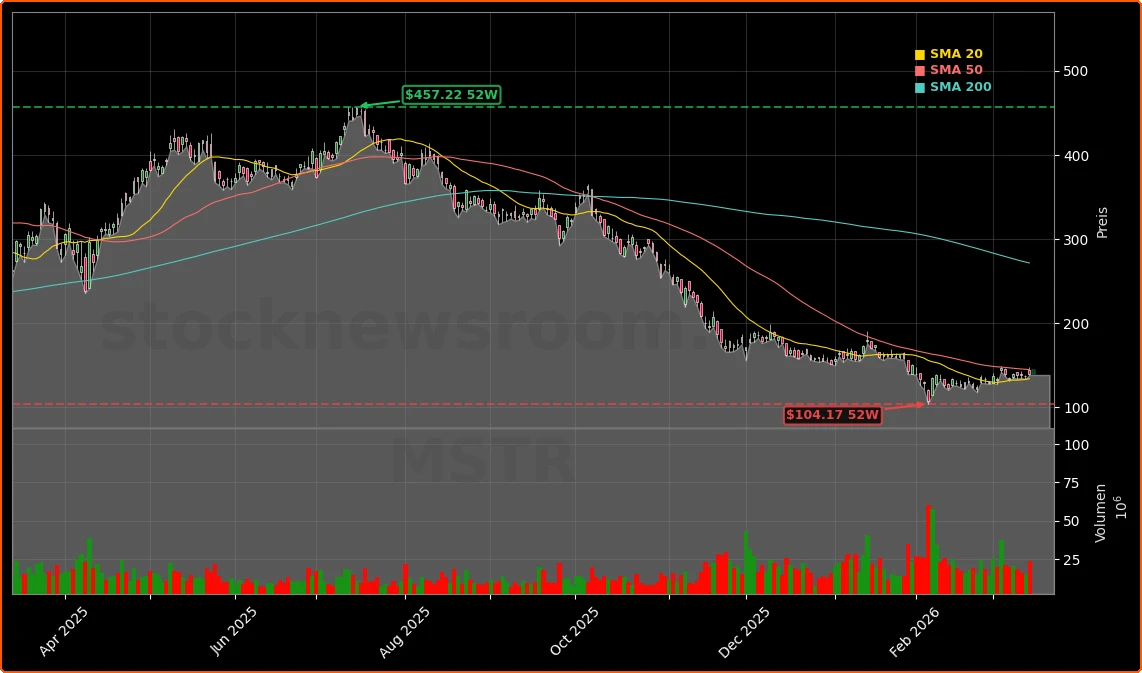
This high‑beta approach shows up in the stock’s behavior. While MSTR is currently well below its 52‑week high, the shares have bounced sharply from a year‑to‑date low near $106 and now trade in a consolidation zone around the mid‑$140s. If Bitcoin, currently hovering in the low‑$70,000s, were to push decisively through $74,000–$80,000, traders on Wall Street are eyeing quick upside targets near $180 for MSTR, particularly through derivatives such as call options and structured products.
For U.S. portfolios, that means MicroStrategy effectively acts as a listed Bitcoin call option with operational software cash flows as a partial buffer. Volatility cuts both ways, and the company’s capital structure is more sensitive to crypto drawdowns than typical NASDAQ software names like Apple or NVIDIA.
How does new capital from Strive change the picture?
Adding a fresh twist to the MicroStrategy Bitcoin Strategy, investment firm Strive has injected $50 million into the company via Series A preferred shares. This preferred equity provides MicroStrategy with additional, relatively stable capital that can be deployed either to service existing obligations or, as many expect, to fund further Bitcoin purchases in line with its treasury policy.
The Strive investment also serves as a signaling event for institutional sentiment. While MicroStrategy is not part of the S&P 500, it has become a reference name for Bitcoin‑linked equity exposure alongside high‑profile innovators such as Tesla. For hedge funds and family offices that cannot or will not hold spot Bitcoin directly, preferred and common equity in MicroStrategy offers a familiar corporate structure with crypto‑driven upside.
At the same time, short interest in MSTR has been climbing, reflecting a growing camp of skeptics who see excessive balance‑sheet concentration in a single volatile asset. These bears are not only fading Bitcoin’s rally but also questioning whether equity holders are being pushed too far down the risk ladder as new hybrid and preferred instruments are issued.
What are analysts saying about MicroStrategy Bitcoin Strategy?
Equity research coverage has become more vocal as Bitcoin grinds higher. MarketBeat recently highlighted that MicroStrategy doubled down on its Bitcoin positioning in a choppy environment, underlining that the company’s equity narrative is now almost entirely tied to crypto cycles rather than core software metrics. Zacks Investment Research has pointed out that MSTR has outperformed on select days even when the broader market softened, underscoring its decoupling from typical NASDAQ and S&P 500 drivers.
Several Wall Street firms have issued constructive views tied explicitly to the MicroStrategy Bitcoin Strategy. B. Riley initiated upside‑oriented coverage on MicroStrategy and Strive, effectively classifying both as “Bitcoin treasury” plays that could outperform if institutional adoption of digital assets accelerates. In separate commentary, analysts have sketched bullish scenarios in which a Bitcoin move toward $100,000 could justify meaningfully higher MSTR price targets, though precise numbers differ by firm.
Both bullish and bearish analysts stress that MicroStrategy provides magnified exposure: when Bitcoin rises, the equity can move by a multiple of the underlying, but the same leverage works on the downside. That makes MSTR more speculative than diversified mega‑caps like Apple or crypto‑adjacent chip leaders such as NVIDIA.
How might U.S. investors position around MicroStrategy?
With MSTR up 1.70% on Friday and another roughly 4% indicated pre‑market, traders are watching the $150 resistance level as a near‑term technical hurdle. A clear break, combined with Bitcoin strength above $73,000, could invite momentum‑driven flows from U.S. growth and thematic funds focused on digital assets.
Longer‑term investors weighing the MicroStrategy Bitcoin Strategy face a straightforward trade‑off. On one hand, the company offers equity‑market access to a large and growing Bitcoin trove, backed by an operating software business and now complemented by preferred capital from Strive. On the other, the balance sheet’s concentration risk, rising short interest, and dependence on crypto liquidity cycles make it far riskier than typical technology holdings.
Conclusion
In summary, the MicroStrategy Bitcoin Strategy continues to define the stock’s identity: a high‑conviction, high‑volatility bet on Bitcoin wrapped in a listed U.S. corporation. For American investors comfortable with that profile, MSTR remains a leveraged vehicle on digital‑asset upside, and the next leg of Bitcoin’s move will likely determine whether the path leads toward $180 targets—or back toward the recent lows.
Further Reading
- MicroStrategy Incorporated (MSTR) on Yahoo Finance (Yahoo Finance)
- MSTR stock analysis as an analyst sees Bitcoin price hitting $100k (Invezz)
- Strategy Doubles Down on Bitcoin in a Volatile Market (MarketBeat)
- Strategy (MSTR) Ascends While Market Falls: Some Facts to Note (Zacks Investment Research)