
Are MongoDB Earnings still worth a growth premium after a near 20% crash on what looked like a strong quarter?
MongoDB, Inc.: How could strong MongoDB Earnings lead to such a brutal sell-off?
On the surface, the latest MongoDB Earnings looked impressive. Revenue in the most recent quarter grew 26.8% year over year to $695.1 million, the strongest growth rate in about two years and roughly $26 million above consensus estimates. Adjusted (non‑GAAP) earnings per share came in at $1.65, beating forecasts by about $0.18. Operationally, the company also made big strides in cash generation, with operating cash flow jumping from $50.5 million a year ago to $179.6 million.
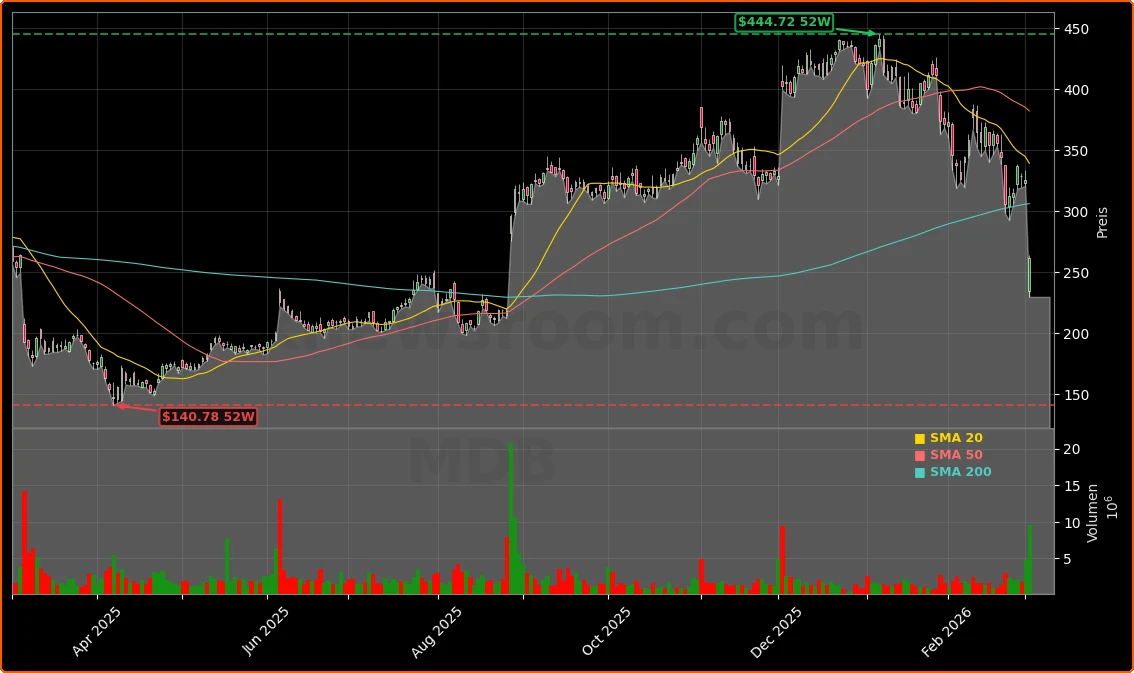
Yet the stock collapsed anyway. At around $261.87 in regular trading, MongoDB shares are down close to 20% on the day and more than a quarter from last week’s levels, after dropping as much as about 27% in pre‑market and extended trading. The move has erased months of gains and pushed the shares to multi‑month lows, underscoring how unforgiving Wall Street is toward richly valued software names when the outlook even slightly misses the mark.
Several factors converged: a softer‑than‑hoped revenue and EPS outlook for the coming quarter, a cautious full‑year revenue guide, signs of decelerating growth in the cloud database platform Atlas, and a broad derating across the software sector. A sudden leadership reshuffle in customer‑facing roles amplified fears that execution risk is rising just as the macro environment and competitive pressures get tougher.
For investors who only glance at the headline beat, the reaction may look irrational. But in an environment where many software stocks trade at high multiples and the NASDAQ is under pressure, expectations matter more than the last quarter’s scoreboard. The MongoDB Earnings release collided with this reality.
MongoDB, Inc.: What exactly disappointed in guidance and growth?
The core problem in the MongoDB Earnings report lies in the outlook, not in the quarter just reported. For the upcoming quarter, management guided revenue to a range of $659 million to $664 million, essentially in line with consensus of about $662.5 million but without any upside. On adjusted EPS, guidance of $1.15 to $1.19 fell short of expectations around $1.21. On paper, the misses are modest, but for a stock priced for perfection, even small gaps can be costly.
For the full fiscal year, MongoDB expects revenue between $2.86 billion and $2.90 billion. That is only slightly below some prior Street models that hovered near $2.9 billion, and management actually projected full‑year adjusted EPS of $5.75 to $5.93, suggesting better profitability than previously assumed. The reaction shows clearly that for this name, growth momentum is what investors are paying for; mild revenue underperformance matters more than marginal upside on earnings.
One particular worry flagged by Wall Street is MongoDB Atlas, the company’s flagship cloud database‑as‑a‑service platform. After years of very rapid expansion, recent growth in Atlas has slowed relative to lofty expectations. Reuters highlighted that slower quarterly revenue growth in Atlas, combined with the muted forecast, contributed to the roughly 27% sell‑off to a six‑month low. In a market obsessed with cloud and AI‑driven expansion, any hint of normalization in a key growth engine invites a sharp reset in valuation.
Stepping back, the message from the MongoDB Earnings call is not that the business is collapsing. Growth in the mid‑20s, strong cash flow, and improving profitability are objectively solid. But the message investors are sending is that “solid” is not enough to sustain premium multiples when the sector is out of favor and when peers in hardware or AI infrastructure are delivering visibly stronger near‑term demand.
MongoDB, Inc.: How does the leadership shake-up alter the risk profile?
Beyond the numbers, the MongoDB Earnings release was overshadowed by management changes that caught investors off guard. Two senior executives in sales and customer‑facing roles, Cedric Pech and Paul Campobassis, are leaving the company. At the same time, MongoDB is bringing in Erica Violini to lead customer affairs, with a mandate to accelerate the next growth phase.
Officially, the company described the transition as planned and emphasized continuity. However, the timing—announced alongside a cautious outlook and slowing Atlas growth—raises questions. The phrasing that Violini was hired to “accelerate the next growth phase” implies dissatisfaction with earlier execution in go‑to‑market or customer expansion. Investors worry that this is more than just a routine reshuffle; it may signal that MongoDB sees structural challenges in converting its strong product position into sustained hyper‑growth.
Leadership transitions in sales and customer roles often carry higher execution risk than changes in back‑office positions, because they can disrupt relationships, sales cycles and internal culture. Coupled with a sector already under scrutiny, this was enough to act as a catalyst for traders already concerned about the stock’s valuation. The MongoDB Earnings miss on guidance therefore has an outsized impact because it is now tied in investors’ minds to uncertainty about management’s ability to reignite growth.
For long‑term shareholders, the key question is whether this is a short‑term disruption or the beginning of a longer period of strategic re‑alignment. Clarity from upcoming quarters—particularly updates on sales productivity, Atlas customer adds, and large‑deal momentum—will be critical.
MongoDB Earnings in the context of the software and AI rotation
The MongoDB Earnings fallout does not happen in a vacuum. Software as a whole is one of the weakest‑performing segments of the market this year, even as headline indices remain near highs. Investors have been rotating out of high‑multiple software names and into AI infrastructure and hardware plays like NVIDIA and more cyclical reopening or value stories. This macro rotation magnifies any stock‑specific disappointment.
Multiple news outlets have pointed out that “good numbers are no longer good enough” for software in 2026. MongoDB delivered beats on revenue, margins, and EPS, but a slightly softer outlook was sufficient to trigger what some commentators have dubbed a “SaaS apocalypse”–style reaction. Other cloud and database stocks, such as Elastic, also traded lower in sympathy, illustrating the sector‑wide sensitivity to guidance.
The market is especially skeptical of software names whose near‑term monetization of AI is unclear. One firm, Bear, downgraded MongoDB to Neutral and cut its price target, citing limited visible AI revenue as a potential overhang. While MongoDB offers tools and integrations that can support AI workloads, investors currently reward companies with direct, measurable AI revenue acceleration, such as GPU sellers or hyperscale cloud providers, more than those whose AI tailwinds are indirect or longer‑dated.
Compared with mega‑caps like Apple or platform names like Tesla that benefit from diversified revenue streams and consumer franchises, MongoDB remains more exposed to sentiment swings in a single, competitive niche—databases and developer infrastructure. That makes the stock particularly vulnerable when the NASDAQ and growth indices move into a risk‑off mode.
MongoDB, Inc.: Is the valuation reset enough after the plunge?
Valuation was a key part of the bear case even before the latest MongoDB Earnings report. MongoDB has long traded at a premium to the broader software universe, reflecting its strong strategic position in document databases, recurring revenue, and high net expansion rates. Even after the sharp decline, that premium has not completely vanished.
Based on MongoDB’s own full‑year EPS guidance, the stock is still trading at a forward P/E in the low‑40s for fiscal 2026, around 42x on some estimates. That is down from far loftier levels, but it remains rich relative to more mature software peers and substantially above the average S&P 500 multiple. Bulls sometimes point to a PEG ratio (price/earnings to growth) around 0.5 as evidence that the valuation is not outrageous given expected earnings expansion, but the market is currently questioning how durable the growth trajectory really is.
Several Wall Street firms have responded by cutting their price targets while mostly maintaining positive ratings. Bernstein reduced its target to $428 but kept an Outperform stance. Bank of America lowered its target to $400, also reiterating a Buy. Oppenheimer and Wells Fargo trimmed their targets to around $375 while staying bullish. This cluster of cuts shows that analysts broadly agree the valuation needed to compress, yet many still see upside from current levels if MongoDB can execute on its strategy.
At the same time, at least one firm—Bear—moved to a Neutral rating, underscoring that not all observers are confident the current reset is sufficient. With the share price now far below prior targets, investors have to decide whether Wall Street is simply slow to update its models, or whether the stock has over‑corrected and now embeds a margin of safety.
MongoDB, Inc.: Key technical levels and risk management for investors
Technically, the MongoDB Earnings sell‑off has done real damage to the chart. The stock had already been flirting with its 200‑day moving average in recent sessions. The post‑earnings gap‑down took the price decisively below that long‑term trend line, typically viewed as a bearish signal and a potential trigger for systematic selling. On an intraday basis, the stock dropped to around $229.60 at one point in extended trading before stabilizing near current levels.
Technical analysts are now watching several support zones. Some see initial support in the $215–$220 range, with a deeper potential “double‑bottom” pattern near $150 if selling pressure persists. These levels are less about precise forecasts and more about risk management: they help long‑term investors plan staggered entries instead of attempting to “catch a falling knife.”
In the near term, volatility is likely to remain elevated. Options markets had been pricing in a big move into the MongoDB Earnings event, but the realized drop still surprised many traders. For portfolios heavily weighted toward unprofitable or high‑multiple software, the MongoDB shock is a reminder to reassess concentration risk, especially relative to the broader NASDAQ and S&P 500 exposure.
Investors who want exposure to data infrastructure but are uncomfortable with single‑stock volatility might consider diversifying across multiple names or using ETFs with broader software or cloud coverage. Those with existing MongoDB positions should revisit their thesis: is the core story about developer adoption and cloud database penetration intact, or has the risk/reward balance materially shifted?
MongoDB, Inc.: What to watch after the MongoDB Earnings shock
Looking forward, the next few quarters will be critical in determining whether the current price reset becomes a buying opportunity or the start of a longer derating. After such a violent reaction to the MongoDB Earnings report, the bar for positive surprises may now be lower—but execution risk is higher.
Investors should focus on a few key metrics. First, the growth rate of MongoDB Atlas: reacceleration or at least stabilization would counter the narrative that the company’s main cloud engine is maturing too quickly. Second, net expansion rates and large‑deal activity: these will show whether existing enterprise customers continue to scale their workloads on the platform. Third, operating leverage and cash flow: further improvements would support the case that MongoDB can grow into its valuation even if top‑line growth moderates somewhat.
In parallel, clarity on the new leadership structure and sales strategy will matter. Any evidence that the new customer‑facing executive team is driving better win rates, faster deal cycles, or stronger partnerships with major clouds could rebuild confidence. Detailed commentary on AI‑related workloads and how they translate into concrete revenue opportunities would also help, especially in a market that is rewarding companies with more direct AI monetization.
For now, the MongoDB Earnings reaction sends a clear message to the entire software complex: in an environment where names like NVIDIA capture the AI narrative and defensive giants like Apple command investor trust, mid‑cap, high‑multiple software stocks must do more than simply beat last quarter’s estimates. They need to convincingly show that growth, profitability, and strategic positioning all justify their valuations—quarter after quarter.
Conclusion
Conclusion: The latest MongoDB Earnings report demonstrates how fragile sentiment can be around premium software names. The company delivered its fastest revenue growth in two years, beat on EPS, and posted strong cash flow, yet the stock was punished for cautious guidance, slowing Atlas growth, and a surprise leadership shake‑up. Valuation has reset, but remains demanding, and both execution risk and sector headwinds are elevated. For most investors, patience may be the better strategy: let the dust from this MongoDB Earnings shock settle, watch how the next few quarters unfold, and only then decide whether the long‑term opportunity in cloud databases justifies stepping back into this volatile story.
Further Reading
- MongoDB, Inc. (MDB) on Yahoo Finance (Yahoo Finance)
- Database Provider MongoDB’s Profit Forecast Disappoints. Its Stock Is Plunging. (Investopedia)
- MongoDB shares plummet 27% on weak growth in cloud business, muted forecast (Reuters)
- Why MongoDB Stock Is Plummeting Today (The Motley Fool)