
Will the Netflix Merger with Warner radically transform the streaming market – or will Netflix prefer to collect the billion-dollar breakup fee?
What is behind the Netflix Merger with Warner?
Netflix, Inc. is in an intense bidding war for Warner Bros. Discovery. The current Netflix offer values the transaction – focused on studios, content catalog, and the HBO Max streaming service – at approximately $82.7 billion. Netflix is offering $27.75 per Warner share, while traditional linear TV channels are left out. Meanwhile, Paramount Skydance has made an improved cash offer of $31 per share for 100% of Warner, clearly surpassing the threshold for further discussions.
Formally, the recommendation still favors the Netflix deal, but the Warner board signals that the Paramount offer could be classified as a “superior proposal.” In this case, Netflix has a four-day window to improve its offer or withdraw from the merger. The actual value of the Netflix offer depends on the later evaluation of the Discovery Global spin-off and its debt, which creates additional uncertainty for investors.
Why is Netflix reacting so strongly in the stock market?
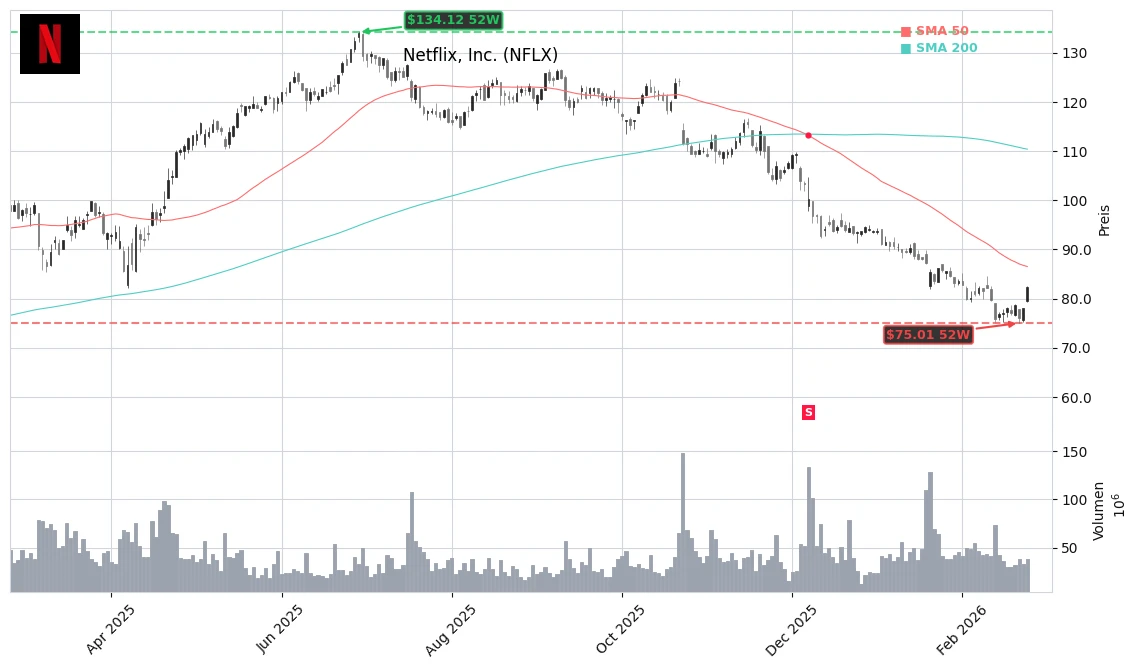
It is noteworthy that Netflix’s stock has risen significantly despite the potential billion-dollar acquisition. After a multi-month correction of around 41–43% since the all-time high in June, Netflix is now trading at $82.27, approximately 5.4% higher than the previous day. Technically, this breakout above the resistance area at $78–79 and a stable reclaiming of the $80 mark is significant, especially after the stock had previously turned upward multiple times around the $75 zone.
A key reason: The market is increasingly pricing in the scenario that Netflix will let the merger fall through, collect the breakup fee of around $2.8 to nearly $3 billion, and avoid a costly, regulatory-risk-laden mega-deal. Instead of shouldering net liabilities potentially exceeding $100 billion, Netflix could maintain its current, relatively comfortable debt level of around 0.6x EBITDA and use the cash for organic growth, content, and stock buybacks.
Netflix Merger or Withdrawal – What Would Be Strategically Smarter?
Substantively, an acquisition of Warner’s assets would be attractive for Netflix: Brands like “Harry Potter,” “The Lord of the Rings,” “The Sopranos,” or “Friends,” as well as 128 million HBO Max subscribers, could further enhance reach and pricing power, particularly accelerating the advertising business. However, this market power has drawn critics in the U.S. Eleven state attorneys general have urged the Justice Department to scrutinize the Netflix merger closely, fearing an overly dominant position in the film and series market.
At the same time, the existing core business is delivering impressive numbers: By the end of 2025, Netflix had 325 million paying subscribers, 2025 revenues of $45.2 billion, and rapidly growing advertising revenues. The ad-supported subscription grew by about 150% in 2025 to $1.5 billion and is expected to double again in 2026 to around $3 billion. This would mean advertising would account for nearly 6% of total revenue – a growth area that can be addressed without major acquisitions.
How Do Valuation and Analysts View Netflix Right Now?
Fundamentally, Netflix is as cheap as it has been in three years following the stock decline. Based on 2025 earnings of $2.53 per share, the price-to-earnings ratio is around 30–31, close to a three-year low and slightly below the Nasdaq-100 level. On a forward basis, with consensus estimates of about $3.12 earnings per share for 2026, the P/E ratio drops to just over 25.
Several firms – including Morgan Stanley, Goldman Sachs, and Citigroup – have recently rated Netflix predominantly with positive long-term outlooks, although short-term uncertainty surrounding the Netflix merger is dampening sentiment. RBC Capital Markets points out in its assessments the strong growth of the advertising business and robust margin development. For this reason, many strategists see the greatest value creation in Netflix allowing for a “graceful exit” from the bidding war, collecting the breakup fee, and preserving its balance sheet for future, smaller deals and content investments.
“In the end, Netflix is a winner even if it loses the bidding process for Warner – as long as the focus remains on profitability and organic growth.”
— A market strategist from the technology sector
Bottom Line
The Netflix merger with Warner Bros. Discovery has transformed from the hoped-for growth engine into a stress test for Netflix’s strategy, balance sheet, and stock performance. For investors, a failure of the deal with simultaneous breakup fee and a focus on the dynamically growing advertising business could be the more attractive option than an overpriced mega-deal with high debt leverage. The upcoming days of the four-day window remain crucial – but also offer a chance for Netflix to emerge from the bidding war stronger and more clearly positioned.
Related Sources
- Netflix, Inc. (NFLX) on Yahoo Finance (Yahoo Finance)
- Netflix: The Four-Day Countdown To Match – Or Walk (Seeking Alpha)
- Netflix’s Warner Deal May Be Dead. Why the Streamer Should Make a ‘Graceful Exit’ (Barron’s)
- Paramount Skydance Just Raised its Bid for Warner Bros. — Is the Netflix Deal Dead? (The Motley Fool)