
Is the Netflix merger with Warner facing strong resistance from U.S. antitrust regulators and politicians?
Why is Netflix at the center of the Warner deal?
Netflix, Inc. is currently vying for the acquisition of Warner Brothers Discovery’s studios and streaming networks—a Netflix merger that could fundamentally shift the power dynamics in Hollywood. The bid of approximately $72 billion aims to consolidate film studios, series libraries, and additional streaming rights under one roof. Netflix Co-CEO Ted Sarandos argues that the acquisition would expand offerings and enable growth for the entire industry, as Netflix currently does not own any major traditional studios.
In parallel, Paramount Skydance is attempting to absorb Warner Brothers through a more comprehensive deal that also includes struggling linear TV channels. While Paramount’s offer is nominally higher, Sarandos emphasizes that this model is more likely to lead to cost-cutting and a shrinking industry, whereas the Netflix merger focuses on scaling in streaming and new content.
For investors, the crucial point is that the competition for Warner increases both strategic opportunities and regulatory risks—and both are currently reflected in a significantly higher volatility of Netflix’s stock.
How aggressively is the U.S. Department of Justice intervening?
The U.S. Department of Justice (DOJ) has initiated a formal antitrust review of the Netflix merger. Central to the inquiry are questions about whether a combination of Netflix and Warner Brothers could create a de facto monopoly in premium streaming and prestigious film productions. Investigators are examining not only the overlap in content but also Netflix, Inc.’s past business practices and potential competitive disadvantages for other studios and filmmakers.
According to media reports, both the Sherman Act and the Clayton Act are cited in internal documents, which are U.S. laws applied to monopolistic behavior and competition-distorting mergers. The explicit reference to these regulations indicates how seriously authorities are taking the case. Observers expect the review to take weeks to months.
A prolonged delay plays directly into Paramount’s hands: Warner Brothers has set a tight deadline for the competitor to submit a “best and final” offer by Monday at 11:59 PM ET. The deeper the DOJ delves into the Netflix merger, the more attractive a seemingly regulatory simpler Paramount solution may appear to Warner shareholders.
What role does Donald Trump play in the conflict?
The situation gains additional intensity due to Donald Trump’s involvement. The former U.S. president sharply criticized Netflix, Inc. over the weekend, publicly demanding the immediate dismissal of board member Susan Rice. Rice, a former ambassador to the United Nations and former national security advisor under Barack Obama, had warned companies in a podcast against aligning too closely with Trump politically, as they could be held “accountable” in the event of a power shift.
Trump labeled Rice as “racist” and “Trump-deranged” and threatened Netflix with unspecified “consequences” if she remained on the board—a threat many observers interpret in light of the ongoing merger review. Ted Sarandos countered that the Netflix merger is “a business deal, not a political deal,” and remained notably calm in the face of the ex-president’s pressure.
However, the political noise increases uncertainty for investors: it could tarnish the public perception of the deal and further complicate the already stringent DOJ review.
Why is the stock falling—and what does it mean for investors?
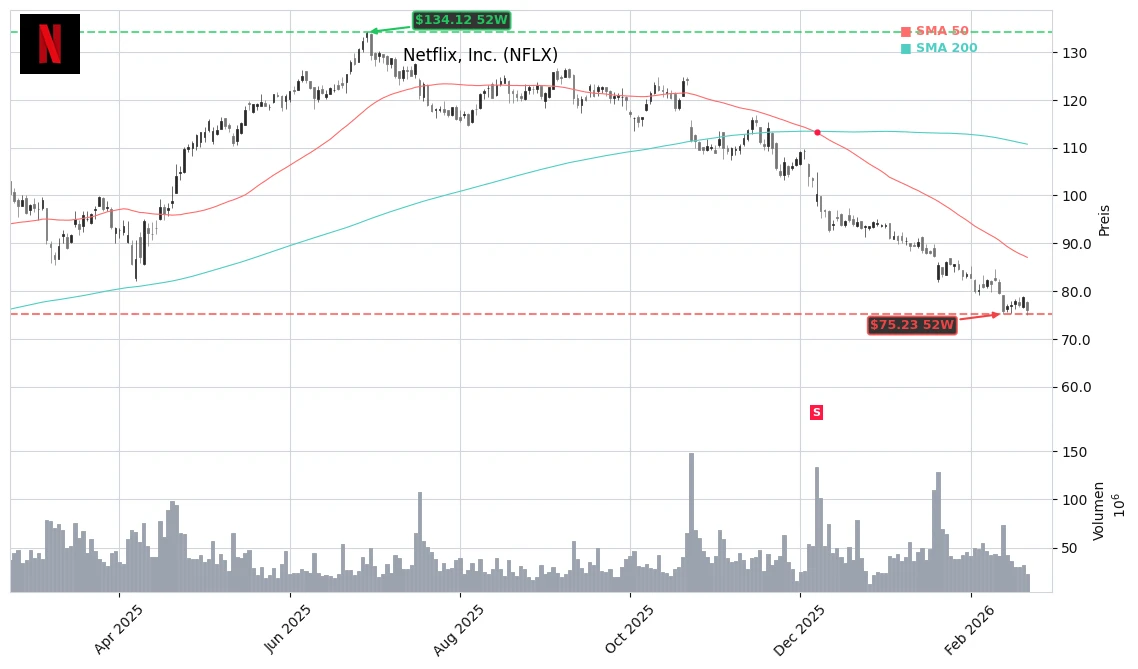
On Monday, Netflix, Inc.‘s stock drops to $76.11, down 3.25% from the previous day. In addition to merger risks, a new research paper from Citrini Research is causing anxiety. It suggests that so-called AI agents, which automatically manage subscriptions, book flights, or optimize online shopping, could pressure the business model of subscription-based services. If intelligent assistants regularly switch users between streaming offerings, customer retention is likely to decrease, and the churn rate for services like Netflix could rise.
Citrini outlines an extreme scenario with high unemployment, a massive economic downturn, and a significant decline in the S&P 500, where companies with subscription models would particularly suffer. Such forecasts are highly controversial, but they resonate in a market already unsettled by the Netflix merger, the DOJ review, and the political dispute surrounding Susan Rice. This explains why even moderate impulses today lead to significant price fluctuations in tech and streaming stocks.
At the same time, more optimistic voices point out that Netflix has historically shown strong recoveries once regulatory and sentiment-driven risks have been priced out of the market. However, there are currently no specific new ratings from firms like Citigroup, Goldman Sachs, or RBC Capital Markets regarding this particular merger scenario; many analysts are waiting for the DOJ’s next steps and the Warner shareholders’ vote in April.
“This is a business deal, not a political deal.”
— Ted Sarandos, Co-CEO of Netflix
Bottom Line
The Netflix merger with Warner Brothers is thus at the intersection of antitrust law, politics, and technological change, making the stock particularly volatile at present. For investors, this means increased short-term risks, but also the potential for a significant rebound if the merger is approved with conditions. The crucial factor now will be how the DOJ expands its review and whether Paramount can turn the showdown over Warner with a final counteroffer.
Related Sources
- Netflix, Inc. (NFLX) on Yahoo Finance (Yahoo Finance)
- DOJ probes Netflix’s power over filmmakers in Warner deal review (The Detroit News)
- Netflix boss defends bid for Warner Bros as Paramount deadline looms (BBC)
- Why Netflix Stock Just Dropped (The Globe and Mail)