
Will the Netflix merger with Warner Bros. Discovery turn into a risky debt gamble or a unique streaming opportunity?
What is behind the Netflix Merger?
Netflix has reached an agreement to acquire significant portions of Warner Bros. Discovery at the end of 2025. The core of the deal is a cash offer of $27.75 per share, totaling approximately $82.7 billion for studios and the streaming business, including iconic brands such as HBO, Harry Potter, and The Lord of the Rings. Concurrently, Paramount Skydance has increased its competing bid and submitted a revised offer to the WBD board. The board of Warner Bros. must now assess whether the new Paramount offer surpasses the deal with Netflix. If so, Netflix has a so-called matching right and four days to counter the higher bid. Should the streaming giant abandon the bidding contest, a breakup fee of $2.8 billion would be incurred. Thus, the Netflix Merger is not only strategically significant but also financially charged.
Netflix: Strength in Operations?
Currently, Netflix is demonstrating strong operational performance. In the fourth quarter of 2025, revenue rose by 17.6% to $12.1 billion, marking the third consecutive quarter of accelerating growth. The number of paying subscribers exceeded 325 million, showcasing the brand’s global reach. For the first quarter of 2026, management anticipates $12.2 billion in revenue, representing an increase of over 15%. Profitability is also improving: the operating margin was 29.5% in 2025 and is expected to rise to 31.5% in 2026. The advertising business is growing particularly dynamically. Advertising revenue surged by more than 150% in 2025 to over $1.5 billion, with a further doubling expected in 2026. This opens up a second growth avenue alongside price increases and customer growth, which could also support the planned integration of ad-supported HBO offerings as part of the Netflix Merger.
How Risky Will Debt Be for Netflix?
The flip side of the deal is financing. Netflix plans to take on approximately $52 billion in additional debt to finance the acquisition and will also assume Warner Bros. Discovery’s existing net debt of $10.7 billion. Although Netflix generated $9.5 billion in free cash flow in 2025 and aims for around $11 billion in 2026, the jump in debt levels would be substantial. Critics point out that the company is transitioning from an asset-light model to a heavily integrated studio corporation, whose cinema and TV revenues could be significantly more volatile. Additionally, there is antitrust uncertainty: the U.S. Department of Justice is examining whether the Netflix Merger with Warner Bros. Discovery could create dominant structures in streaming and Hollywood. A failure of the deal would limit the increase in debt but would still incur noticeable costs through the breakup fee.
What Does the Bidding War Mean for Netflix Stock?
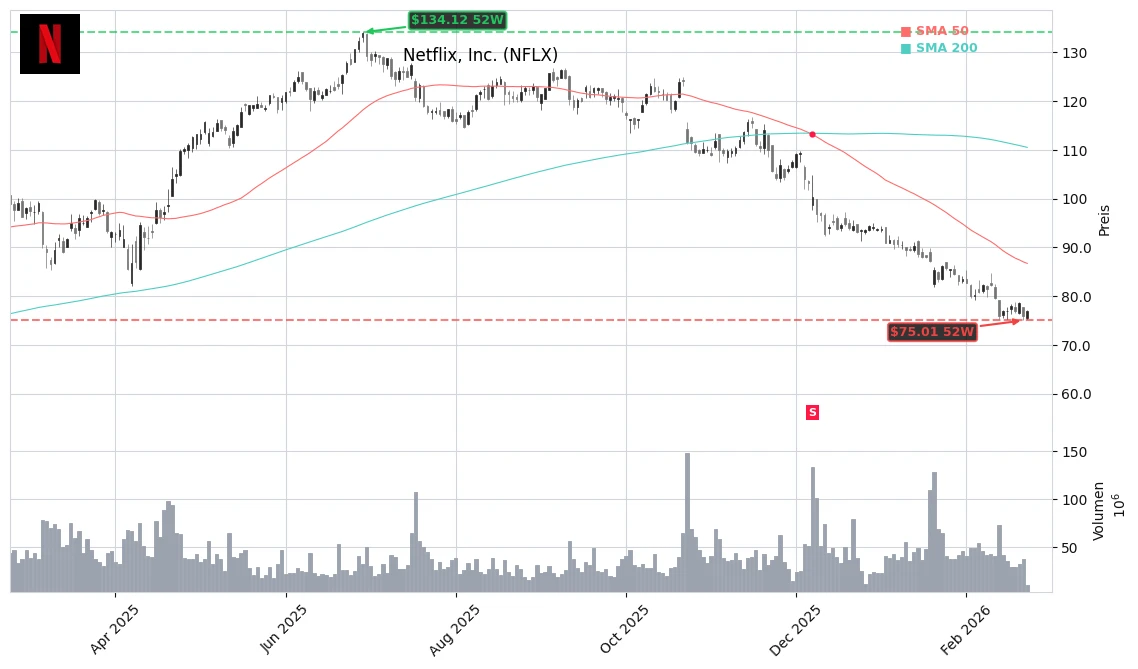
On the stock market, merger speculation has so far done more harm than good. The Netflix stock has significantly declined since the beginning of the year and is trading well below previous highs. At a price of around $76.91, the valuation corresponds to about 24 to 25 times the expected earnings per share for 2026. Some market observers see this as a level where much of the risk of the Netflix Merger is already priced in. Others warn that an escalating bidding war with Paramount Skydance could further drive up the acquisition amount and increase debt levels. Strategically, Warner Bros. Discovery is existentially important for Paramount, while for Netflix, it remains more of a “nice to have” deal to expand its dominance in Hollywood. Analysts like Gary Black argue that Netflix, thanks to strong cash flows and balance sheet strength, has the longer breath and could reach prices around $100 again in the medium term, even in the event of a loss in the bidding contest. Investment banks like Citigroup and RBC Capital Markets have recently focused on the shifted risk-reward profile and higher leverage but still see structural strengths in the core streaming business.
Bottom Line
The Netflix merger with Warner Bros. Discovery is a double-edged sword: it promises strong content and economies of scale but brings high debt and regulatory risks. For investors, the current decline in stock price indicates that some of this uncertainty is already priced in, while Netflix’s operational business and advertising growth continue to impress. Whether the bidding war with Paramount ends or escalates will be crucial in determining whether the Netflix merger acts as a stock driver or a drag—active investors should monitor the coming weeks closely.
Related Sources
- Netflix, Inc. (NFLX) on Yahoo Finance (Yahoo Finance)
- Netflix Stock Keeps Dipping: Is It Finally Time to Buy? (The Motley Fool)
- Netflix: Stock to Avoid or Once-in-a-Decade Opportunity? (The Motley Fool)
- Warner Bros. Discovery says Paramount makes higher bid, board will weigh offer against Netflix deal (CNBC)
- UK to regulate Netflix and other streamers in line with broadcasters (Reuters)