
Is Wall Street quietly betting that a high‑stakes Netflix Merger failure could be the best outcome for shareholders?
Is Wall Street cheering a failed Netflix Merger?
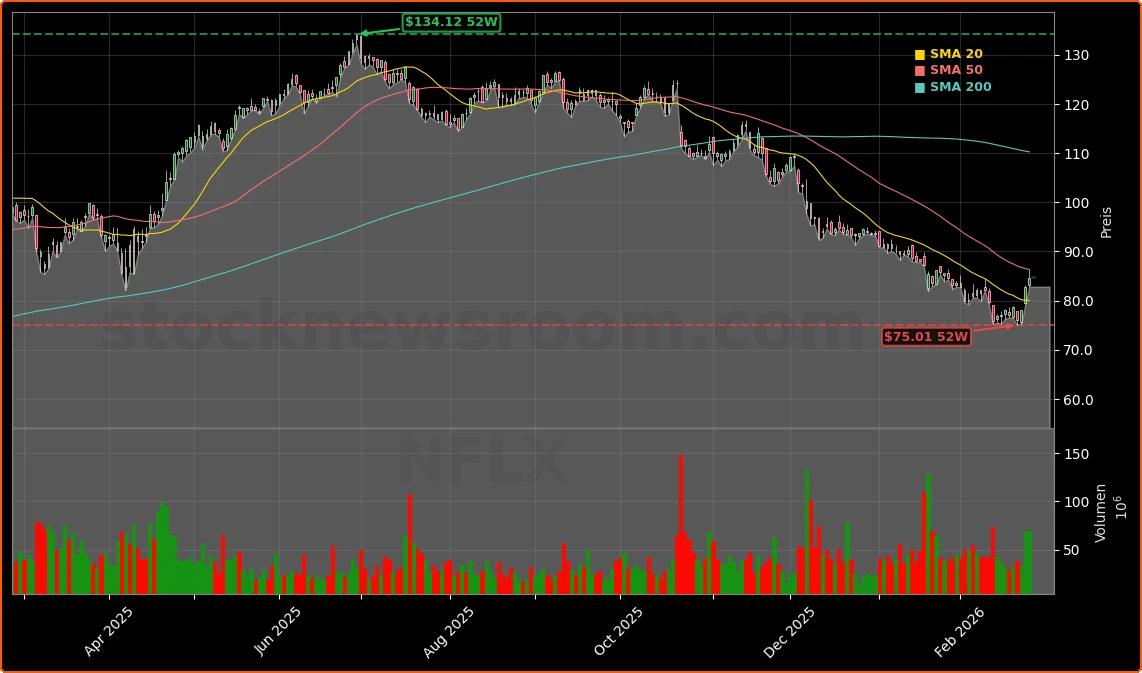
Netflix, Inc. (NFLX) has become one of the most active names in the S&P 500 and NASDAQ 100 this week as traders handicap the future of its contested bid for Warner Bros. Discovery. Despite lingering volatility, the stock has bounced from levels not far above its 52‑week low and finished Thursday at $84.59, while after‑hours trading edged the price to $84.72. The move came even as Warner Bros. Discovery’s board formally deemed Paramount Skydance’s revised $31‑per‑share cash proposal a “company superior proposal,” starting a four‑business‑day window for Netflix to match or sweeten its own deal.
That reaction underscores a crucial point for US investors: equity markets increasingly prefer a scenario in which the Netflix Merger collapses, leaving the streaming leader with its clean balance sheet and organic growth strategy intact. A completed transaction would likely saddle Netflix with more than $50 billion in new debt and force a deeper pivot into theatrical releases, a model that shareholders have historically viewed as lower‑margin and more cyclical than pure streaming.
At the same time, Netflix continues to operate from a position of operational strength. The company finished 2025 with roughly 325 million subscribers, driving revenue of about $45.2 billion, up 16% year‑over‑year, and diluted EPS growth of 28%. The new advertising tier, launched in late 2022 at $7.99 per month in the US, produced an estimated $1.5 billion in ad revenue in 2025 and is projected to double to $3 billion in 2026.
How do politics complicate Netflix’s strategy?
Deal dynamics around the Netflix Merger are unusually political. Co‑CEO Ted Sarandos was in Washington on Thursday for meetings at the White House, where the agenda includes both the Warner Bros. Discovery bid and pressure from President Trump to remove former national security adviser Susan Rice from Netflix’s board. Recent comments by Rice criticizing media companies seen as too accommodating to the administration have drawn sharp backlash, with the White House signaling that personnel decisions could influence its posture on mega‑deals in the media sector.
Sarandos has pushed back publicly, emphasizing that the company views the Warner Bros. Discovery transaction as a business decision rather than a political statement. Nonetheless, the optics of a West Wing visit in the middle of an active bidding war highlight the regulatory risk that could shadow any eventual approval. Antitrust regulators would need to weigh the combination of Netflix’s dominant global streaming platform with Warner’s deep content library and studio assets at a time when consolidation among US media and tech giants is already under intense scrutiny.
For portfolio managers, this raises the probability that even if Netflix were to outbid Paramount, closing the deal could be slow, litigious and expensive. That further strengthens the argument that the most shareholder‑friendly outcome might be to collect a sizable termination fee if Warner Bros. Discovery ultimately accepts the Paramount offer and leaves Netflix on the sidelines with fresh cash and no integration risk.
Where does Netflix stand versus Paramount and Apple?
Strategically, Netflix still looks better positioned than traditional media rivals such as Paramount Skydance, even without a Warner Bros. Discovery tie‑up. The company’s scale advantage in streaming, with more than 320 million subscribers compared with Paramount’s far smaller Paramount+ base, enables significantly higher content budgets and better global monetization. While taking on Warner’s assets could accelerate growth in studios and intellectual property, it would also import the drag of declining linear TV networks that remain a challenge for Warner’s standalone outlook.
At the same time, Netflix is increasingly moving onto the turf of big tech competitors like Apple and NVIDIA‑powered cloud platforms by expanding into sports, gaming and podcasts. A newly announced partnership with Apple to expand Formula 1 coverage in the US from 2026 illustrates this shift: Apple TV will be the primary live broadcaster, while Netflix is slated to host its first live Grand Prix with the 2026 Canadian race. For investors, that deal signals that Netflix can deepen engagement and attract younger audiences through sports without owning a legacy broadcast infrastructure.
In the broader mega‑cap tech and growth complex that also includes Tesla and Apple, Netflix trades at roughly 30 times trailing earnings, a multiple that has compressed by more than 50% over the last year as merger risk weighed on sentiment. Some Wall Street analysts argue that at this valuation, the stock embeds significant pessimism about the Netflix Merger, leaving room for upside if the company either walks away or secures terms that limit leverage and protect its investment‑grade profile.
Technical analysts point to a potential “hammer” reversal pattern in the monthly chart, with a green March candle seen as a possible trigger for a run back toward the psychologically important $100 level. Derivative traders are positioning around that thesis using discount options structures that would benefit from a failed deal and a relief rally in the shares, even after short‑term mark‑to‑market losses of more than 20%.
Major brokerages such as Citigroup, Goldman Sachs and Morgan Stanley have yet to publish updated formal ratings in response to the latest Paramount bid, but recent commentary from the Street has broadly emphasized Netflix’s long‑term fundamentals over the outcome of any one transaction. With ad revenue ramping, new ventures in live sports and gaming, and a still‑underpenetrated global streaming market, many institutional investors see a clearer risk‑reward profile if the Netflix Merger with Warner Bros. Discovery ultimately does not proceed.
Investors appear increasingly convinced that the best outcome for Netflix shareholders is the one in which the company walks away from a risky Warner Bros. Discovery transaction with its balance sheet and strategic flexibility intact.
— Stocknewsroom.com analysis
Conclusion
For US investors, the next four business days will be crucial. Netflix must choose between escalating an expensive bidding war or stepping back and letting Paramount absorb Warner’s legacy challenges. In either case, the company remains a central growth story in the S&P 500 media and tech space, and the market’s reaction so far suggests that discipline on price and leverage could be rewarded more than empire‑building.
Further Reading
- Netflix, Inc. (NFLX) Quote & Profile (Yahoo Finance)
- Warner Bros Discovery Deems Paramount Skydance Offer Superior, Starting Four-Day Clock for Netflix (CNBC)
- Warner Bros Says Paramount Bid Superior, Countdown Begins for Netflix Response (Reuters)
- Apple and Netflix Partner to Expand Formula 1 Coverage in the U.S. Beginning in 2026 (LA Magazine)