
Is Netflix’s decision to walk away from the Warner Bros. deal a missed empire-building chance or the smartest move of this cycle?
What does the Netflix Merger retreat mean for the stock?
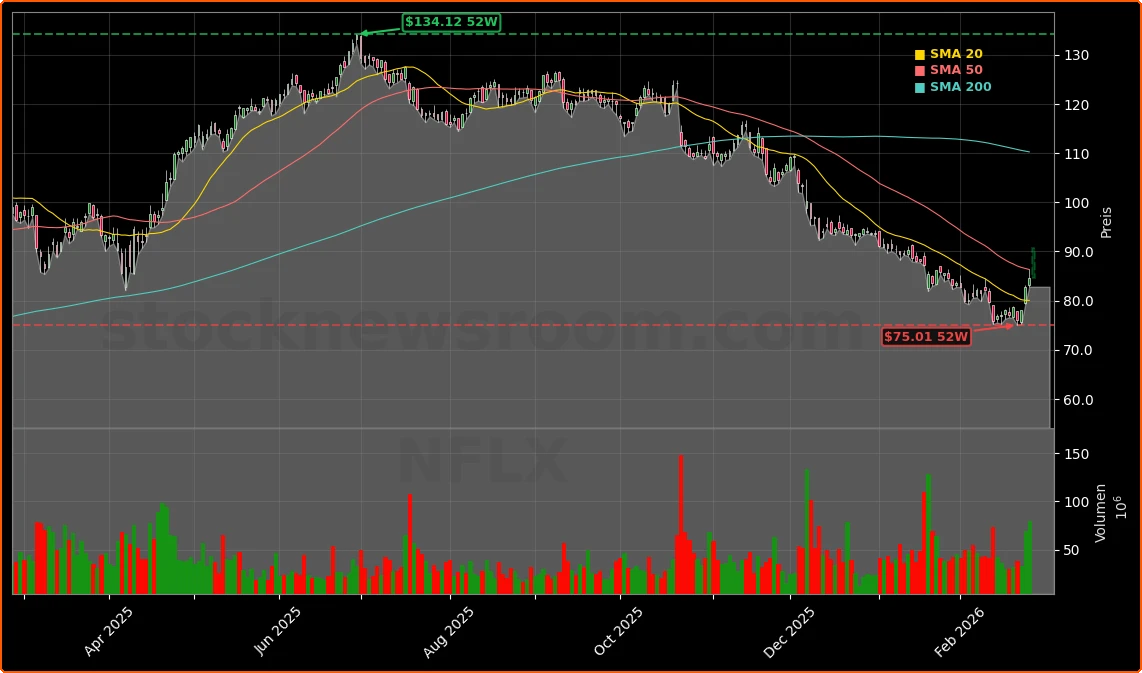
The immediate market verdict on the failed Netflix Merger is positive. With shares up more than 7% pre-market after a nearly 10% after-hours spike, investors are signaling relief that Netflix will not shoulder over $60 billion of additional debt tied to Warner Bros. Discovery. Instead, the company keeps its relatively modest $5.5 billion debt load and a debt-to-EBITDA ratio around 0.5, leaving ample balance-sheet flexibility at a time when streaming is being reshaped by artificial intelligence and escalating content competition.
Netflix emphasized that the transaction was always a “nice to have at the right price, not a must-have at any price.” Management said the Warner deal would have created shareholder value and offered a clear regulatory path, but the price required to match Paramount Skydance’s all-cash offer of roughly $111 billion for the entire Warner Bros. Discovery group was no longer financially attractive. Crucially, Netflix was targeting only the studio and streaming businesses, while Paramount is taking on all of Warner Bros. Discovery, including legacy linear TV networks like CNN.
The stock’s rebound also comes after a bruising period: Netflix had fallen from a 12‑month high near $133 to lows around $76 earlier this week, as investors fretted that a massive acquisition could weaken returns. The pullback from the Netflix Merger now removes a major overhang for growth-focused portfolios concentrated in the NASDAQ and S&P 500 communication services segment.
How does Netflix compare to Paramount and rivals?
By stepping aside, Netflix hands victory in the bidding war to Paramount Skydance, but avoids what some on Wall Street see as a poisoned chalice. Paramount is absorbing Warner Bros. Discovery’s heavy debt and structurally declining linear assets just as AI-driven content tools threaten to compress margins across Hollywood. Netflix, by contrast, keeps a cleaner balance sheet and can channel capital into original programming, live sports and events, and interactive experiences.
Management plans to allocate about $20 billion to content this year, up from roughly $17 billion in recent years, reinforcing Netflix’s position as the must-have subscription in global streaming. Some of that firepower will be needed: major franchises like Stranger Things and The Witcher have either concluded or lost momentum, and recent seasons of Bridgerton have not dominated the cultural conversation as before. To stay ahead of competitors such as Apple, NVIDIA-powered AI platforms, and traditional media houses, Netflix must create fresh, must-watch IP that can cut through a growing wave of “good enough” AI-generated video content.
For U.S. investors, the contrast with legacy players is sharp. Paramount Skydance will now be deeply tied to linear TV cycles and regulatory scrutiny, while Netflix can remain focused on subscription profitability, advertising expansion, and global scale. In that sense, the abandoned Netflix Merger underscores a broader shift in media away from empire-building toward disciplined returns on capital.
Regulatory risk and the White House angle for Netflix
Another factor behind the halted Netflix Merger appears to be regulation. Co‑CEO Ted Sarandos met with White House officials in Washington, D.C., shortly before Netflix publicly walked away. While the company insists finances were the main driver, any combination of Netflix with Warner Bros.’s HBO, film library, and production lot would likely have faced intense scrutiny from U.S. antitrust authorities and European regulators, especially under a political environment wary of Big Tech and media consolidation.
By declining to escalate the bidding war, Netflix avoids months—if not years—of integration risk, legal challenges, and potential behavioral remedies that could dilute the strategic value of the deal. Instead, the company can refocus on scaling its ad-supported tier, expanding live sports such as NFL and WWE rights, and experimenting with in-person experiences that mirror moves by Disney and other entertainment giants.
This was always a nice-to-have at the right price, not a must-have at any price.
— Ted Sarandos, Co-CEO of Netflix
Conclusion
Analysts at major U.S. brokerages are broadly supportive of this stance. While no new target changes have been published overnight, firms such as Goldman Sachs, Morgan Stanley, RBC Capital Markets, and Citigroup have previously highlighted the importance of capital discipline and cash-flow visibility for streaming leaders. The abrupt end of the Netflix Merger pursuit aligns closely with that playbook and may pave the way for renewed buyback activity and potential upward estimate revisions if subscriber and ad revenue trends hold.
Further Reading
- Netflix, Inc. (NFLX) at Yahoo Finance (Yahoo Finance)
- Netflix Stock Up Nearly 10% After Ditching Warner Bros. Discovery Deal (Variety)
- Netflix Backs Out of Warner Bros. Bidding, Paramount Set to Win (The Hollywood Reporter)
- Stock Market Today: Paramount, Netflix Shares Rally Offhours (The Wall Street Journal)