
Is the latest bullish Nike Forecast a real turnaround signal or just another false start for a battered sportswear giant?
Is the new Nike Forecast justified after Barclays?
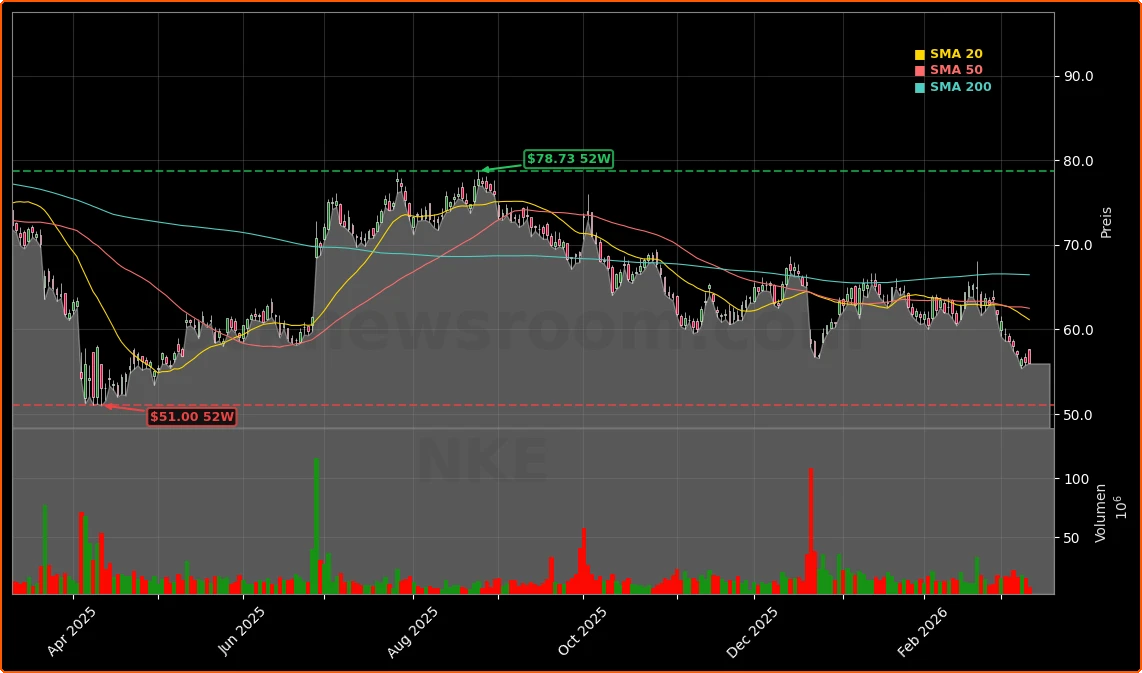
Nike, Inc. shares were recently changing hands at about $55.99, slightly below the prior close of $56.29, despite a short-lived premarket pop following a Barclays upgrade to “Overweight” from “Equal Weight.” Analyst Adrienne Yih lifted her price target from $64 to $73, arguing that the risk-reward profile has improved markedly as the market still values Nike as if it were stuck in a deep operational crisis. Her Nike Forecast implies roughly 30% upside from current levels, broadly in line with other bullish Wall Street targets that see fair value in the mid-70s or higher.
Yih highlights progress on inventory reduction, a structural realignment of the business, and a more disciplined focus on brand health and margins. In North America, Nike’s largest region, the reset is said to be tracking largely according to plan, with the running category growing at a double-digit pace and sales rising faster than inventories. That combination is critical for any constructive Nike Forecast because it indicates healthier sell-through and less risk of margin-damaging discounting.
Beyond Barclays, Investor’s Business Daily notes that Nike briefly led the Dow on the upgrade, while options traders began positioning for a potential turnaround-driven bounce. At the same time, other research voices caution that sentiment shifts can be fragile if the operational data fail to confirm the new narrative.
Can Nike reclaim growth against Adidas and others?
Nike’s stock slide has been severe: the company has lost roughly two-thirds of its market value since its peak almost five years ago. The setback is rooted in post-pandemic missteps, especially an aggressive push into direct-to-consumer (DTC) channels at the expense of long-standing wholesale relationships. That strategy created volatility in revenues, pressured margins and opened the door for competitors such as Adidas, Lululemon and Under Armour to gain shelf space and mind share.
Under new CEO Elliott Hill, a veteran returning from retirement, Nike is pivoting back toward a more balanced model. The company has resumed selling on Amazon and has been rebuilding ties with key wholesalers like Foot Locker, with wholesale revenue reportedly growing around 8% in the second quarter of fiscal 2026. This reset echoes broader consumer-discretionary themes where brands like Apple and NVIDIA have shown that diversified distribution and ecosystem strength can support more durable earnings power than single-channel bets.
Fundamentally, Nike still generates more than $46 billion in annual sales and retains elite global visibility through sports licenses and athlete endorsements. Free cash flow over the last year was close to $2.5 billion against roughly $2.4 billion in net debt, leaving the balance sheet in solid shape. For dividend-focused investors in the S&P 500, some strategists now frame Nike as a beaten-down but high-quality income name, similar to how Tesla is sometimes viewed as an innovation play after big drawdowns.
How does the Nike Forecast balance risks and valuation?
From a classic valuation lens, Nike doesn’t screen as ultra-cheap on earnings, because profits have been hit by discounting, tariffs and weak demand in China and parts of Asia-Pacific. However, on a price-to-sales basis, the stock is trading near multi-year lows, a key pillar of the current Nike Forecast among value-oriented analysts. A recent Forbes analysis pointed out that an 11% market-cap drop over just a week has pushed Nike’s valuation toward levels that historically preceded multi-year recoveries, provided the business could stabilize.
Not all commentary is bullish. Several notes from The Motley Fool argue that Nike’s misjudged DTC pivot set the company back years and that global performance remains uneven, with strong running shoes offset by softer trends elsewhere. One bearish Nike Forecast even questioned whether the stock can sustainably reclaim the $70 level without clearer evidence of accelerating earnings. Additionally, China remains a major question mark, with demand visibility still limited and geopolitical tensions or new tariffs posing ongoing headline risk.
On the cost side, Nike is implementing organizational changes expected to result in about $300 million in pre-tax charges, according to recent disclosures. These restructuring moves are designed to streamline operations and support margin recovery but could weigh on near-term earnings prints. For Wall Street, the next few quarters will be crucial to confirm whether cleaner inventories, channel balance and cost actions translate into a tangible inflection in profitability.
What should U.S. investors watch in the next Nike Forecast?
For American portfolios, Nike remains a significant consumer-discretionary holding and a notable member of the Dow and S&P 500. The average Bloomberg-style analyst consensus now shows 28 Buy ratings, 13 Holds and only 2 Sells, with a mean price target around $75.38, implying roughly mid-30% upside from today’s price. More bullish voices, such as Jefferies analyst Randal Konik, see potential up to $110, while Bernstein’s Aneesha Sherman maintains a target of $85, underscoring how wide the Nike Forecast range has become.
Technically, the stock recently marked new 52-week lows near the low-$50s, with last year’s tariff-driven trough around $50 viewed as potential major support. Interestingly, investor interest got a boost when Apple CEO Tim Cook disclosed a personal stake in Nike back in December, triggering a temporary rally from about $57 to $66. While that pop has faded, it illustrated how quickly sentiment can improve once investors sense the worst is behind the company.
The market is still pricing Nike as if it were stuck in a deep operational crisis, but the risk-reward profile has clearly improved.
— Adrienne Yih, Barclays analyst
Conclusion
In the near term, traders will focus on inventory trends, margin commentary and China updates in upcoming earnings calls, while longer-term investors will pay close attention to how Nike balances wholesale and DTC, defends its brand premium, and competes with Adidas and other global rivals. Any confirmation that double-digit growth in running and healthier North American trends are sustainable would likely push the Nike Forecast further toward a constructive, multi-year recovery story.
Further Reading
- Nike, Inc. (NKE) Quote on Yahoo Finance (Yahoo Finance)
- Nike Stock Upgraded on Turnaround Hopes (Schaeffers Research)
- Nike Leads Dow On Upgrade, Analyst Sees 30% Premium (Investors Business Daily)
- Is Nike Stock Now A Value Play? (Forbes)