Can the latest NIO Strategy rally mark a real profit pivot, or is the stock still just a high‑beta China sentiment trade?
NIO Strategy and the Market: What the Latest Rally Really Signals
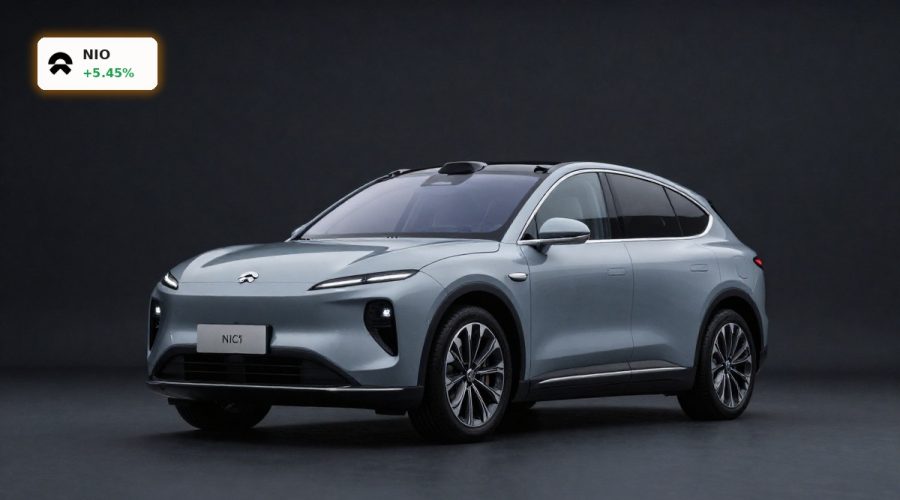
For U.S. and international investors, NIO sits firmly in the high‑beta corner of the electric vehicle space, trading more like a leveraged sentiment play on Chinese growth and EV risk appetite than a stable auto incumbent. The stock closed around $4.84, up 5.45% on the day, slightly above after‑hours levels of about $4.88. That move followed February delivery data showing 20,797 vehicles shipped, up roughly 58% year over year, and confirmation that cumulative deliveries have now passed the one‑million mark.
From a Wall Street perspective, the key shift in the NIO Strategy is not just volume, but the company’s guidance that Q4 2025 should come in with an adjusted operating profit of at least $100 million. If NIO can back this up when it reports full results later this month, it would mark a pivotal transition from a pure growth story to a business that at least occasionally covers its operating cost base.
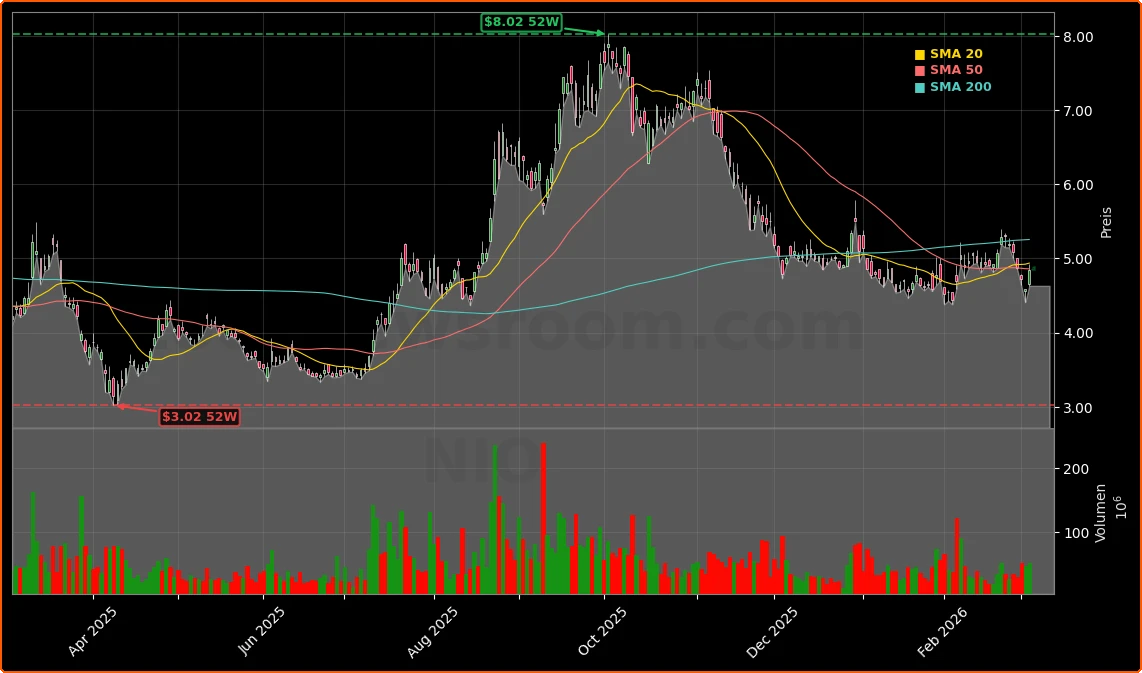
Even after the recent bounce, shares remain far below the 52‑week high of about $8.01 and only a bit above the 52‑week low near $3.03. The stock is still deeply underwater relative to its 2018 IPO price and long‑term holders remain in the red. In other words, the market is not pricing NIO as a clear secular winner on the level of Tesla or NVIDIA; instead, it reflects skepticism that the NIO Strategy can deliver scale economics in a brutally competitive landscape.
Trading volume has recently run more than 20% above its three‑month average, and options activity has been heavy, with calls dominating. That profile fits a short‑term trading favorite rather than a consensus long‑term compounder. The question now is whether the company’s operational data – particularly in China – can justify a re‑rating from speculative EV trade to emerging cash‑flow story.
NIO as a Test Case for Premium EV Demand in China
The most convincing part of the NIO Strategy today is the performance of its core premium brand in China. In February 2026, NIO’s 20,797 deliveries came against a backdrop of broader weakness in the Chinese EV and hybrid market, where overall volumes have been under pressure due to reduced incentives and higher sales taxes in some segments. Several competitors saw double‑digit percentage declines, yet NIO’s premium lineup managed nearly 60% growth.
This divergence underscores the company’s positioning toward more affluent buyers who are less sensitive to subsidy adjustments and tax policy. While mass‑market players focused on aggressive price cuts have struggled, NIO’s focus on higher‑end sedans and SUVs, subscription‑like services, and technology differentiation appears to be resonating. Commentary from sell‑side desks, including bullish notes from The Motley Fool’s coverage and positive framing from Benzinga, reflects a growing view that NIO is gaining share in a more resilient slice of the market.
However, investors should not confuse this resilience with invulnerability. The premium Chinese EV space is still crowded, with domestic brands, legacy automakers, and global players like Tesla all vying for the same upper‑middle‑class customer. Execution missteps, delays in product refreshes, or a deterioration in brand perception could quickly erode the current advantage. For now, though, February’s numbers support the thesis that NIO’s China‑centric portion of the NIO Strategy is working better than many feared late last year.
NIO Strategy and the Onvo Problem: Can the Mass‑Market Bet Be Fixed?
Where the NIO Strategy clearly falters is in its mass‑market Onvo sub‑brand. While the flagship marque is beating the domestic market trend, Onvo’s February deliveries of just 2,981 units were down about 26.4% year over year, sharply missing earlier ambitions for the line to become a volume growth engine. This underperformance has already had personnel consequences: former Onvo president Alan Ai departed after failing to achieve his targets and has resurfaced in the hotel industry as chief growth officer at H World Group.
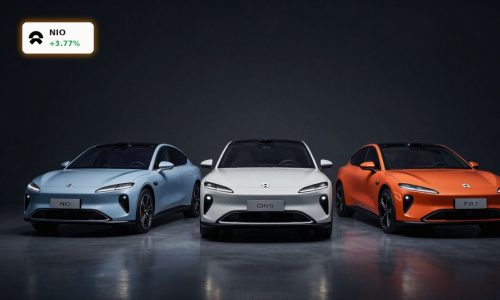
Onvo’s weakness matters for investors because it challenges NIO’s attempt to cover the broader Chinese auto pyramid. The initial vision behind the NIO Strategy was a multi‑tiered brand architecture: a premium NIO core, a mid‑to‑mass Onvo mainstream offering, and a more compact, lower‑priced Firefly project. If the middle tier sputters, the group’s ability to leverage common platforms and achieve scale benefits gets compromised.
Management is trying to reset expectations with a product‑led response. The new Onvo L80 SUV is slated for an April unveiling, aimed at re‑energizing the lineup with a more competitive, family‑oriented model. Investors should listen for details on pricing, range, and software features, especially how they stack up against domestic rivals and internal NIO models to avoid cannibalization. A credible turnaround here could repair confidence in the broader NIO Strategy; continued stagnation would underscore how hard it is to build a second brand in a market already saturated with options.
NIO Product Offensive: ES9 and Technology as Strategic Levers
To sustain momentum at home and offset weaknesses at Onvo and abroad, management has accelerated a product and technology offensive. CEO William Li has pulled forward the launch of the new flagship SUV ES9, a more than five‑meter‑long vehicle that will debut on April 9, ahead of the Beijing Auto Show. The plan is to begin deliveries by June 1, an aggressive ramp that suggests strong confidence in production readiness and demand potential.
The ES9 is expected to showcase NIO’s latest proprietary tech, including new autonomous driving chips from its Shenji NX 9031 line and the SkyRide chassis system, which targets ride comfort and handling on par with premium European brands. Around the same time, minor but important upgrades are scheduled for the existing ET5, ES6, and EC6 models – the so‑called “5566” lineup – to defend their competitiveness in range, software, and user experience.
On the financing side, NIO is temporarily sweetening offers with sub‑1% interest rates for qualified buyers, a tactic that could pull forward demand but also risks compressing near‑term margins. For long‑term investors, the key is whether these promotions generate enough scale to dilute fixed costs, offsetting the hit to per‑unit economics. If successful, this part of the NIO Strategy could accelerate the path to sustainable operating profits.
Under the hood, NIO is also investing heavily to reduce reliance on third‑party technology. Its in‑house chip division, GeniTech, recently received a cash infusion of 2.25 billion yuan, highlighting a push toward vertical integration reminiscent of what Apple did in smartphones and NVIDIA has done in GPUs. At the same time, NIO is deepening its partnership with Bosch to cover all three group brands – NIO, Onvo, and Firefly – focused on software‑driven systems such as intelligent braking and sensor modules. This hybrid approach of in‑house innovation plus selective partnerships is a central pillar of the NIO Strategy to build differentiated, defensible advantages in a commoditizing hardware market.
NIO and Europe: A Costly Strategic Misstep
If China is the showcase for what works in the NIO Strategy, Europe is the warning sign. The company’s expansion into key European markets like Sweden, the Netherlands, and Norway has faltered, with February registrations plunging and, notably, zero new vehicles registered in Sweden for the first time since 2022. Executive Vice President Mark Zhou has publicly acknowledged fundamental mistakes in the initial 2022 rollout, especially around product sizing: NIO brought over large, high‑spec SUVs and sedans that did not align with many European buyers’ preferences for more compact, efficient models.
This misread of local taste is more than a marketing glitch. It raises questions about capital allocation, brand positioning, and management’s ability to localize offerings in diverse markets. European expansion was originally presented as an important leg of the growth story that could diversify revenue away from China and enhance NIO’s global recognition, similar to how Tesla leveraged early success in Europe alongside the U.S. to build brand equity. Instead, Europe has turned into a drag that consumes resources and delivers limited volume.
For U.S. investors, the key question is not whether NIO retreats entirely from Europe – that seems unlikely in the near term – but whether the company can pragmatically downshift its ambitions, rationalize costs, and redesign offerings for local demand. Unless there is a clear, data‑driven reset of the European piece of the NIO Strategy, the region will continue to be a source of operational noise and potential cash burn.
Valuation, Profitability Path, and Analyst Sentiment on NIO
At roughly $4.8 per share and with the stock still trading below long‑term moving averages, NIO’s market value reflects both its execution progress and the heavy risk premium attached to Chinese EVs. The valuation is no longer the euphoric multiple embedded during the 2020–2021 EV bubble, but it is also not yet a deep‑value play in the way some distressed autos have traded historically. The prospective Q4 adjusted operating profit of at least $100 million is an important signpost; if confirmed, it would demonstrate that the combination of higher volumes, mix improvements, and cost control is slowly working.
Analyst sentiment remains split. Bullish research from U.S. outlets like The Motley Fool and institutional commentary picked up by Zacks Investment Research emphasize the upside if NIO can turn its domestic momentum into a consistent profitability trend and Tesla‑style software margins. A number of Wall Street analysts, including those at Deutsche Bank, have highlighted the strong start to March orders, noting that the first three days of the month produced the highest weekly order rate so far in 2026. While specific target changes from houses like Citigroup, Goldman Sachs, or Morgan Stanley are not detailed in the latest data set, the overall tone has shifted from outright skepticism to cautious optimism, especially around the Q4 earnings catalyst.
Conclusion
On the trading side, high options open interest and heavy call volumes underscore that speculative capital is still very active in the name. For risk‑tolerant investors, this can work both ways: it amplifies upside on positive news but increases downside volatility if earnings or guidance disappoint. Any surprise around the ES9 launch timing, Onvo recovery, or European restructuring can trigger sharp swings as short‑term traders reposition.
Further Reading
- NIO Inc. (NIO) Stock Price, Quote & News (Yahoo Finance)
- Stock Market Today, March 4: Nio Rises After Deliveries Surpass 1 Million Vehicles (The Motley Fool)
- Nio Stock Climbs As Deliveries Top One Million Vehicles Milestone (Benzinga)
- EV Wars In February: BYD Sales Slump, NIO Sales Soar (Seeking Alpha)
- NIO, XPeng & Li Auto Post Delivery Results for February (Zacks Investment Research)