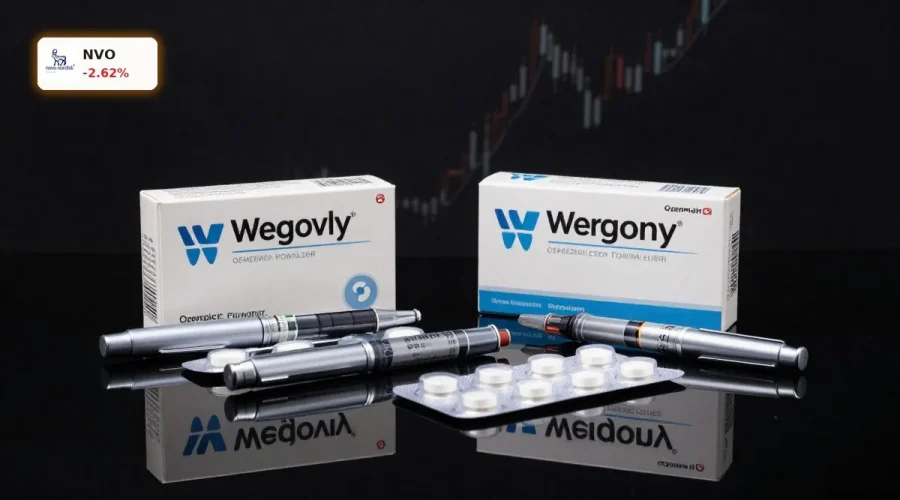
Is the Novo Nordisk price war in the GLP-1 market turning into an expensive defensive battle – or is it opening new opportunities for investors?
Novo Nordisk Under Pressure: How Deep is the CagriSema Shock?
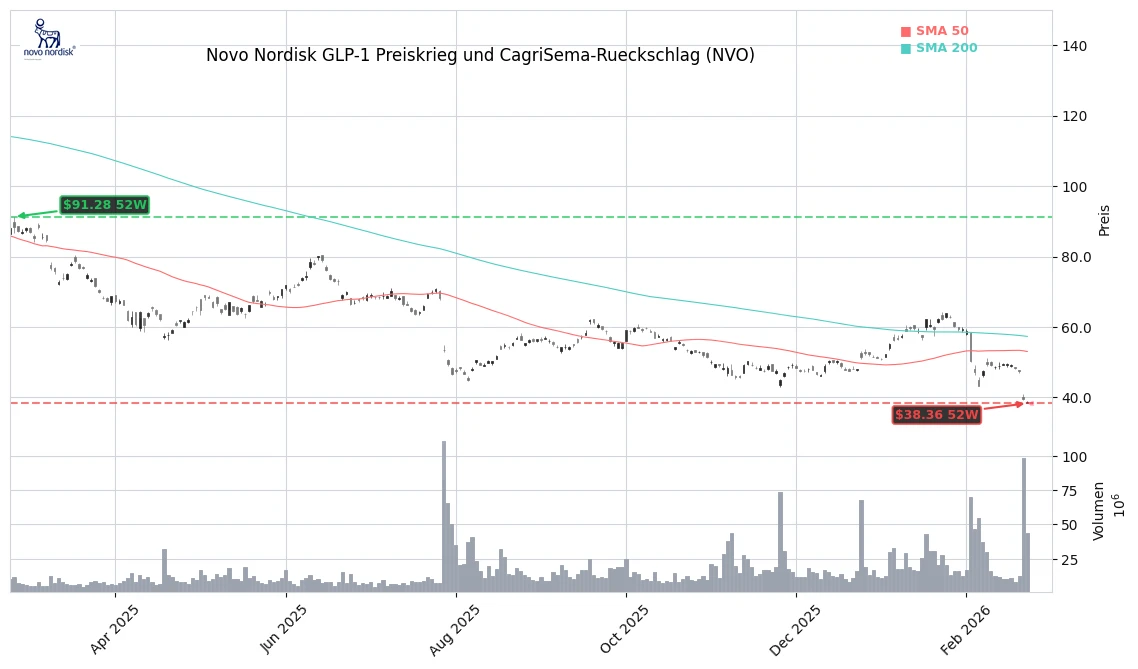
The latest data from the late “Redefine 4” study has abruptly dampened hopes for a clear technological leap with CagriSema. The combination drug achieved an average weight reduction of about 23% after 84 weeks in obese patients, falling short of Eli Lilly’s Tirzepatide (Zepbound), which reached approximately 25.5%. The stock market reacted brutally: in a single trading day, shares of Novo Nordisk lost up to 17%, and for the week, the decline totals around 22% according to market data. With a current price of about $38.59 per share (previous day $39.63; -2.62%, pre-market $37.79), NVO is trading near its 52-week low and far from previous highs. Chart-wise, the previous fragile upward trend is considered destroyed, as the low from November 24, 2025, has been breached, and the stock is back in a clear downward trend. Additionally, a forecast significantly cut in February anticipates a revenue decline of about 10% for 2026 – a stark contrast to the boom years of the GLP-1 hype.
How is the Novo Nordisk Price War in the GLP-1 Market Escalating?
Alongside the study shock, the company is ramping up its efforts in the Novo Nordisk price war. Starting January 2027, the U.S. list prices for the blockbuster drugs Wegovy and Ozempic are set to drop significantly. Wegovy will be reduced by about 50%, and Ozempic by about 35%, both expected to be priced around $675 per month. For self-payers, price ranges of approximately $149 to $499 are also announced. This directly targets the pricing positioning of Eli Lilly’s Zepbound, which costs between $299 and $449 per month depending on the discount structure. The backdrop is a rapidly growing yet highly sensitive market: the global GLP-1 revenue, currently around $72 billion, could rise to about $139 billion by 2030. Simultaneously, surveys show that nearly 70% of patients make their therapy decisions heavily dependent on costs, and about 40% actively use discounts and coupons. The Novo Nordisk price war is therefore intended not only to defend market shares but also to improve access, for instance, through lower copayments in U.S. insurance models.
Novo Nordisk Price War vs. Pipeline: Is the Oral Offensive Sufficient?
Despite the disappointment with CagriSema and the Novo Nordisk price war, management continues to focus on innovation. A central growth driver remains the oral Wegovy variant, which aims to complement the injection market. In terms of efficacy, Novo leads with about 15% weight loss compared to around 12% for Eli Lilly’s oral solution, but it struggles with more complex dosing rules, which could limit everyday usability. Revenue expectations vary widely: while Novo Nordisk itself sets a conservative $800 million for 2026, Goldman Sachs reportedly expects only about $650 million, with the optimistic scenario reaching up to $2.5 billion. Another strategic component is the recently announced partnership with Vivtex. In a deal worth up to $2.1 billion, Novo Nordisk aims to develop new oral biologics for obesity and diabetes. This collaboration is expected to reduce reliance on injections in the long term and broaden the product range in the GLP-1 segment.
What Does the Double Blow Mean for Investors in Novo Nordisk?
For investors, the situation remains ambivalent. On one hand, the stock is clearly battered after a yearly decline of about 56% and the drop near the 52-week low; some market participants refer to it as a “broken stock” that needs time to stabilize. On the other hand, Novo Nordisk remains one of the leading players in the GLP-1 market with Semaglutide products like Ozempic, Wegovy, and Rybelsus. Analyst firms like Zacks Investment Research see strong cash flows and high gross margins despite margin pressure, which could limit the valuation discount. Major investment banks like Citigroup, Goldman Sachs, or RBC Capital Markets have recently lowered their price targets but point to the deep pipeline and the continued dominant position in the diabetes business. It is clear that the massive Novo Nordisk price war will permanently diminish the company’s pricing power and dampen the prospects for extremely high long-term returns – the often-dreamed tenfold increase from $100,000 to $1 million in ten years is now considered unrealistic by market strategists.
We hope these price reductions will improve access and increase affordability.
— Jamey Millar, Executive Vice President US Business, Novo Nordisk
Bottom Line
In summary, the CagriSema setback combined with the aggressive Novo Nordisk price war marks a turning point in the GLP-1 boom: growth remains, but at significantly lower margins. For long-term oriented investors, the current weakness phase could still present opportunities, as Novo Nordisk attempts to defend its leadership role in diabetes and obesity with oral innovations and partnerships like Vivtex. Upcoming quarterly results and the market launch of the weight loss pill will show whether the company can regain market confidence and lead the stock out of the current stabilization phase.
Related Sources
- Novo Nordisk A/S (NVO) Stock Overview and Metrics (Yahoo Finance)
- Novo Nordisk cuts Wegovy prices in half while its stock sits near a 52-week low (24/7 Wall Street)
- Novo Nordisk to slash list prices of Ozempic, Wegovy by up to 50% (Fox Business)
- Novo Nordisk partners with Vivtex in up to $2.1 billion deal for oral obesity drugs (Reuters)