Are NVIDIA AI Earnings still powering a durable supercycle, or are investors pushing a $4 trillion giant into bubble territory?
NVIDIA AI Earnings as a Market Anchor for Wall Street
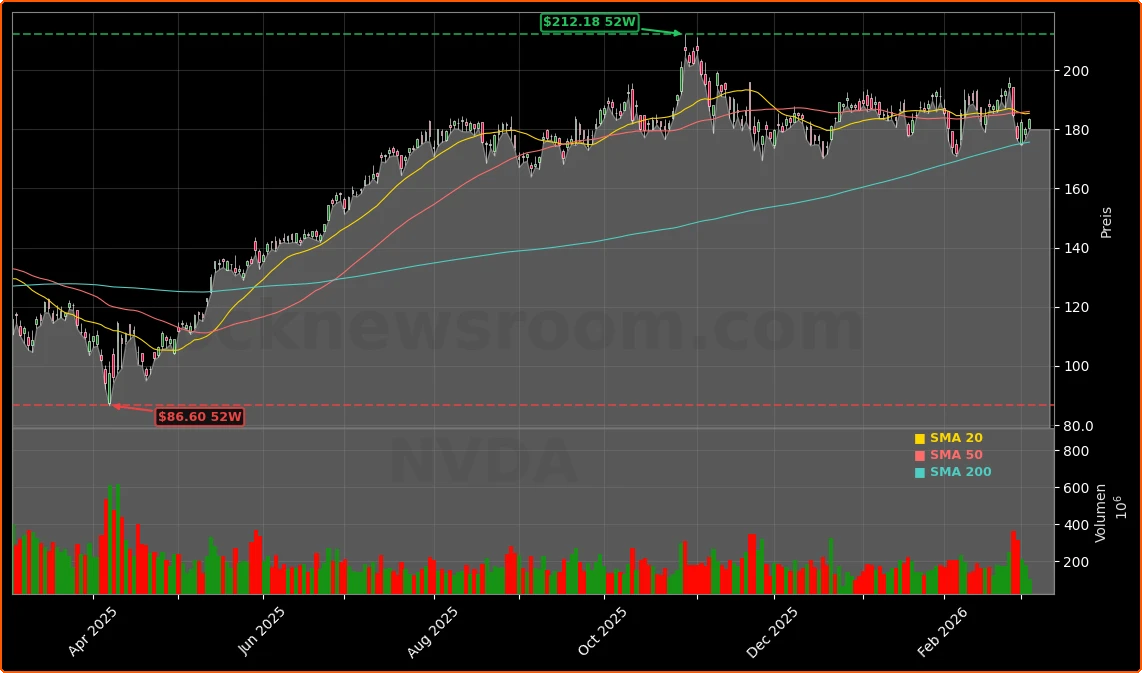
NVIDIA now sits at the center of both the NASDAQ and S&P 500 narrative. The stock trades around $183.63 as of today’s close, up about 2% on the day, but still well below its 52‑week highs, reflecting a consolidation phase after several years of outsized gains. Over the last five years, NVIDIA shares have climbed close to 1,300%, while the S&P 500 gained less than 80% over the same period. That staggering divergence explains why every NVIDIA AI Earnings report is treated as a referendum on the entire AI and data‑center buildout.
In its most recently reported quarter (fiscal 2026 Q4, for the period ending in late January), NVIDIA delivered around $68.1 billion in revenue, up roughly 73% year over year. Adjusted earnings per share came in at about $1.62 versus Wall Street expectations near $1.53. Management also guided for roughly $78 billion in revenue for the current quarter, well ahead of consensus estimates in the low $70 billions at the time. These are historical figures now, not fresh headlines, but they illustrate the scale of the company’s AI-driven transition.
Despite this, the stock actually declined in the days following that earnings release, at one point falling more than 5% the next session. The muted price reaction to blowout NVIDIA AI Earnings highlights how much optimism is already embedded in the share price and how sensitive investors have become to any sign that hyperscaler spending might eventually slow.
NVIDIA AI Earnings: How Strong Is the Core Business?
The engine behind NVIDIA AI Earnings is its data center segment, which has effectively transformed the company from a gaming GPU specialist into the backbone of the global AI infrastructure. Hyperscale cloud providers such as Amazon, Microsoft, Alphabet and Meta rely heavily on NVIDIA’s accelerators to power training and inference for large language models and agentic AI workloads. Jensen Huang famously summarized this new world as, “In AI, compute is revenues” – and NVIDIA is selling the compute.
What stands out is profitability. NVIDIA is currently generating adjusted gross margins in the mid‑70% range – roughly 75% recently – in an industry where 50% has historically been considered strong. That margin profile reflects not just hardware scarcity but a full‑stack approach that integrates chips, networking, software and developer tools into a single ecosystem. CUDA, AI libraries and enterprise software offerings make NVIDIA’s platform sticky, reinforcing pricing power and keeping competitors like AMD and custom ASIC vendors one step behind.
Some institutional investors worry about how sustainable those margins are as competition increases and customers gain bargaining power. Management’s guidance, however, still points to gross margins around 75% for the current fiscal year, suggesting that any price pressure from new architectures like Blackwell has so far been offset by volume growth and software value. For U.S. investors, this matters because earnings power – not just revenue growth – is what ultimately supports a trillion‑dollar valuation.
Is NVIDIA Still a Growth Story at a $4 Trillion Market Cap?
Valuation is the central tension in the NVIDIA AI Earnings debate. At a market value around $4.4 trillion in recent months, even a further doubling of the share price would imply a market cap well above the entire current U.S. tech sector’s annual earnings. Despite that sheer size, the stock is not trading at nosebleed multiples by high‑growth standards. On a trailing basis NVIDIA changes hands at roughly 37 times earnings, and on a forward basis estimates imply about 23–24 times expected earnings. That’s only modestly above the S&P 500’s forward multiple near 22.
Analysts continue to view the risk‑reward as attractive. One broker, CLSA, issued a high‑conviction “buy” rating with a price target around $300, arguing there are few reasons to be structurally worried about NVIDIA’s AI trajectory. On the buy‑side, billionaire investor Leo KoGuan reportedly bought about 1 million NVIDIA shares recently and has signaled plans to double that position, openly rejecting the idea that AI is a speculative bubble. His move underlines how large, sophisticated investors are still willing to lean into NVIDIA on weakness rather than rotate away.
Retail sentiment is more divided. Some long‑term holders have taken profits, citing an “euphoric phase” and the classic warning sign of inexperienced traders piling into the stock. Others view the current sideways trading range since mid‑2024 as a constructive consolidation that allows earnings to catch up to price. From a U.S. portfolio construction perspective, NVIDIA remains a core growth holding, but investors should temper return expectations: repeating a 1,300% gain over the next five years is mathematically far less likely.
NVIDIA Versus AMD, Broadcom and the Rest of the AI Stack
To judge how durable NVIDIA AI Earnings are, investors must consider the competitive landscape. Advanced Micro Devices offers credible GPU alternatives, and Wall Street bulls at banks like UBS have highlighted AMD’s long‑term AI opportunity. Yet AMD is struggling to fully convince investors in what’s being called a “discerning phase” of AI spending, where customers and shareholders are demanding clear ROI and integrated solutions rather than speculative capacity. The lack of a mature, NVIDIA‑style full‑stack ecosystem keeps AMD at a disadvantage for now.
Broadcom is another important player, especially in custom accelerators and networking silicon for customers like Alphabet. Broadcom’s earnings are closely watched alongside NVIDIA’s to gauge the breadth of AI infrastructure demand. Meanwhile, hyperscalers such as Alphabet and Amazon are investing heavily in their own in‑house chips and tensor processing units to reduce reliance on NVIDIA’s GPUs. Alphabet, for example, plans to spend roughly $175–$185 billion this year on capex related to AI data centers and is working hard to get more performance per dollar by using its own hardware where possible.
Even so, NVIDIA remains the standard for high‑end AI compute, especially for cutting‑edge training and inference clusters. Specialized AI cloud providers such as CoreWeave are doubling down on NVIDIA hardware. CoreWeave recently announced a multi‑year deal with Perplexity AI to run next‑generation inference workloads on NVIDIA GB200 NVL72 clusters, underscoring how the most advanced AI startups still choose NVIDIA as their performance benchmark. That continued design‑win momentum supports visibility into future NVIDIA AI Earnings, even if hyperscaler capex growth becomes more selective.
How Rubin, Photonics and the AI “Factory” Vision Extend the Cycle
An important part of the bull case is that NVIDIA is not standing still. The company has already shifted from Grace Hopper and Blackwell to its next major platform, Rubin, which it claims will set a new standard for building and securing the world’s most advanced AI systems. Early demand signals for Rubin, expected to ramp shipments in the back half of the year, are described as “extremely robust.” Some institutional estimates see NVIDIA’s revenue for the first quarter of 2027 potentially reaching around $78 billion, well above what the market has recently priced in – though such long‑range forecasts should be treated as directional rather than precise.
NVIDIA is also investing heavily in the “roads between the chips.” It has committed about $4 billion to photonics companies Coherent and Lumentum – roughly $2 billion each plus long‑term supply agreements – to secure optical components for AI data centers. This has helped trigger sharp rallies in those stocks when the market focuses on optics ahead of NVIDIA’s GTC conference. Coherent recently unveiled a new optical spectrum synthesizer targeted at telecom and high‑bandwidth applications, and its AI‑related funding from NVIDIA is widely viewed as a vote of confidence in optical interconnects as the next bottleneck to be solved.
Beyond components, NVIDIA is promoting the concept of AI “factories” – massive, dedicated data‑center campuses designed specifically for AI workloads. A recent example is a huge AI campus project in Missouri that aims for up to 1.2 gigawatts of compute capacity, putting it among the largest AI facilities under construction globally. Such projects underpin a multi‑year capex cycle that could support NVIDIA AI Earnings even if individual hyperscalers occasionally pause or rebalance spending.
Macro Risks: What Could Break the AI Supercycle?
The broader U.S. equity bull market that began in late 2022 has been heavily powered by AI infrastructure and mega‑cap tech. Economists and strategists increasingly warn that if AI data‑center spending slows materially, it could hit GDP growth, earnings for the largest S&P 500 constituents and even labor markets. In other words, NVIDIA’s fortunes are now macro‑relevant.
Several risk factors stand out. First, geopolitical tensions – from export controls on high‑end chips to potential disruptions around key shipping lanes – could restrain global data‑center expansions or limit NVIDIA’s ability to serve certain regions. Second, if corporate customers decide that early AI projects are not generating sufficient returns, they may delay or cancel deployments, pressuring both hyperscaler capex and NVIDIA AI Earnings. Third, margin compression is a possibility if competition intensifies and customers demand lower prices per unit of compute.
On the other hand, the technology itself is still early. Agentic AI systems, which can autonomously perform complex workflows, are just beginning to roll out in enterprise environments. Tools like Anthropic’s Claude agents, Perplexity’s research assistants, and AI‑driven automation in customer service and back‑office tasks are opening new use cases that require ever‑more compute. NVIDIA CEO Jensen Huang has argued that markets underestimate the impact on software and enterprise workflows, suggesting that AI will augment, not replace, many categories of commercial software platforms. That view has already helped sentiment in names like ServiceNow, which saw its stock rebound after being explicitly cited as well positioned for AI agents.
Positioning NVIDIA in a U.S. Equity Portfolio
From a portfolio strategy perspective, NVIDIA now behaves more like a core macro asset than a niche growth stock. It is a top weight in major indices and sector ETFs, including many S&P 500 and NASDAQ funds where it sits alongside giants like Apple, Microsoft and Alphabet. This concentration cuts both ways: when NVIDIA AI Earnings surprise to the upside, passive investors enjoy a tailwind; when the stock stumbles, it can drag entire benchmarks lower.
Some traders are using option‑based ETFs like the YieldMax Short NVDA Option Income Strategy ETF (DIPS) to generate income while synthetically shorting NVIDIA via options, reflecting demand for both bullish and bearish structured products. At the same time, long‑only managers continue to accumulate shares on pullbacks, treating current sideways action as an opportunity to add exposure at forward multiples that no longer look extreme for a company with NVIDIA’s growth profile.
For risk‑aware U.S. investors, the key is sizing. NVIDIA can justifiably be a large single‑stock position for aggressive growth portfolios given its dominance in AI hardware and software, but diversification still matters. Complementary holdings in other AI beneficiaries – from cloud hyperscalers to optical and memory suppliers – can help spread exposure across the broader AI stack.
Conclusion
Looking ahead, the next few years will test whether the AI boom is truly a new industrial revolution or a more cyclical capex wave. NVIDIA AI Earnings will remain the quarterly scoreboard. Revenue guidance, data‑center demand signals, gross‑margin resilience and Rubin platform adoption will all be critical markers. As long as NVIDIA maintains its technological lead, full‑stack ecosystem and extraordinary profitability, the stock is likely to stay a central pillar of AI‑focused portfolios, even if future returns are more moderate than the spectacular gains of the past decade.
Further Reading
- NVIDIA Corporation (NVDA) Stock Quote & Profile (Yahoo Finance)
- Nvidia Leads Chip Stock Rebound, Billionaire Investor Buys 1 Million Shares (Benzinga)
- CoreWeave Signs Multi-Year Deal with Perplexity AI for NVIDIA GB200-Powered Inference (MLQ.ai)
- After Soaring Nearly 1,300% in 5 Years, Can Nvidia’s Stock Still Rise Higher? (The Motley Fool)
- Coherent, Lumentum, and AAOI Jump in Premarket Trading Wednesday (24/7 Wall St.)