Can NVIDIA’s trillion‑dollar AI infrastructure vision and aggressive buybacks still justify the stock after its latest pullback?

Is NVIDIA AI Infrastructure still priced for perfection?
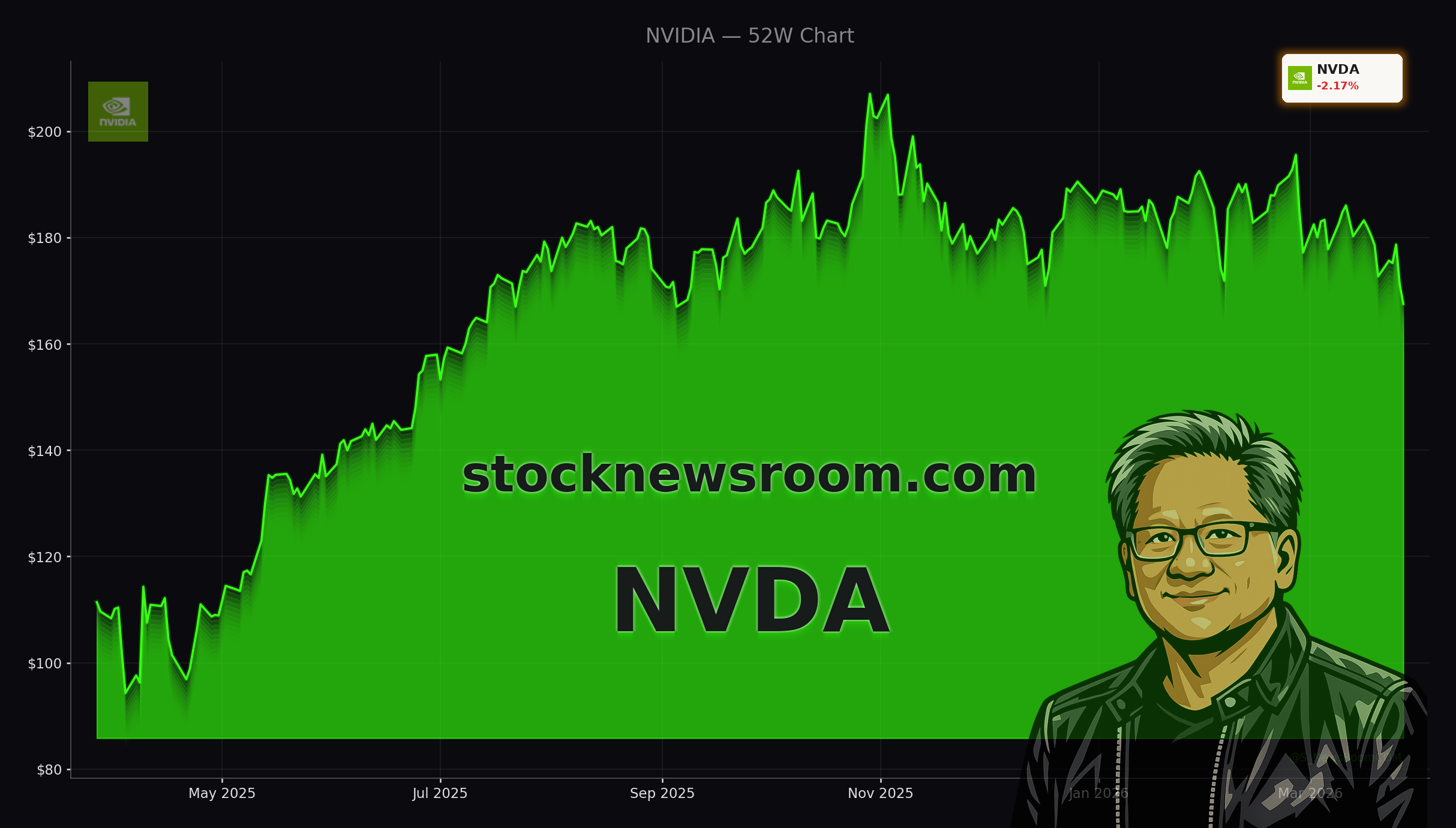
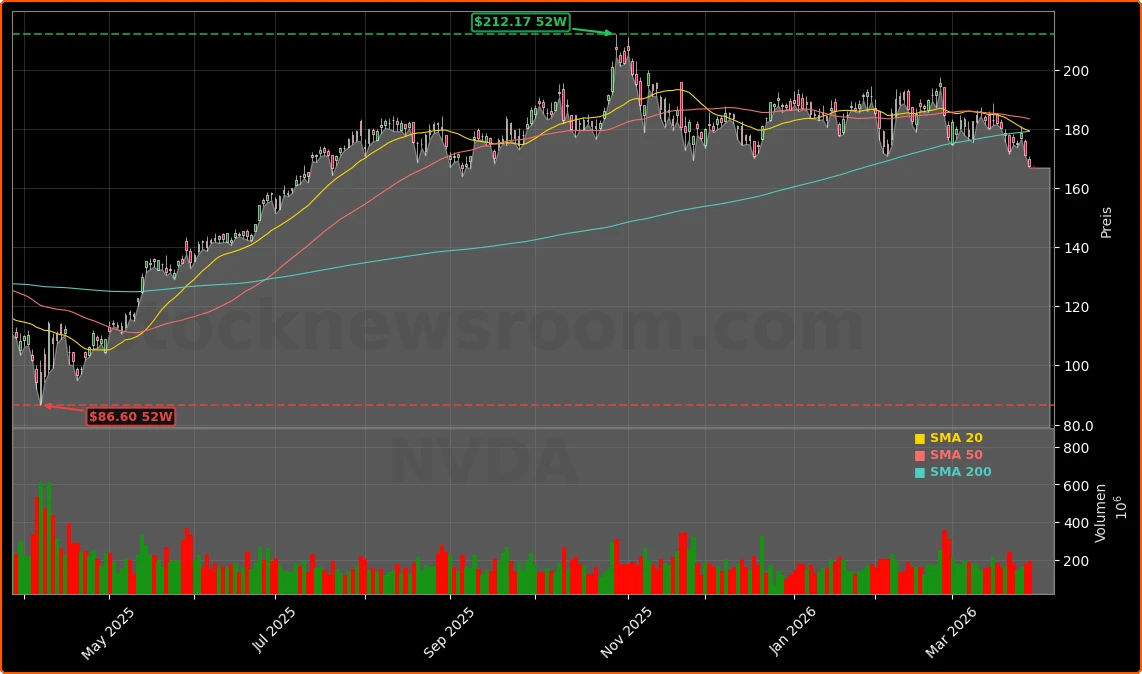
After a historic run to a peak $5 trillion valuation in late 2025, NVIDIA now sits around a $4.1 trillion market cap, with the stock down roughly 10% year to date and trading below all key moving averages. Its forward P/E near 19.7 is just under the S&P 500’s multiple, a sharp reset for a company that long commanded a premium. Yet fundamentals remain explosive: fiscal 2026 revenue hit about $215.9 billion, up 65%, with data-center sales of $62.3 billion, up 75%, powered by insatiable demand for NVIDIA AI Infrastructure from cloud giants and enterprise customers.
Jensen Huang recently told investors he now sees at least $1 trillion in AI chip and infrastructure sales built on the Blackwell and Rubin roadmaps through 2027, driven by a shift from one‑time training to perpetual inference workloads. That demand backdrop underpins bullish long‑term price targets from Wall Street; many large banks still rate the stock “Buy,” with consensus targets near $275, even as short‑term momentum looks weak and the 14‑day RSI has slipped toward oversold territory.
How does Vera Rubin change NVIDIA AI Infrastructure?
The Vera Rubin platform marks a strategic pivot from pure GPU vendor to full-stack NVIDIA AI Infrastructure provider, tightly integrating GPUs and CPUs, high‑bandwidth memory and storage. Partners like Micron are ramping HBM4 specifically for Rubin, alongside PCIe Gen6 SSDs and SOCAMM2 modules that accelerate both GPU throughput and CPU orchestration for agentic AI. NVIDIA is even extending this stack into orbit with its Space‑1 Vera Rubin module for satellite-based data centers, enabling AI inference directly in space and hinting at a future where some compute demand shifts off planet.
For U.S. investors, this broadening footprint means NVIDIA is less a cyclical chip name and more an infrastructure utility for AI, competing with Apple, Tesla and hyperscalers for the market’s top valuation slot while fending off Advanced Micro Devices and Huawei-based alternatives in China.
Is the $40 billion buyback good capital allocation?
The most controversial piece of the story is capital return. NVIDIA deployed just over $40 billion on buybacks in fiscal 2026, roughly 33% of its $120 billion net income and nearly seven times its $6.1 billion in capex. Critics argue that every dollar not reinvested in R&D, fabs, or software ecosystems could weaken its edge as competitors scale their own accelerators.
CFO Colette Kress counters that the company already funds a “robust innovation pipeline” spanning CUDA, physical AI and equity stakes in CoreWeave, OpenAI and Nebius, while using repurchases to “support the ecosystem” and spread its AI bet onto its own shares. With $58.5 billion still authorized, future buybacks effectively leverage any upside if NVIDIA AI Infrastructure continues to dominate cloud and on‑premise data centers worldwide.
Related Coverage: Investors worried about valuation pressure and rising Chinese competition can dive deeper into these themes in NVIDIA AI Valuation -1.9%: Boom Engine Or Bubble Risk?. For a complementary look at the memory side of the stack that underpins Vera Rubin, read Micron HBM4 Launch Boom: Are AI Margins at Record Peak?, which explores whether the AI memory cycle can sustain current profitability.
We look at our capital return very, very carefully, and we do believe that one of the most important things that we can do is really supporting the extreme ecosystem that’s in front of us.— Colette Kress, NVIDIA CFO
In sum, NVIDIA AI Infrastructure remains the core plumbing of generative AI, while management’s aggressive buybacks signal confidence that the runway is far from over. For U.S. portfolios, the stock has shifted from a pure growth trade to a central macro bet on AI itself. The next leg of earnings and Rubin deployments will show whether capital allocation and execution can keep justifying NVIDIA’s outsized role in global markets.