
Can the NVIDIA AI Strategy keep its near-monopoly grip on AI compute as it pivots from pure chips to software, cloud and open source?
How is NVIDIA AI Strategy shifting beyond chips?
The current NVIDIA AI Strategy is no longer just about selling the fastest graphics processing units. The company has ridden the AI boom to a market cap above $4 trillion and triple‑digit revenue growth, with data center sales now accounting for roughly 90% of total revenue. Yet management is clearly signaling that the next leg of growth will come from higher‑margin software, open‑source models and platform economics layered on top of its GPU dominance.
Over the next five years, NVIDIA plans to invest about $26 billion in developing open‑source AI models, positioning itself as both the hardware backbone and a key model provider for enterprises and developers. These models are expected to be tightly tuned to its CUDA software stack, further increasing switching costs for cloud providers, corporates and startups that already build on CUDA’s more than 400 optimized libraries.
That software‑first turn is critical as the AI market fragments between proprietary systems from big tech and a growing ecosystem of open models used in academia, healthcare, climate research and sovereign AI projects. By anchoring open models to its GPUs, the NVIDIA AI Strategy aims to capture value every time workloads scale, regardless of which application layer ultimately wins.
Where do Nebius and global cloud deals fit?
NVIDIA is also using its balance sheet to extend the AI stack into infrastructure. The company is increasing its stake in Nebius, a so‑called “NeoCloud” platform that targets multi‑gigawatt AI data centers and several billion dollars in annual recurring revenue by 2026. This move gives NVIDIA an embedded channel to sell chips and shape the surrounding software and networking architecture, particularly in Europe where concerns about dependence on U.S. hyperscalers and Chinese compute are rising.
For U.S. investors, Nebius and similar cloud partnerships underscore that NVIDIA is morphing into an AI infrastructure financier, not just a component supplier. Recent data shows the company has deployed more than $50 billion across roughly 170 AI‑related deals worldwide, from cloud providers and robotics platforms to quantum‑secure networking. This capital flies under the radar of traditional earnings models but could lock in long‑term GPU demand and recurring platform revenue.
Major hyperscalers are reinforcing that thesis. Meta, Microsoft and Amazon are all designing custom accelerators, yet have signed multi‑year, multi‑generation contracts to keep buying NVIDIA and AMD chips. Meta’s in‑house silicon is framed as a hedge against vendor lock‑in, not a replacement. The broader message for Wall Street: the AI build‑out is still in an early investment cycle, and NVIDIA remains at the center of it.
What role does open source play in NVIDIA AI Strategy?
Open‑source models are a critical pillar of the NVIDIA AI Strategy because they address two structural trends: global access and regulatory scrutiny. In the U.S., leading frontier models like GPT‑5.4, Gemini 3.1 Pro and Claude Opus 4.6 are tightly controlled and monetized via cloud APIs. That has pushed researchers, sovereign AI initiatives and many enterprises toward open‑source alternatives, a large share of which have roots in China or Europe.
By funding its own open‑source models, tuned for CUDA and its flagship GPUs, NVIDIA can offer a more unified, geopolitically acceptable stack that spans U.S., European and Asian customers. The company is already showcasing use cases well beyond chatbots: climate “digital twins” via its Earth‑2 initiative, probabilistic weather prediction, genomics and drug discovery, and industrial robotics. In each case, the same pattern appears – open or flexible models, running on NVIDIA hardware, orchestrated through its software ecosystem.
This strategy could also blunt competitive pressure from AMD and specialized accelerators by making rival hardware less attractive for developers entrenched in CUDA‑tuned open models. For long‑only U.S. portfolio managers, that combination of hardware lead and software lock‑in is a key reason NVDA still trades only modestly above the S&P 500’s forward earnings multiple, despite far higher growth.
What risks threaten NVIDIA’s AI monopoly narrative?
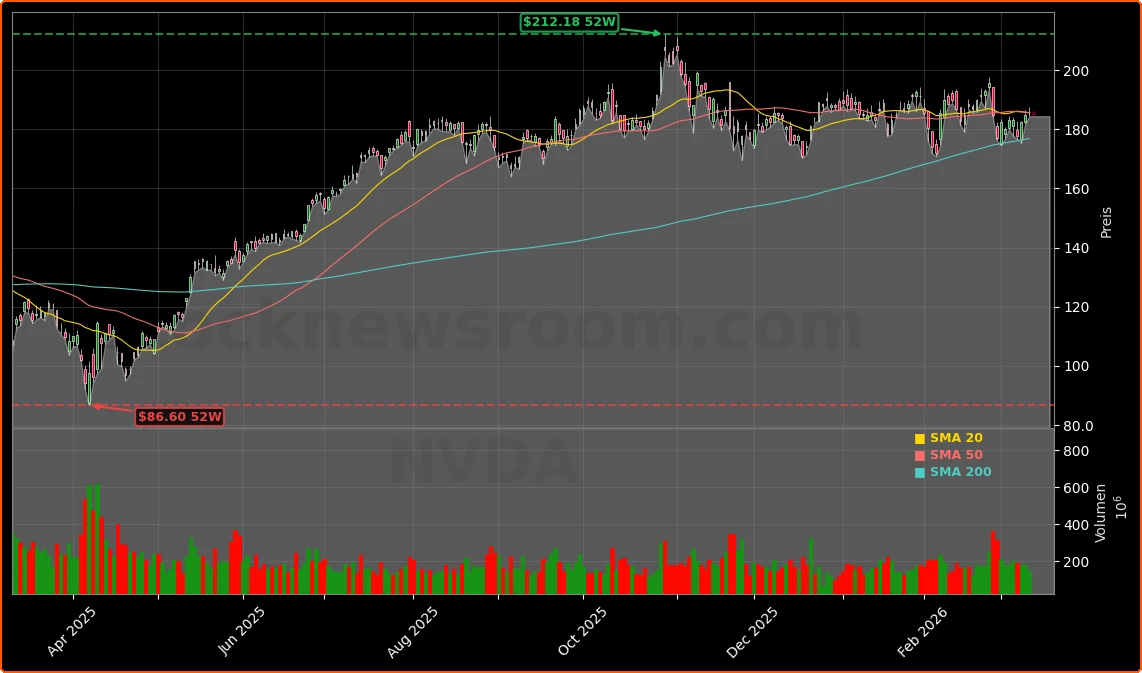
The flip side of the NVIDIA AI Strategy is rising concentration risk. The company now derives the overwhelming majority of its revenue from AI data centers. A meaningful slowdown in AI capex from hyperscalers or a pause in large language model build‑outs could hit growth quickly. While management argues that AI adoption in robotics, telecom, autonomous driving and sovereign compute will diversify demand, the stock’s recent 1,000%+ multi‑year run means sentiment is highly sensitive to any sign of capex fatigue.
Supply chains add another layer of vulnerability. High‑end NVIDIA GPUs are manufactured primarily by TSMC in Taiwan, which in turn depends on EUV equipment from Dutch group ASML and a global helium and energy infrastructure that runs through chokepoints such as the Strait of Hormuz. Any sustained disruption affecting memory giants in South Korea or power‑hungry fabs could curtail the production of critical components, with knock‑on effects for device makers like Apple and EV players such as Tesla.
Regulation is also tightening. U.S. export controls are explicitly designed to limit China’s access to next‑generation AI chips and models, capping NVIDIA’s ability to monetize what could otherwise be its largest incremental market. At the same time, Europe’s focus on data sovereignty and energy usage for AI may push more governments to back local infrastructure providers, pushing NVIDIA deeper into complex joint ventures and political negotiations.
We are still at the very beginning of the AI stack. Securing energy, scaling chips and building full-stack infrastructure will define the next industrial revolution.
— Jensen Huang, CEO of NVIDIA
Conclusion
Analyst sentiment on Wall Street remains largely positive. Major houses such as Goldman Sachs, Morgan Stanley and Citigroup still highlight NVIDIA as a core AI exposure, often with “Buy” or “Overweight” ratings and price targets that assume continued hyperscaler capex and sustained software expansion. However, some firms, including RBC Capital Markets and others, caution that any abrupt AI spending slowdown or a sharp cyclical downturn could drive multiple compression even if NVIDIA executes well operationally.
Further Reading
- NVIDIA Corporation (NVDA) on Yahoo Finance (Yahoo Finance)
- Nvidia Is Making a Massive $26 Billion Bet on the Future of Artificial Intelligence (AI) (The Motley Fool)
- How Nvidia is funding the AI boom with billions in global startups (Invezz)
- Europe Needs Nebius, And Nvidia Knows It (Seeking Alpha)