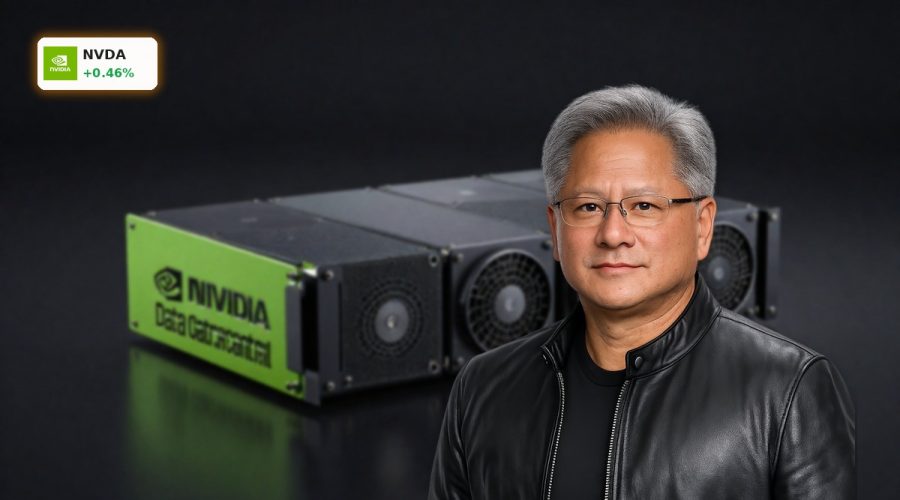
Can the evolving NVIDIA AI Strategy around Nemotron 3 Super keep the company anchored at the core of the global AI build‑out?
Is NVIDIA still the AI market anchor?
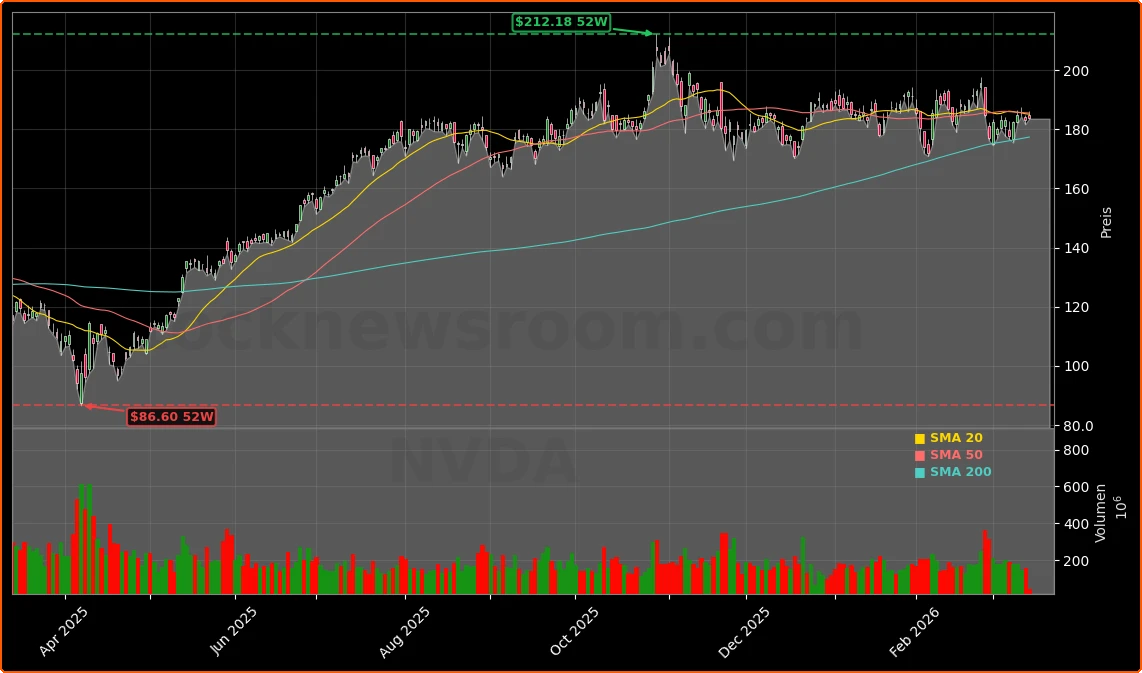
Despite a broad selloff that has pulled major indices off recent highs, NVIDIA remains one of the central anchors of the AI trade on the NASDAQ and in the S&P 500. At roughly $184, the stock is well below its 52‑week peak but far from distressed territory, reflecting a market that has transitioned from euphoria to consolidation. Hedge fund heavyweights, including Steven Cohen’s Point72, continue to hold large AI‑infrastructure positions, with NVIDIA Corporation among the top exposures for managers seeking leverage to long‑term data center demand.
Valuation remains a recurring concern. On a price‑to‑sales basis around 20, NVIDIA is expensive versus the broader market but cheap compared with pure‑software high flyers, and analysts at Zacks highlight sustained earnings power as a reason the name remains one of the most searched U.S. stocks. Rotation within tech is more complex: some MAG7 names have slipped from leadership status, but the NVIDIA AI Strategy—spanning GPUs, networking, software and models—still defines the core plumbing of generative and agentic AI.
How is the NVIDIA AI Strategy changing at GTC?
GTC 2026 in San Jose is widely described as the “Super Bowl of AI,” and this year’s focus underscores how the NVIDIA AI Strategy is evolving. Jensen Huang has been signaling a shift from pure generative AI toward agentic AI and eventually physical AI, where autonomous agents and robots handle complex, multi‑step tasks in the real world. That roadmap is not just marketing; it underpins NVIDIA’s push deeper into enterprise workflows, industrial automation and autonomous systems.
A centerpiece is Nemotron 3 Super, an open AI model with 120 billion parameters, optimized so that only about 12 billion are actively used during inference. With a 1‑million‑token context window and significantly higher throughput and accuracy than prior Nemotron generations, it is designed to power large multi‑agent systems—from coding assistants to life‑science research agents—that can generate token volumes many times larger than standard chatbots. Software players such as Palantir and Siemens are already integrating the model into complex workflows, highlighting how the NVIDIA AI Strategy is moving up the stack from silicon to full AI solutions.
What does Nemotron 3 Super mean for data centers?
The launch of Nemotron 3 Super fits directly into the company’s broader data center ambitions. As multi‑agent workloads explode token counts and context requirements, hyperscalers and enterprises need more compute, more efficient networking, and tighter hardware‑software integration. That plays to NVIDIA’s strengths in high‑end GPUs, tightly coupled networking, and its CUDA and AI software ecosystem.
Global customers are racing to secure access to that stack. ByteDance, parent of TikTok, is scaling high‑end Blackwell‑based systems in Malaysia via regional cloud partners to sidestep export constraints, reinforcing NVIDIA’s role as the default provider of cutting‑edge AI accelerators outside China. At the same time, energy demand for AI data centers is surging, intertwining tech and energy markets as oil approaches $100 a barrel. Rising power and logistics costs could pressure gross margins, even for a company with some of the highest margins in the sector, and investors will listen closely at GTC for updates on energy efficiency and total‑cost‑of‑ownership improvements.
How exposed is NVIDIA to supply and geopolitical risks?
Beyond energy, supply‑chain fragility is back in focus. Helium shortages, exacerbated by outages at key LNG facilities in the Middle East, threaten to constrain chip production because the gas is critical for wafer cooling at foundries in Taiwan and elsewhere. NVIDIA relies on partners such as Taiwan Semiconductor Manufacturing for advanced process nodes; any prolonged disruption in gases or high‑bandwidth memory (HBM) capacity would ripple through AI GPU supply.
Competition is also intensifying. In China, Cambricon has turned profitable and is positioning itself as a local alternative after U.S. export rules squeezed NVIDIA out of much of the mainland market. In the U.S. and Europe, AMD is pressing its own data center GPUs, while Micron’s HBM capacity for 2026 is already effectively sold out, underscoring how critical memory partners are to the NVIDIA AI Strategy. Yet, for now, NVIDIA’s end‑to‑end platform and software moat give it a dominant share of AI compute spending, with many investors treating it as a relative safe haven during macro shocks.
What role will physical AI and robotics play?
A key theme at this year’s GTC is physical AI—robots and autonomous systems that move beyond screen‑bound inference into factories, warehouses and consumer environments. Partners like Sharpa, a robotics unicorn, are using NVIDIA simulation technologies to train dexterous manipulators that can perform complex tasks with human‑like precision. Industrial IT specialists such as Reply are bringing NVIDIA‑powered digital twins into real‑world production and logistics lines, linking AI models directly to machines, sensors and robots.
This expansion into physical AI aligns with partnerships across enterprise software, from ServiceNow and SAP to Siemens, aiming to create “digital AI workers” embedded in business processes. For Wall Street, that opens up a much larger total addressable market than today’s text‑and‑image‑centric generative AI, but it also raises execution questions: Can NVIDIA scale its ecosystem fast enough while managing high energy prices, tight HBM supply and heightened geopolitical risk? The answer will shape whether the NVIDIA AI Strategy can drive another leg higher for the stock or simply support its current premium valuation.
Agentic and physical AI are the next chapters of our journey, turning models into digital and robotic coworkers across every industry.
— Jensen Huang, CEO of NVIDIA
Conclusion
For U.S. investors, the NVIDIA AI Strategy now spans agentic models like Nemotron 3 Super, global data center build‑outs and an aggressive push into physical AI and robotics. If Jensen Huang can convince markets at GTC that NVIDIA can turn these pillars into sustained, energy‑efficient growth despite inflation, supply bottlenecks and emerging rivals, the stock could reclaim leadership among mega‑cap tech. The next few days should clarify whether NVIDIA remains the go‑to AI infrastructure play for long‑term portfolios or whether investors will increasingly diversify toward competitors and suppliers around its ecosystem.
Further Reading
- NVIDIA Corporation (NVDA) stock price and data (Yahoo Finance)
- NVIDIA Corporation (NVDA) is Attracting Investor Attention: Here is What You Should Know (Zacks Investment Research)
- Read This Before Nvidia GTC 2026: Agentic AI And LPU (Seeking Alpha)
- Reply at NVIDIA GTC: Digital twins and physical AI driving the next stage of industrial value creation (PRNewsWire)